Spencer Wright is a Brooklyn writer, editor, and product developer who makes his living from Scope of Work, the independent publication he began as The Prepared in 2013. Before publishing became his main occupation, he managed construction, built custom bicycles, developed motorized architectural doors, worked in corporate strategy, and helped run a company making engineering software. With his childhood friend Zach Dunham, he also developed The Public Radio, an FM receiver housed in a mason jar. These jobs sometimes overlapped. He is now a publisher who has made things and continues to ask how other people do their work. (1; 2; 3.)
Wright is also a parent, cyclist, habitual reader, and candid observer of his working life. His writing contains tools and factories, but also exercise, family, books, and encounters with neighbors. Those details help explain the person behind a publication whose current description is “Writing about work, attention, and the built world.” He calls the newsletter both his livelihood and the principal focus of his intellectual and online life. (4; 5.)
Long Island, California, and learning to ask
Wright grew up on the eastern end of Long Island, in the Hamptons. His father was a contractor, and construction and the service industries were ordinary occupations among the parents of his friends. He remembers being around building sites from childhood. The Hamptons in this account are not simply a landscape of wealthy homeowners: they are also the place where people build and maintain those homeowners’ houses. (6.)
His university education was in linguistics, especially English syntax. In a 2024 reminiscence, he recalls Geoffrey Pullum teaching Chomsky’s ideas with serious attention and disagreement. Wright admired learning from someone whose work one also criticized. This is a specific intellectual formation he still remembers: formal systems, explanatory arguments, and a teacher who did not make respect depend on agreement. His later reading of Daniel Everett’s Don’t Sleep, There Are Snakes reopened questions from those classes. (7.)
After college he wanted to build things. In the account he published in January 2023, he places a drive west in early 2006: an F-250 pickup, belongings in the back, and a gut renovation of an old ski condominium near Lake Tahoe ahead of him. He spent two years in Truckee. His clients were his parents, and at twenty-three he had accumulated less than a year of construction experience, largely during summers and semesters away from school. A projected twelve-month job took approximately twice as long. He encountered hidden water damage, unfamiliar local subcontractors, and technical decisions he did not yet know how to anticipate. (8.)
Family gave him a consequential first project; access did not give him the judgment to manage it. He describes being reactive, uncomfortable with hiring and firing, and reluctant to reveal confusion. His pickup helped him fit into construction, while he suppressed aspects of the liberal college graduate and cyclist he also was. His later lesson is practical: ask what an unfamiliar term means, and stop treating ignorance as disqualification. After six years in California, including college, he returned east missing thunderstorms and egg sandwiches. (9.)
This early work matters because it involved both physical labor and responsibility for other people’s labor. A building project is a succession of dependencies: opening a wall exposes new conditions; a subcontractor’s mistake becomes someone else’s emergency; an attractive drawing does not establish whether a crew can execute it. The mature Wright repeatedly writes about those dependencies. The evidence does not establish a single moment when he acquired that interest. It establishes that he lived with it before he had a public audience for explaining it.
A bicycle business, 2008–2011
From 2008 to 2011 Wright operated Traffic Cycle Design, a one-person business making custom steel bicycles, particularly high-end everyday commuters. It combined individual commissions with small production runs. The work required a welding and machine shop, but also accounting, a website, photographs, and graphic design. He taught himself to maintain much of the machinery. His own retrospective emphasizes that the business exposed limits in his craft, business ability, and self-management; it was formative without being an uncomplicated demonstration of entrepreneurial independence. (10.)
One commission shows the kind of work concealed by the phrase “custom bicycle.” In 2010 a customer wanted an unusual combination of an internally geared rear hub and belt drive. Wright worked with Rohloff, Carbon Drive, and Phil Wood to make the configuration possible. These are component specialists with different design constraints; a bicycle builder had to get their parts and tolerances to agree. The project illustrates a recurring role in his career: not inventing every component, but making a workable arrangement among suppliers, materials, and a customer’s request. (11.)
Years later, visiting a Taiwanese frame factory with Brilliant Bicycles, he compared the production workers’ routines with his own. The factory used numerous dedicated fixtures, and one worker aligned a frame and reamed its seat tube in roughly two minutes. Wright reckoned that a comparable operation in his old shop might have taken him half an hour. He also noticed that the factory installed certain small fittings before welding rather than afterward, as he had done. His captions preserve uncertainty about operations he could not identify. This is a useful corrective to any image of the accomplished maker as someone who arrives at a factory already knowing its secrets. (12.)
The bicycle business gave him embodied knowledge of setup time, alignment, fastening, and finish. It also gave him a comparison against which industrial competence could become visible. He could recognize the significance of a worker’s speed because he had performed the operation slowly himself. That relationship between partial competence and further learning would become valuable in his writing.
Doors large enough to become an engineering education
Between 2011 and 2013 Wright worked for a wood-and-glass manufacturer, where his metalworking experience led to building a research and development machine shop and becoming lead designer on an extraordinary residential project. A house behind the dune separating the Atlantic from Shinnecock Bay required enormous electronically controlled sliding doors. Wright’s portfolio describes sixty doors in the main house, approximately twelve feet tall by seven feet wide and about a ton apiece. Structural aluminum, blackened mahogany, glass, custom rolling hardware, low-voltage power, and embedded computers had to function as one architectural system. (13.)
The doors had several operating states. Brushless motors controlled movement, while an inflatable weather seal needed its own compressor. Wright’s responsibilities extended from drawings and research through procurement, assembly, installation, activation, and troubleshooting. Extrusion suppliers, machine shops, anodizers, molders, and electronics specialists were part of the production chain. The job also took him to China for the first time, where he visited manufacturing facilities and found a supplier for components. The technical achievement was inseparable from coordinating that chain and making a factory-built assembly survive installation on a construction site. (14.)
Dunham entered this project through sound: the doors needed audible signals. Through him, Wright met embedded-systems engineer Todd Bailey, whose way of framing requirements became an important practical education. Wright also took MIT’s online circuits course, 6.002x, with Dunham and Bailey. He found the mathematics difficult and relied on their help. His description of himself in the interview as an “ersatz engineer” acknowledges the absence of a conventional engineering education, while naming some of the people and institutions through which he learned. (15.)
There was also a less spectacular discipline. In a 2020 post, Wright recalled a rule from the door shop: the workday began at 7 a.m., and everyone committed to spending as much as forty-five minutes resetting the combined design, prototyping, and production space. Leaving work out overnight was permissible; beginning another day in disorder was not. After his work became mainly digital, he struggled to find an equivalent to sweeping a floor. Clearing email did not provide the same satisfaction. (16.)
By March 2017 he was explicitly connecting that job to his interest in organizational culture. The engineering problems had been formidable, but he thought the culture of the project had affected the result at least as deeply. His later work at Undercurrent, and his study of companies such as McMaster-Carr and Amazon, reinforced this attention to the conditions under which a team could make a good product. This was his own retrospective connection, rather than a theory that needs to be imposed on the biography. (17.)
New York and several jobs at once
Wright moved to New York City in 2013. His later account places him working part-time as a mechanic at NYC Velo, with one wrench in his bag, and spending evenings with Dunham in a Bed-Stuy apartment developing the radio. The newsletter began amid that occupational uncertainty, giving his reading and interest in useful work an outlet. (18.)
A Radiolab advertisement had introduced him to Undercurrent, the New York strategy firm. He spent a year on its periphery, staying in touch and making friends while publicly documenting his own projects. In his firsthand account, he joined full-time in April 2014. Corporate consulting was unfamiliar, but he valued the colleagues, arguments, client work, and sustained reasoning it required. He would later describe long days at client sites and wrap-up documents written on the return flight. (19.)
His October 2014 inventory of commitments captures the period more accurately than a single job title. He worked full-time at Undercurrent; co-founded Centerline Engineering to design, manufacture, and distribute The Public Radio; collaborated with Dustin Lindley at the University of Cincinnati Research Institute on metal printing; advised Brilliant Bicycles on geometry and product development; founded the New York Infrastructure Observatory, modeled on its Bay Area counterpart; and produced The Prepared for approximately 150 readers. The radio’s procurement and customer service were a substantial part-time job, while the bicycle advising averaged under five hours weekly. (20.)
This arrangement made exploration possible, but it also crowded his life. In February 2015 his partner, Ada, asked whether he was a workaholic. Wright reported working until midnight almost every night for much of the preceding six months, moving among consulting, radio production, email, and the newsletter. He distinguished a desire for work itself from a desire for recognition and creative and financial freedom, then questioned whether that distinction actually changed the outcome. It is a rare explicit statement of ambition accompanied by doubt about the means of pursuing it. (21; 22.)
Undercurrent was acquired by Quirky in 2015 and shut down a few months later. Contemporary reporting by Shareen Pathak in Digiday places its closure at the end of July and describes Wright moving into freelance work. The firm’s employees said it remained profitable while its acquirer was in financial difficulty. These are company circumstances, not evidence of Wright’s personal balance sheet. They nevertheless explain why a valued job disappeared independently of whether he had found his place there. (23.)
Wright’s own response was mixed: affection for a workplace that had supported him, skepticism about Quirky’s products and development approach, and an intention to concentrate further on industrial additive manufacturing. Undercurrent had supplied a cash budget for his titanium experiments. That support is essential to the story. Work subsequently presented as an independent designer’s research was materially enabled by a corporate employer, as well as by manufacturing specialists willing to collaborate. (24.)
The Public Radio: a small product with a substantial production system
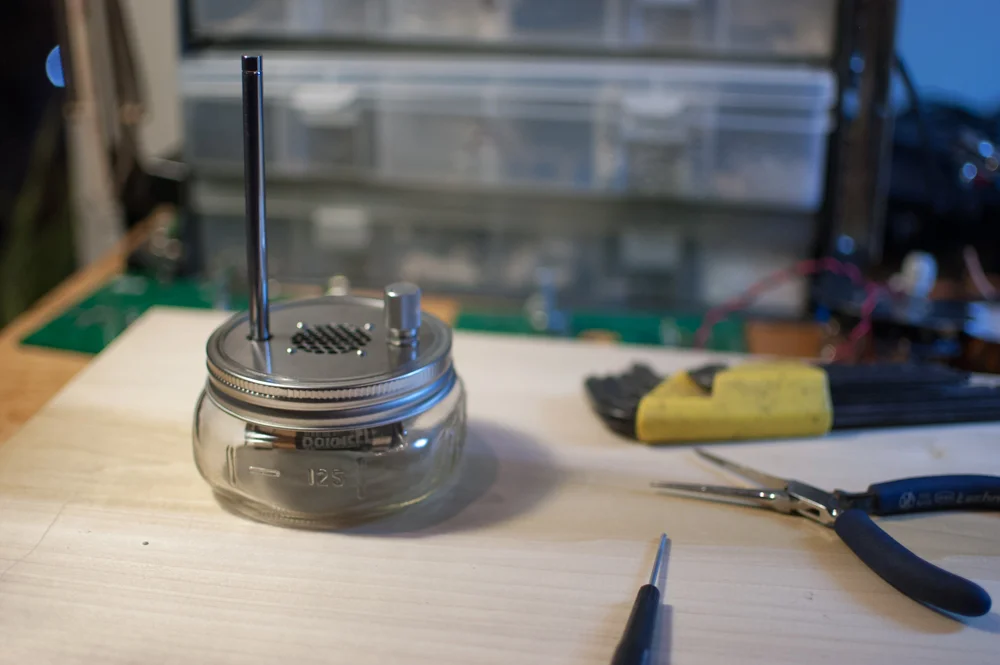
The Public Radio was a collaboration between Wright and Dunham. Its October 2014 Kickstarter campaign raised approximately $88,000. The object had an antenna and one knob for power and volume; buyers specified the FM station before it was shipped. Dunham preferred WNYC, while Wright’s product description named HOT97. A mason jar supplied a readily available enclosure and a familiar appearance. The device’s outward simplicity should not be confused with a simple development process. (25.)
A February 2015 development report shows an actual diagnostic problem. The team had been treating poor sound as a reception issue. Working with Bailey, they found interference from the chosen Class-D amplifier instead. Replacing it with a Class-AB amplifier improved performance, after which they could return to manufacture: assembled circuit boards, a speaker spacer, lid tooling, and the testing and tuning jigs. The component had initially seemed attractive because of availability, ease of development, and battery efficiency; those advantages did not settle whether it worked in the assembled product. (26.)
Wright’s published assembly instructions from the following week begin with an already assembled circuit board and a set of mechanical parts. They show the speaker fitted to the board, a spacer and lid placed over the volume-control shaft, nuts and screws installed loosely before being tightened, and the knob’s set screw aligned with the shaft’s flat. The antenna, batteries, jar, and retaining ring complete the object. What the consumer encounters as one uncomplicated thing is a sequence of parts, ordering rules, and opportunities for error. Documenting the sequence was part of designing the product. (27.)
Its contemporary commercial site describes hand assembly in Massachusetts and tuning to order. Its station-partnership offering includes wholesale pricing, custom engraving and packaging, and either bulk delivery or direct fulfillment to donors. It says thousands of public-radio listeners have received the device as a pledge premium since 2015. Thus the audience was not only individual gadget buyers: local broadcasters could use a physical object to support their own relationship with listeners. (28; 29.)
The support pages also complicate the original promise of permanent tuning. Radios made from 2017 onward can be retuned using a button on the board; older devices have a different procedure. Replacement antennas are available, with a photograph requested to identify the appropriate version. These small after-sale obligations belong to the life of a product just as much as the initial Kickstarter. (30.)
The radio subsequently became an example through which other companies demonstrated manufacturing systems. At the 2019 Digital Factory conference in Boston, Formlabs and partners offered a special version that attendees configured and assembled. A Tulip kiosk recorded station and knob choices and printed a QR label; workstation displays guided assembly while sensors recorded actions and inventory. Formlabs printed alternative knob assemblies, Vention supplied workbenches, and a RightHand Robotics cell supplied packaging. This is vendor documentation of a demonstration, not an independent audit of every ordinary Public Radio order. It does corroborate the product’s movement into a wider industrial software and equipment network. (31; 32.)
The contrast between product and production is instructive. Simplifying what a listener had to do displaced work into programming, order management, assembly, and support. That work could be organized at small scale, but it did not disappear. The radio made Wright responsible to paying users in a way that a prototype or an explanatory blog post did not.
The image could not be loaded. View the original using the source link below.
Titanium, collaborators, and the difference between a print and a product
Wright’s metal-printing work began with a bicycle component he could understand mechanically: a seatmast topper, the small assembly that joins a saddle to a bicycle’s seatmast. His March 2015 account followed roughly fourteen months of design and a visit to Cincinnati to work with Dave Bartosik and Dustin Lindley. Greg Morris had made introductions, and Undercurrent funded the project. An EOS machine built titanium from successive layers of powder fused by a laser. Wright recorded six unsuccessful configurations, including distortion caused by heat and difficult support removal. Build orientation changed not only whether the part survived, but how many pieces fitted in a run and how long the machine would be occupied. (33.)
The research became more than a demonstration that complex shapes could be printed. Wright needed round clamping surfaces, usable threads, acceptable finish, strength, and a plausible cost. These requirements belong to different stages of manufacturing. A geometry that reduced weight could require extra supports during printing; removing those supports could scar the surfaces; finishing could alter dimensions. His accounts made those disagreements legible to readers who otherwise encountered either spectacular finished parts or broad claims about a manufacturing revolution.
Publication also changed who would help him. Tom De Bruyne of the Belgian company Layerwise contacted Wright after reading about his difficulties. With project engineer Martijn Vanloffelt, Wright developed new supports and orientations. After eight build iterations in total, a completed topper went to Germany’s EFBE Prüftechnik. Wright reported that it passed the prescribed fatigue test and withstood the highest static force the test rig could apply, with no microfractures detected by dye inspection. Yet printing ten units still cost about $500 per part, before the commercial question had been resolved. This was a successful prototype and test result, not proof of a viable retail business. (34.)
Subsequent work examined the surface problem. In February 2016 he described electron-beam-printed parts from Addaero, following advice from Tim Bell and JT Stone at MicroTek. Surface treatment could make them visually impressive while revealing pits beneath the original roughness. Wright wanted to know what finishing did to performance, not simply whether the result looked expensive. Some suppliers’ methods were proprietary, placing limits on what he could explain. (35.)
A separate seatpost assembly failed fatigue testing in 2016. Wright reported both the fracture locations and a defective adhesive joint connecting titanium and carbon fiber. He treated the latter as a design-for-assembly problem as well as an assembly mistake: a good design should make correct assembly more reliable. This assembly differed from the topper tested the preceding year: the two results belong to separate designs and stages of his research. (36.)
By December he was working with Agustin Diaz at REM Surface Engineering on chemical and vibratory finishing of electron-beam-printed titanium. Three parts deliberately carried different amounts of extra material to compensate for what finishing would remove. He compared surface data and microscopy while retaining three distinct questions: could the process be affordable, could it meet functional requirements, and would someone want the resulting object? Those questions prevented aesthetic progress from standing in for the other two. (37.)
Wright’s contribution here was a detailed public encounter with an industrial process, conducted with companies, researchers, test laboratories, and financial support. The writing became useful because the project remained awkward enough to show where expertise and equipment had to enter.
From testing software to helping run nTopology
In January 2016 Wright announced that he was joining nTopology full-time to run business operations and help direct product strategy. A conversation with Bradley Rothenberg, nTopology’s co-founder, whom he knew from New York’s small additive-manufacturing world, had developed into weekly correspondence. He tested the company’s private beta in August 2015 and found that its rule-based lattice tools let him pursue functional structures conventional CAD had made difficult. The relationship moved from conversation to use to employment. (38; 39.)
For a non-engineer, a lattice is a network of small beams rather than a completely solid body. Varying their thickness, direction, and density lets a designer vary properties within a part. Wright’s interest was not simply in intricate appearances: he wanted to connect mechanical simulation with changes to geometry while retaining control over what the computer was allowed to decide. His new job placed him between users’ practical needs, the company’s commercial operation, and product decisions. (40.)
His January 2017 sample prints at C&A Tool in Churubusco, Indiana tested transitions between solid and lattice regions, with beams only fractions of a millimeter thick. He named Rich Stephenson as someone who was educating him about the industry. In June, a titanium bicycle stem printed through friends at Playground Global contained roughly 45,000 beams, but still needed subsequent operations such as cutting threads and machining clamping areas. Software opened new forms without abolishing the older operations that made those forms usable. (41; 42.)
This period also brought him into institutions less visible than startup companies. In April 2017 he reported participation in an ASME additive-manufacturing advisory panel, ASTM F42, and the 3MF Consortium, where he represented nTopology. He had joined ASTM while still employed by a consultancy largely associated with marketing and human resources. He found that sustained interest could gain a generalist a hearing among career engineers, competitors, suppliers, and customers. Standards were also a practical expense: obtaining the document describing a test could be costly for an independent developer. (43.)
His standards work makes “self-taught” an incomplete description. He did learn outside a degree program, but he learned inside relationships and institutions: a colleague’s help with circuits, a supplier’s process knowledge, a test engineer’s rig, a corporate research budget, and a committee’s accumulated experience. His public work repeatedly depended on being able to enter those settings and ask useful questions.
How an email became a publication
The first newsletter was sent in November 2013. Wright’s January 2015 retrospective records the earliest experiments as emails without subscribers and places the subsequent list at 194 readers. About a third were people he knew personally, some largely through the newsletter itself. In April 2014 he began adding an invitation to have coffee. That invitation made acquaintance part of the publication’s operation from its first small phase. His stated purpose was to be useful, connect, and tell readers about things that mattered to him. (44.)
The initial method was a reproducible chain of reading and selection. Links arrived through RSS, Twitter, Undercurrent’s Slack, Gin Lane’s email conversations, Brilliant Bicycles colleagues, and readers. Wright saved them in Pocket, read during two thirty-minute commutes, starred worthwhile pieces, and used IFTTT to email himself the links. Back at a computer, he added a short description or observation to the forthcoming campaign. He usually had forty to eighty pieces waiting. The method relied on a train ride and a social network as much as on software. (45.)
The list grew to 556 subscribers by the beginning of 2016. Wright reported average open rates of 52.3 percent and click rates of 28.6 percent, alongside twenty-six unsubscribes in the preceding year. These measures mattered because this was still a fairly intimate reading relationship, not just an audience number. They also made readership available to him as something he could observe and compare over time. (46.)
By July 2016 there were about 1,000 subscribers. He estimated reading fifty articles each week, largely on the subway and while traveling, then spending another hour or two composing the issue on weekends. An average issue represented roughly seven hours of work. Pocket, IFTTT, Gmail, and Mailchimp cost him $344.99 annually. Five people had contributed a total of $76.25. Small advertising experiments had cost $40 on Twitter, $25 on Facebook, and $75 on Reddit. This was a meaningful professional practice, but reader donations alone plainly did not compensate the labor reported. (47.)
Its indirect returns were more immediate. Wright reported several emails a week, exchanges of expertise, and at least one connection that helped someone get a job. He described the newsletter as a calling card. Guest editor Eric Weinhoffer also gave him relief from the weekly obligation. The important economic distinction is between money earned by a publication and opportunities enabled by it: in this phase, the second could matter well before the first became a living. (48.)
The form also suited a reader with heterogeneous interests. Sections on planning, manufacturing, maintenance, distribution, testing, and tangents could put a research paper next to a factory video, a labor story, or an unusual tool. This organization made specialist material approachable without requiring that every issue assert one grand argument. A reader could enter through a familiar subject and encounter something outside their job.
Reporting, writing, and the work of editing
Curation was only one part of Wright’s practice. The New York Infrastructure Observatory organized visits, and he published notes from an early tour of Amazon’s Middletown, Delaware, fulfillment center. Rob Snowden, Dan Suo, Jason Spinell, and Wright contributed retrospective notes after a roughly seventy-five-minute tour. They described scanners, storage rules, conveyors, packing, and workers’ tasks, while also recording the visit’s speed and limits. Such a source is a group’s observed account in 2014, not a comprehensive or current audit of Amazon. (49.)
His 2015 comparison of Amazon Business and McMaster-Carr joined that interest in systems to experience purchasing parts. A catalog’s consistent presentation, controlled product information, and usefulness in selecting an ordinary fastener could matter more than sheer assortment. He distinguished the companies’ approaches rather than assuming that the largest internet platform necessarily had the best answer for industrial buyers. It is a product developer’s question about how information reduces or creates work. (50.)
A revealing statement about his writing appeared in September 2016, when he published a draft from his consulting period. Reading a Smithsonian report on museums and audiences, he admired analysis that combined evidence, institutional purpose, proposed action, and room for ambiguity. He wondered whether slide decks, the consultancy’s normal output, could support the same intellectual seriousness. The issue was not merely whether prose looked more serious than slides. He wanted a form that could ask whether an organization’s goals were appropriate, and whether its measures actually described its effects. (51.)
Delegation introduced another set of mechanics. By May 2020 he expected to write about half of the year’s newsletter issues himself and to manage guest editors for the rest. He said he was imperfectly communicating a standard of quality. Defining the paid offering, making its purpose intelligible, and persuading people to join without marketing he considered sleazy were also on his working agenda. Publishing was becoming a job comprising editorial direction, scheduling, business communication, and relationships, as well as the sentences carrying his name. (52.)
Hillary Predko, who joined the staff in May 2021, supplied a particularly concrete description of editing. Reading-group conversations could produce transcripts longer than 10,000 words. She cut them by approximately 80 percent, choosing a narrative thread from a discussion whose direction had partly followed the members on the Zoom call. An interview about history might become a piece on public and private ownership; an interview about robots might retain animal analogies while losing a separate discussion of work. This is Predko’s documented labor within Wright’s publication, not a method that should be credited to him alone. (53.)
A later encounter with Nicola Twilley shows how Wright combines reporting with that membership program. In 2024 they visited restaurant-supply stores on the Bowery, asking a salesperson about commercial refrigerators, walk-in installations, temperature controls, and costs. The resulting article moves between the street, an expert’s interpretation, and practical questions inside a shop. Twilley subsequently spoke with the reading group; Wright published a condensed, lightly edited transcript. His questions included how she found a book-length topic and how research became a readable piece of writing. (54; 55.)
Those conversations are also occasions for learning his own occupation. In his October 2024 book notes, Wright watched Twilley’s work with interest in her wider publication schedule and relations with editors. He imagined that writing for a larger institution and having editors of his own could be useful. Independence had not extinguished a desire for apprenticeship, peers, or a setting larger than the business he had created. (56.)
Readers, sponsors, platforms, and a livelihood
Reader support became materially significant through Patreon, which Wright used from April 2017 for three years. By the end of that period it handled a substantial part of The Prepared’s income and, as he put it, ultimately his family’s income. The change from spare-time newsletter to household support can be established; the public sources do not supply an audited salary or a precise date for leaving every other job. (57.)
His departure from the platform was driven by operational complaints. Per-creation pledges could have spending caps he could not easily see; declined charges complicated rewards; accounting and customer information were hard to reconcile. In his 2020 comparison, QuickBooks and Squarespace together cost $1,125 per year, against a projected $10,000 in Patreon charges. Moving required substantial management, and roughly one-third of patrons dropped their pledges. These are his dated costs and experiences, not claims about how the platform operates today. They show that a small publisher’s independence includes mundane decisions about billing and records, and that changing the system can lose supporters as well as save fees. (58.)
Membership provided more than a paid version of an email. Wright’s contact page offers an introductory call of forty minutes, framed as a discussion of an industry, a project, or possible technologies. Business membership has been advertised with several Slack seats, job listings, sponsorship discounts, and access to reading groups and events. A call makes a promise of the publisher’s time; a discussion space requires continuing participation; a reading group needs book selection, meetings, invitations, and editorial follow-through. Those obligations help explain why a publication can occupy a whole working life. (59; 60.)
In October 2023 Wright described working with Predko full-time and approximately a dozen part-time writers, with revenue divided roughly equally between advertisers and readers. A Monday issue had been scheduled by Friday, freeing that day’s reflection to concern the larger enterprise. Slack contained practical questions and ongoing projects; meals and travel often became opportunities to meet readers. He took pleasure in that overlap but also recognized how thoroughly the business occupied his social life. The community was not merely a metaphor for the email list. It had places, recurring activities, people building things, and claims on his calendar. (61.)
Predko left the staff in March 2024 to start a design firm with her partner. Her farewell explains a route from reader in 2018 to guest contributor and then staff member, and a renewed wish to spend more time making things. She expected to remain in the Slack community. Her departure demonstrates both the importance of a collaborator to SOW and the fact that collaborators had projects and ambitions beyond it. (62.)
The business changed substantially too. In July 2024 Wright reported that 88 percent of his income came from individual subscriptions and 12 percent from advertising. Two or three years earlier, about 70 percent of revenue had come from advertisers, with job posts accounting for a substantial share of the remainder. Subscription dollars had risen, but advertising had fallen by more, so his overall income had declined. He nevertheless felt happier with the business, believed his writing had improved, and preferred the incentives and interactions associated with subscribers. These statements do not establish a 2026 revenue split, but they prevent the 2023 staffing and advertising model from becoming a timeless description. (63.)
The occasion was the members’ reading of Tim Hwang’s Subprime Attention Crisis. Hwang was a friend; members nominated the book, selected it, and spoke with him. Editorial choice, friendship, reader participation, and reflection on the business met within the same program. (64.)
Why The Prepared became Scope of Work
On 26 December 2022, Wright announced the change of name from The Prepared to Scope of Work. Looking back, he described his thirty-year-old self in 2013 as someone whose expected career path had disappeared. “Prepared” had expressed an attempt to ready himself for meaningful work. Almost a decade later, he wanted a name broad enough to consider what work actually accomplished, and for whom. (65.)
The announcement places making and maintaining beside being a friend, partner, and parent. It also asks how claims of effective work should be assessed against other lives, culture, and ecosystems. He describes sharpening woodworking tools after watching Japanese carpenter Dylan Iwakuni, cleaning and waxing a bicycle, and attending to a tool chest. The enlarged subject emerges from actual household and workshop tasks, not just an editorial slogan. (66.)
The change did not erase his technical interests. It made room to ask how attention to them fitted into a life. One inventive example was the 2024 World Umarelling Championship, organized with T. W. Lim. Borrowing the Italian figure of the umarell, a person who watches construction work, it invited adults and children to observe and record work around them through sketches and short descriptions. Its judges included writers and practitioners such as Geoff Manaugh, Henry Grabar, Ian Coss, and Predko. Wright contributed observations of work in Crown Heights. The invitation gave ordinary onlookers a way to notice skilled labor without pretending to be experts in it. (67.)
The title change is therefore best understood as a documented widening of questions, rather than a clean break between an apolitical manufacturing enthusiast and a later ethical writer. Earlier construction memories, supplier relationships, and organizational analysis already involved responsibility, labor, and judgment. What became more explicit was the inclusion of those matters in the publication’s announced purpose.
Places, books, and the life around the work
Wright’s geography joins several worlds: Long Island construction, California education and renovation, Brooklyn family life, American manufacturing towns, and suppliers and factories in East Asia and Europe. These places performed different roles. Cincinnati offered additive-manufacturing expertise; Belgium supplied a specialized production partner; Germany supplied testing; Taiwan and China were settings for both procurement and learning. Treating all of them as stops on a travel itinerary would miss the relationships that took him there.
In a 2025 essay on imports and tariffs, Wright returned to photographs of a Taiwanese bicycle-fork factory in 2014 and a speaker-manufacturer visit in Dongguan in 2015. He remembered walking among small workshops in Chang’an, with machines, children, stools, and shops close together, and questioned whether his affection romanticized what he saw. The essay also shows his research in motion: looking up trade categories, inspecting products at home and in a grocery store, comparing sources, contacting a brand, and acknowledging uncertain arithmetic. Its value for this biography is his combination of firsthand experience and admitted limits, not an endorsement of every economic conclusion. (68.)
The place closest to his ongoing work is New York. His guest contribution to Why Is This Interesting? in 2021 compared maritime right-of-way rules with the ethics of city streets. The newsletter’s editors introduced him as a former strategy consultant, whistling champion, and Brooklyn resident carrying children and tools by bicycle. In his argument, rules should express how powerful or mobile parties treat those with less ability to get out of the way. This is one public route from the product developer’s practical questions into urban civic life. (69.)
The household bicycle is also a making project. In September 2021 he published a video of building a specialized kickstand, using a CNC-machined aluminum block and stainless-steel legs. The bicycle carried a seat he had made for his daughters and needed changes to lighting and finish. This was maintenance and fabrication in support of daily life, rather than an experiment justified by an eventual consumer market. (70.)
His reading ranges beyond industrial subjects. He has written about Daniel Kahneman, Robert Caro, and Carlo Rovelli. Caro’s The Power Broker and Lyndon Johnson biographies accompanied physical work as audiobooks. Rovelli’s The Order of Time prompted a newsletter draft he abandoned, then a blog post: he wanted to convey how the book changed his thinking, while finding that difficult to explain to someone who had not read it. The sources establish interest and admiration, rather than one comprehensive explanation of Wright’s style. (71; 72; 73.)
Parenthood changes what reading is for. In May 2024 Wright described taking practical lessons from Michaeleen Doucleff’s Hunt, Gather, Parent: letting children help with real tasks, reducing repeated instructions, and explaining consequences. He discussed the book with SOW members. In June 2026 his six-year-old’s questions about bicycles brought him back to David Macaulay’s The Way Things Work, a book he had read with his own father. Reading and explaining travel in both directions across the family, as well as between publisher and audience. (74; 75.)
His 2026 essay Tuesday moves through a park workout, conversation with another man exercising there, news of a death in that man’s circle, his own physical limits, and an outing with his children to the Museum of Modern Art. Work and attention have become elastic enough subjects to hold grief, paintings, tourists, bodies, and ordinary encounters. The industrial observer now gives similar space to experiences that belong to a neighbor, reader, and father. (76.)
A practice built through repeated changes of role
The strongest continuity in Wright’s career is not mastery of one technique. It is the movement between doing work, learning what the work requires, and describing it to other people. A bicycle commission teaches him to negotiate among component makers. A door project introduces embedded engineering and supplier coordination. Titanium experiments expose an industrial process’s costs and limits. A newsletter turns reading and introductions into a repeatable obligation, then a business whose billing, collaborators, and readers need as much care as its prose.
The institutional record gives those movements substance. Employment, collaborators, manufacturers, test laboratories, committees, readers, and households appear throughout the biography. Independence describes the authority he now exercises over a small publishing practice; it does not describe the absence of dependence. His capacity to explain work grew partly from repeatedly being the person who needed someone else’s explanation.
Wright himself resists treating his career as a perfectly executed plan. In December 2023, prompted by his daughter’s recital about having a purpose in life, he described a life substantially shaped by chance. He also recalled taking a break from editing to clear a bathroom drain: the attraction was a physical problem he could actually finish. He did not resolve the relation between that satisfaction and writing for a living. He leaves that uncertainty in the published account. (77.)
Wright’s present writing is consequently wider than a manufacturing newsletter’s initial subject area might suggest. He can explain the alignment of a frame, the editing of an interview, the price of a billing platform, or a conversation in a park because these are different parts of his lived and working world. The publication has become a place where he can bring those experiences into conversation, while continuing to learn what to make of them.
Research note: Sources were accessed on 3 October 2026. This profile relies extensively on Wright’s contemporaneous project accounts and later autobiographical writing, cross-checked where possible against a collaborator’s account, contemporary business reporting, product documentation, and manufacturing partners. Technical outcomes and financial figures are dated self-reports unless otherwise identified. Public evidence does not establish his birth date, a complete employment chronology, present household finances, or a current staff census. Several SOW interviews expose only part of their text without a subscription; only accessible material is used here. Early URLs sometimes contain a different date from the displayed publication date; dates above follow the displayed date.
Notes from a bicycle frame factory in Taiwan, published 3 January 2015, describing an October visit↩︎
3D printing titanium and the bin of broken dreams, 15 March 2015↩︎
The Prepared: where it’s at and how I’m doing with it, 31 July 2016↩︎
Notes on Amazon and decisions in B2B ecommerce, 15 August 2015↩︎
Intentions & Modes of Communication, published 18 September 2016 from a July 2014 draft↩︎
Three things you should know before starting a Patreon page, 27 June 2020↩︎
The Maritime Law Edition, 2021 contribution reprinted 27 December 2023↩︎