Ray Maker is an American sports-technology reviewer, writer, video maker, and recreational endurance athlete, better known by the name of his website, DC Rainmaker. He grew up near Seattle, built a career in enterprise computing, and began blogging while living in the Washington, DC, area. His wife and business partner, Bobbie, is a baker and triathlete who appears on the site as “The Girl.” They have three daughters. After living in Paris and Amsterdam, the family moved to Mallorca in September 2024. His reviews explain, in unusually concrete detail, what happens when a watch, cycling power meter, indoor trainer, or other device encounters an actual workout, a difficult route, a software update, or a second manufacturer’s equipment. 1 2
The recognizable public figure—with several watches on his arms and several recording devices on a bicycle—developed gradually. He was first a computer specialist who started running, then a novice triathlete writing race reports for colleagues, then a blogger answering strangers’ purchasing questions. For years he did that work around an international IT job. Understanding that sequence makes his career more intelligible than treating the website as the inevitable expression of a lifelong calling. 6 10 19
A Seattle childhood, and an unusually early working life
Andrew Tilin’s 2018 Outside profile places Maker’s childhood in Mukilteo, north of Seattle. His father worked as an editor and engineer at KIRO-TV; the household included a brother, and its reading included Consumer Reports and Cook’s Illustrated. Maker played soccer and baseball and raced skis. The same account describes him writing software for the television station at fifteen and becoming a Microsoft Certified Professional at seventeen. These are useful particulars: computing entered his life through a working household and a local institution, while comparative consumer testing was something he encountered before becoming a reviewer. They do not establish a preordained career plan. 5
His own account supplies the occupational sequence. He ran a small software business in high school, was accepted to college, and instead began work about a day and a half after graduation in 2000: first nonprofit IT, then a bank during acquisitions. Microsoft recruited him in 2004, taking him from Seattle to Washington, DC. His decision belongs to the dot-com period’s particular labor market. Writing in 2015, he doubted that a school graduate could repeat the same leap under the conditions then prevailing. 3 5
This was infrastructure work, rather than writing consumer applications. In his FAQ, Maker describes large organizational messaging and authentication systems—Microsoft Exchange and Active Directory—serving tens or hundreds of thousands of users, along with migration, storage, datacenter, and cloud projects. A customer might need an existing system moved without breaking its daily operation; knowing how a product ought to work was only the beginning. Implementation meant discovering dependencies, identifying failure, and communicating a solution. 4
Outside reports that Microsoft managers required understandable documentation; former colleague Joel Yoker recalled Maker’s patience in helping individuals. That supports a modest interpretation: the website’s explanations developed partly from a professional habit of making complicated systems usable. It would overstate the evidence to call the reviews an IT practice transferred intact to sport. 5
Becoming an athlete before becoming a reviewer
Maker had run cross-country during his first high-school year as conditioning for ski racing, disliked it, and stopped for about a decade. In spring 2006 he began again, struggling to complete a mile. Within several months he ran the Marine Corps Marathon in 4:23; he describes losing roughly sixty pounds. A local coach, Alan Melvin, subsequently helped him progress toward longer triathlons and faster running. 1
The first triathlon account is particularly revealing because it predates his established persona. Written for a company triathlon mailing list after the July 2007 Seafair sprint, it was republished on the blog in March 2008. He had committed to an autumn half-Ironman while barely able to swim a pool length, then followed a plan through swimming, cycling, and shorter races. Seafair brought nervous breathing, an inexpensive Fuji bicycle kept in Seattle, a pump that fell apart, and a timing chip that came loose. His running was considerably stronger than his swimming or cycling. The report records errors, embarrassment, improvisation, and pleasure alongside times and places. It also shows that the first audience was a community of coworkers who raced, rather than potential customers for a media business. 6
A half-Ironman comprises a 1.2-mile swim, 56-mile bicycle ride, and half-marathon; moving toward the full Ironman doubled those distances. Maker’s first blog entry, dated September 4, 2007, describes travelling from Mukilteo to Penticton, British Columbia, to register in person for the following year’s Ironman Canada. His Seattle roots made the location attractive because family and friends could be nearby. He watched the existing race and rang a cowbell for other competitors. The post’s immediate subject is the formidable thing he had signed up to do, not the invention of a review business. It also anchors the blog’s chronology more securely than the 2006 start date given in the later Outside profile. 7
His August 2008 Ironman Canada report gives the athletic ambition texture. Parents and brother attended, his brother photographed the race, and a fellow competitor reminded him not to expend too much effort on the early hills. Maker finished in 10:49:19, but his account dwells on energy depletion: afterward he discovered that he had consumed much less of his planned nutrition than intended. He describes walking, revising time goals, trying to do arithmetic while exhausted, and finally being glad to finish. It is a record of learning to manage effort with a fallible body, not merely of learning to read a device. 8
Running continued to matter independently of triathlon. At the 2008 Philadelphia Marathon he ran 2:54:48, qualifying under the then applicable standards for Boston and New York. The report includes his pacing graph and late-race calculations, but also a road-trip companion, the painful attempt to climb the Philadelphia Museum of Art steps afterward, and cheesesteaks. These early posts already combine technical records with the ordinary social life of amateur sport. The later emphasis on devices did not create that combination; it grew within it. 9
An email became a public resource
“DC Rainmaker” joined his location to a play on his name. In an interview with The Peaceful Runner, Maker explained that “Rainmaker” alone was unavailable on Blogspot, so he added “DC.” He also described a schedule of work, commuting, two daily workouts, and writing on weekends or flights. Ideas could be outlined during long runs. The interview is undated and predates his departure from IT; its value is in reconstructing the original rhythm, rather than measuring his current workload. 10
The decisive early review concerned the Garmin Forerunner 305, a large GPS training watch. Maker later explained that he had bought it after using an earlier Polar watch and that the review began as a long email to Microsoft coworkers. Putting that material online made it discoverable beyond the original distribution list. In January 2021 he retrieved his and Bobbie’s old 305s, searched for a functioning cradle and cable, and compared the old watch with newer devices. The retrospective connects the family’s own equipment history to a wider history of wearable computing. 11
The original November 2007 review is already concerned with practical decisions: what the watch records, how its screens and accessories work, its limitations, and what a prospective owner needs to understand. The device was useful across running and cycling, but this was not yet the everyday smartphone-connected watch now familiar to nonathletes. A sports user had to manage a separate recording instrument and its computer software. Maker wrote from the position of someone trying to make that arrangement work, with enough detail that another owner could follow him. 12
An interview published by Terra in 2023 describes his move from disappointed customer to comparative reviewer and the way colleagues’ questions expanded the initial audience. It also records a later judgment about the business: making a watch is only one part of the job. A manufacturer must sustain its app, firmware, features, and subsequent support while competing with established platforms. This distinction helps explain why his subject gradually extended beyond isolated hardware. A purchase brings an athlete into an evolving technical system. 13
A 2015 Bicycle Retailer traffic comparison placed DC Rainmaker sixth among the participating cycling websites when ordered by North American users. It was a publisher-supplied comparison with important exclusions, not a comprehensive global league table. Nevertheless, it documents the scale the once personal blog had acquired before he left his salaried career. 14
Bobbie, marriage, and Paris
Maker met Bobbie through Pacers’ running club in the Washington area. They trained and raced together. Her longstanding nickname on the blog initially limited the personal identification attached to his writing; it persisted as the public site became more open about family life. In practice she became central to its operation, handling accounting, paperwork, shipping and receiving, logistics, and some video editing. It is misleading to describe DC Rainmaker as a man doing every aspect of a business alone. 1 4
They married in July 2011 in Punta Cana, in the Dominican Republic, with about seventy-five family members and friends. A post about their wedding transport records a distinctive small project: instead of hiring a limousine for a short trip, they bought a $99 Target Schwinn beach bicycle, dismantled it, painted it white, and reassembled it. Groomsmen helped; Bobbie made the sign. The account is an ordinary, playful instance of the couple making something together, with the same attention to screws, labels, tools, and practical sequence that appears in his technology writing. 15
Paris began as an employer-supported relocation in June 2012. Maker’s new responsibilities covered Europe, the Middle East, and Africa, with considerable freedom to choose a base provided that it had good air connections. He and Bobbie considered other cities before choosing Paris. His employer supplied relocation services and language support; she brought some school French from Canada, while he described his own more tentative preparations. Products still had to reach him, and the audience was already international. The move therefore joined the couple’s wish to live abroad to the geography of a multinational job, rather than marking an immediate departure into independent blogging. 16
Bertie’s CupCakery was Bobbie’s enterprise. In a June 2013 update written in her own voice, she describes bilingual staff, another baker, permits for outdoor seating, and food-safety certification connected with cream-cheese icing. Nutella and salted caramel were part of the local product mix. Blog readers visited, returned with friends, and helped the young shop survive through purchases. Her account also recalls a Canadian sporting background in competitive squash and badminton. The woman later administering a technology site had her own athletic history, customers, employees, and difficult encounter with French commercial rules. 17
The businesses initially crowded into a Paris apartment: Maker counted more than ten trainers and six bicycles at one point. In May 2014 the couple obtained a commercial space, then spent months dealing with contractors, layout, and paperwork. Bobbie’s expanding cake work occupied one part; the underground testing and storage area became the DCR Cave. They designed the arrangements themselves with employees helping negotiate French processes. Labeled storage made it easier to retrieve a watch or component to answer a reader’s question. Space was consequential because a review did not end at publication: old devices and replacement parts remained useful for later comparisons and support. 18
Leaving Microsoft required more than an audience
Maker left his IT job in October 2015, after roughly twenty months establishing both businesses and securing the French permissions needed to remain. He wrote with affection about his coworkers and job, but also about combining international travel, blogging, and being away from Bobbie. He had not discovered a preferable profession and resigned the next day. His household’s immigration status made the timing dependent on institutions outside the website. 3
Sarah Bonner’s June 2025 Slowtwitch interview revisits those overlapping working lives. Maker recalls datacenter work and very long weeks, travel to places including China, Australia, and Brazil, and writing during flights. The article describes a business supported through affiliate relationships and readers rather than payment for favorable device reviews. Its portrayal of a father with three daughters living in Mallorca confirms the distance from the earlier itinerant corporate employee. It does not supply an audited income, a company valuation, or a complete financial history. 19
The change gave Maker more time for the site, but also concentrated his livelihood in it. That creates a practical obligation to keep publishing, to maintain access to new devices, and to sustain a relationship with people deciding what to buy. Those obligations can be inferred from the disclosed model; they should not be converted into assertions about his private anxieties or undisclosed finances. The record supports an account of occupational change with a family and administrative infrastructure behind it.
Amsterdam and Mallorca: a household and a testing geography
The family’s departure from Paris unfolded in stages. They packed the apartment around Christmas 2017, spent several months in Australia, and established themselves in Amsterdam in April 2018. Maker’s announcement emphasizes a quieter home, outdoor space, and more room for the children, alongside the need for a more usable workspace. Paris friends from the Expatriés Triathlon team helped with moving. Bobbie had already shifted from the small cupcake shop toward custom cake work, which he described as requiring fewer staff and producing better business results. Their daughters entered Dutch daycare after exposure to English and French. These were household decisions as well as decisions about professional convenience. 20
The new geography brought nearby cycling routes and industry contacts; the Netherlands contained Tacx, TomTom, and other relevant offices. A January 2019 tour of the Amsterdam Cave shows the work becoming visibly spatial: equipment storage, indoor cycling setups, and areas for filming and operating the website. A camera-ready room and a bicycle that can accept several sensors are part of the means of production. The volume of physical objects distinguishes this job from an occupation conducted entirely through a laptop. 20 21
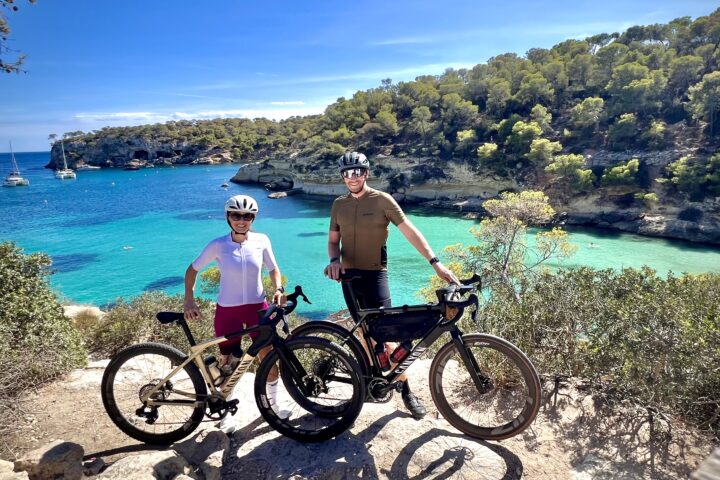
In September 2024 the family moved again, this time to Mallorca. The Amsterdam office’s eventual demolition and lease deadline were one circumstance. Maker also identified sunshine, a new family adventure, and immediate access to mountains, road and off-road cycling, and open-water swimming. Testing that had previously required travel could happen locally. The daughters, already Dutch speakers, began learning Spanish and Catalan. Even a familiar family technology changed meaning: the heavily loaded Amsterdam cargo bicycle could not easily manage the steep approach to the new home. Place alters what equipment is convenient, what conditions can be tested, and what the daily family routine requires. 2
The annual “gear I use” articles supply a less promotional view of the household. In his 2025 list Maker describes cheap swimming goggles, cycling gloves acquired seventeen years earlier, and paying for multiple training subscriptions. He also says his professional need to remain familiar with technology changes his replacement cycle. His personal setup is therefore a poor model for an ordinary person’s necessary expenditure. The list openly distinguishes the equipment that happens to suit him from a universal buying guide. 22
Bobbie’s own gear article, published in December 2024, is a useful second voice. She describes returning seriously to triathlon after a long hiatus and accommodating sport around three children. She retains clothing that still works, uses several inexpensive fans for indoor training, and explains why she returned from a newer Garmin model to her Fenix 7S Pro. Her choices expose a distinction between possessing the newest device for work and preferring a familiar device for training. She is a user and athlete whose judgments are not reducible to those of the site’s main reviewer. 23
The image could not be loaded. View the original using the source link below.
What a review actually requires
The basic problem in a sports-device review is comparison under the same conditions. A watch can produce an attractive map and still mishandle a difficult turn; a power meter can report a plausible ride average while missing brief accelerations. The reviewer has to know which discrepancy comes from the product, the recording device, the connection between them, the way the product was installed, or his own test. Maker’s published methods are valuable because they make that diagnostic sequence visible.
His 2017 Favero Assioma review begins with retail units he obtained himself and approximately forty-five days of riding. He describes fitting and settling the pedals, checking their zero offset, updating or inspecting software, and comparing indoor and outdoor behavior. Indoors he can vary cadence and sustained effort; outdoors he encounters temperature changes, road vibration, rain, and short sprints. Multiple power meters occupy different parts of the same bicycle, and recording devices collect their outputs. “Power” here means the rate of the rider’s mechanical work, in watts; it is not simply speed, which also changes with wind and gradient. 24
ANT+ and Bluetooth are wireless arrangements through which a pedal, heart-rate strap, watch, cycling computer, or trainer exchanges defined kinds of data. In the Assioma review, Maker lists which measurements travel through which connection and examines how applications handle them. A device that measures correctly but fails to connect to the user’s computer or training app can still be a poor purchase. This is a consumer-scale instance of attention to systems and dependencies; its authority comes from demonstrated testing. 24
He also insists that no familiar reference product is automatically infallible. In a 2016 interview with Ben Greenfield he discusses using several power meters rather than treating one as an unquestionable standard. The reference itself can fail. The method is comparative and diagnostic: investigate agreement and disagreement across independently measuring devices, then work out why a discrepancy occurred. It is not equivalent to certification by a metrology laboratory. 25
Making the evidence inspectable
The DCR Analyzer emerged from a bottleneck in this process. Maker had been using Excel and Golden Cheetah to normalize and present data, spending substantial time on each workout. He worked with the developer behind FitFileTools.com to create a dedicated comparison tool, used it privately, and opened it to others in 2017. Its launch prices were $5 for a day pass and $29 for an annual subscription. This is a software product derived from a recurring difficulty in doing the reviews, rather than a training service devised independently of them. 26
Its manual explains the mechanics. Files from several devices are aligned by recorded timestamps; charts can be zoomed and smoothed, and GPS tracks examined on a map. FIT, TCX, and GPX are file formats in which devices and applications preserve workout records. The tool compares corresponding moments within the same activity, rather than pretending that Monday’s run and Tuesday’s run provide identical conditions. It can distinguish left-leg power from total power and expose missing recording points. Public links allow other people to inspect a dataset and download the original files. Maker explicitly rejects manufacturing intermediate points merely to fill gaps. This does not make every inference reproducible, but it lets a reader challenge more than a review’s conclusion. 27
The contemporary record of his LIMITS power-meter testing makes another distinction. A ride average can conceal an over-reading in one interval and an under-reading in another. Maker therefore examined cadence, changing temperature, response to sprints, left/right differences, and power over different time windows. He sometimes recorded the same sensor twice to distinguish a transmission problem from a measurement problem. Agreement among several meters was evidence to investigate, not proof that the majority must always be right. He published the raw files and provisional results before claiming a finished review. 28
Field conditions, deliberate experiments, and limits
The 2023 Polar Vantage V3 review shows why the workflow cannot be reduced to a quick run around the block. Maker tested a loaned watch for about a month, described a long hike in which navigation repeatedly crashed, and reported battery behavior in sunlight along with Polar’s explanation. He separated usable observations from measurements he did not claim to validate: detecting sleep times is different from establishing the accuracy of sleep stages. His discussion of the latter is a warning about the available comparison methods, rather than evidence that a consumer reviewer possesses clinical authority. 29
Some experiments are more deliberately constructed. In May 2015 he tested the original Apple Watch through swimming, high-diving trials with another person, and pressure-chamber cycles. The experiment investigated the difference between a conservative published water-resistance specification and actual observed survival. He explicitly separated those observations from Apple’s warranty and advised against treating them as permission to ignore the manufacturer’s recommendation. A functioning watch immediately afterward also could not exclude delayed failure. The interesting achievement is the distinction between specification, observation, and responsible inference, not the spectacle of submerging an expensive object. 30
Reviews can also include several years of ownership. His November 2022 Peloton Bike review followed almost three years with a bike used at home, while a Bike+ stood at the office. He bought a lightly used bike in the United States because local delivery was unavailable, verified its initial calibration, and transported it to Amsterdam in checked luggage. Replacing its pedals with power-meter pedals allowed comparison against its reported output. The account combines family use, a supply-and-shipping problem, physical modification, and measurement; the equipment’s location affected which model the family actually used most. 31
The subject has expanded to cameras and drones partly because filming moving athletes is itself a technical problem. In his 2022 DJI Mini 3 Pro review, Maker examined autonomous following, obstacle avoidance, controller requirements, and the difference between following in open space and negotiating a cluttered route. Video makes some of those failures directly observable in a way that a table of specifications cannot. The review discloses a media loan and its intended return, and states that companies do not see the text or footage before publication. These are declared procedures, not independent proof that every possible influence has been eliminated. 32
Product access, industry relationships, and disagreement
By 2015 manufacturers and their intermediaries were treating Maker as more than a retail customer. Steve Frothingham’s Bicycle Retailer interview includes publicist Mark Riedy’s account of early access and feedback. Maker described unpaid conversations with manufacturers and bringing together patterns from reader complaints, sometimes funding the relevant travel himself. That access helps him understand forthcoming products; it also puts him inside the industry’s information exchanges. The article traces his separation rules partly to employment restrictions around government-facing work, rather than a journalism-school education. 33
That arrangement creates a recurrent tension. Early knowledge and access can improve a review, while familiarity with a company’s staff can encourage accommodation or make exclusion costly. No evidence cited here demonstrates a concealed bargain. The disclosed structure nevertheless deserves analysis: a reviewer whose audience expects new products has reason to cultivate the same companies whose claims he must test. Published unfavorable findings and clear accountings of loans help readers evaluate that relationship; they cannot dissolve it completely.
The LIMITS crowdfunding episode provides a concrete case of adversarial scrutiny. In April 2015 Maker questioned the schedule for an inexpensive power meter positioned between a pedal and crank, while distinguishing the plausibility of the idea from the evidence of a functioning product. In November he published questions about prototype hardware, comparative files, manufacturing, and compatibility, together with the company’s answers. He was also a paying backer. His objection was that progress announcements and marketing terms did not substitute for inspectable measurements or a credible production timetable. These are his documented criticisms of the company, rather than a legal finding about its conduct. 34 35
When a reader, Jon Entwistle, obtained a unit at a Scottish launch event in 2016, he sent it to Maker for testing. The subsequent data page identified the unit’s provenance, installation, calibration, and conditions, and withheld a final review pending clarity about what backers would receive. The reader was not merely a spectator: he supplied the physical object that allowed a public dispute to become a test. 28
Maker returned to the story in August 2023 when LIMITS announced its dissolution. He distinguished later ownership and management from the initial disputes, noted that he had not tested the subsequent iterations, and acknowledged that founders can lose substantially when a startup fails. The long interval matters. The episode is not a tidy anecdote about one hostile verdict destroying a company, and the available material does not establish such causation. It shows a reviewer following a claim over time, while later developments exceed what his own testing can settle. 36
How the work is paid for
The published model has several parts. A reader can use retailer affiliate links; a qualifying purchase generates a commission. The seller is an intermediary, so this differs from a manufacturer paying for a review, but it still connects the review business to purchasing activity. The distinction matters commercially and editorially. An affiliate-funded publication has an interest in being useful at the point of purchase, even when its judgments favor a less expensive device or advise waiting. 37
The October 2012 announcement of a partnership with Clever Training documents an early formal version: readers received a discount on eligible products, the retailer handled purchasing and support, and the resulting relationship helped fund the site. Maker presented it as a way to make existing purchasing traffic support the work. It is a historical partner, not a reason to assume that the same retailer, discount, or rate remains available today. 37
The advertising page says that manufacturers whose sports-tech products he reviews cannot buy advertising or sponsored content on the site. It distinguishes those companies from businesses selling items outside that review scope, including nutrition and clothing. Its audience statistics are explicitly old—last updated in February 2018—and should not be recast as current reach. The important evidence is the stated editorial and commercial policy, not an inflated picture assembled from historical subscriber counts. 38
Readers can also pay directly. The supporter offering includes an ad-free site, a comment badge and editing privileges, priority for some events, and behind-the-scenes Shed Talkin’ videos with Ray and Bobbie. Bobbie writes the newsletter. The appeal is not simply to unlock a review; it asks readers to sustain the publication and offers more access to its everyday operation. The website also sells access to the Analyzer, so income need not arise only from consumer purchases prompted by equipment reviews. 39 26
He has sponsors and commercial partners. The site’s page labeled “Partners (2025)” lists Canyon, Ciovita, HJC Sports, Precision Fuel & Hydration, and Thomson Bike Tours. It describes the relationships as supporting independent sports-tech reviews through products and services outside their main review scope. This is more precise than calling him sponsor-free. The same page promises coverage of trips with Thomson, illustrating why the definition of “review” matters: the separation claimed for formal device evaluations is not a claim that all travel or lifestyle coverage is commercially unaffiliated. Partner fees and their share of revenue are undisclosed in the material examined here. 40
The distinction has a material form. His 2025 gear list describes Canyon loaner bicycles used as platforms for testing devices across different kinds of riding; he says he does not review the bicycles themselves. He also owns bicycles he bought. A watch borrowed for a review, a retained retail device, and a partner-supplied test bicycle are different kinds of access, and the reader needs the disclosure to understand which is involved. 22
The apparel venture gives one relationship a visible product. In September 2024 Maker announced a custom cycling and running range made with Ciovita, with retail orders and sizing handled through the clothing company. Ciovita’s own announcement emphasizes its European expansion and Amsterdam presence as well as the collaboration. Maker supplies an audience and a recognizable name; the manufacturer supplies design, production, and distribution. This is a different commercial arrangement from a watch loan or a retailer commission. 41 42
There is no basis here for estimating his annual income. Reach, affiliate links, merchandise, and a longstanding publication show a functioning occupation; they do not disclose commissions, costs, profit, or household wealth. The evidence supports analysis of the incentives and declared boundaries, with uncertainty about their financial proportions.
Readers, collaborators, and the wider cycling world
The site belongs to several overlapping communities. It serves runners and triathletes choosing their first watch, cyclists comparing power meters, owners diagnosing a broken connection, and engineers interested in how a product behaves outside its development environment. Their questions can generate new tests; returning a loan does not remove the need to answer questions about that product. The explanatory work is consequently partly asynchronous service to a large group, not only the production of a finished article.
It also has named collaborators. A podcast launched in 2015 with TRS Radio was revived in 2019 with Australian cycling-technology specialist Shane Miller, GPLama. Maker’s announcement presents shared industry discussion as the format, replacing the earlier dependence on recorded reader questions. In January 2024 the FIT File Podcast returned with Des of DesFit, with Miller and other guests envisaged as occasional participants. Conversation lets the reviewers compare experiences, discuss products whose testing is incomplete, and explain industry developments in a different rhythm from a long written evaluation. 43 44
The peer network crosses languages. Swiss French-language reviewer Greg at nakan.ch interviewed Maker at CES in 2018 and published the conversation with French subtitles. In a Dutch Tweakers discussion in October 2024, reviewer Eric van Ballegoie said he knew Maker through press events, had exchanged experiences and sometimes tested together, and used DCR Analyzer. Van Ballegoie also distinguished Maker’s emphasis on sports functions from his own broader attention to everyday smartwatch features. That is a useful external limit on the site’s scope, alongside evidence that another reviewer actually uses its tool. The sources do not establish a formal partnership or mentorship. 45 46
Professional racing is another adjacent world, rather than his own athletic occupation. At the 2023 men’s Tour de France he inspected what teams were actually using, distinguishing sponsorship from the equipment found on bicycles. At the Tour de France Femmes he examined the improving provision of devices and the greater public accessibility of that day’s technical area. A list of sponsored brands alone would not capture the differences between nominal supply, riders’ choices, and the objects available at the start. Field reporting supplies that missing observation, while one reporter cannot see every rider’s setup. 47 48
The Cave’s open houses make the audience briefly local and physical. Maker’s December 2024 report describes the last Amsterdam winter gathering, with around two hundred attendees, a group run beginning at All4Running, food and beer, a question session, and access to indoor bikes and other equipment. Friends and volunteers staffed the door and bar; DesFit attended, and Bobbie helped run the event. Partners supplied additional support. Such a gathering joins the household, visiting readers, specialist peers, local businesses, and the equipment normally visible only on a screen. Its reported scale is for that event, not a measure of the entire readership. 49
A public person with an ordinary household
Domestic life enters the work through more than anecdotes appended to reviews. In December 2019 Maker reviewed the Fisher-Price Smart Cycle, an inexpensive connected children’s exercise toy, at the end of a series about much more expensive indoor cycling equipment. His parents had transported its box to Europe; his two older toddlers helped test it, while the youngest was still a newborn. He applied his usual assembly and connectivity questions, but also noticed how easily a child could defeat a tablet holder and how children’s game controls confused adult habits. The joke works because the review takes the toy’s actual users seriously. 50
The publication remains active: the homepage checked on 3 October 2026 lists a new review dated 2 October and industry reporting dated 28 September. The settled family narrative and the continuing stream of new equipment coexist. The archived articles are useful precisely because they preserve earlier circumstances without requiring the reader to confuse them with today’s location, commercial terms, or products. 51
The early wedding bicycle, the race trips, the wife’s cake shop, children’s equipment, and the later family cargo bike are not evidence that everything in his life is an experiment. They are publicly documented glimpses of shared projects, constraints, and enjoyment. They help explain why the website can contain exacting criticism without becoming only a succession of specifications. Maker’s first reports were already about going somewhere with other people and doing something imperfectly.
His career combines particular opportunities: a very early entry into technical employment, coworkers who shared endurance sport, a search-driven web in which unusually detailed answers could attract strangers, an international job that made Paris possible, a partner with her own business and administrative abilities, and readers who sustained the later publication. None alone explains the result. His specific contribution has been to keep converting use into an account another person can inspect: installation, interfaces, connections, inconvenient failures, and the conditions under which a conclusion holds.
That contribution has limits. Much of the record is his own narration, not independent observation of every working day. One experienced tester cannot represent every body, skin tone, swimming style, disability, climate, or software combination. A persuasive field review is neither a population study nor a permanent verdict on software that continues changing. The commercial boundary he describes must be judged alongside disclosed partnerships and the reader’s access to data. Keeping those distinctions visible allows the profile to describe a substantial, skilled occupation without turning its practitioner into an infallible authority.
Sources and chronology
Research checked 3 October 2026. The bibliography separates dated original posts from interviews, commercial disclosures, and independent or peer accounts. Dates describe publication unless the entry explicitly identifies an event. Older pages can retain updated site footers, affiliate links, and other present-day material; those additions are not evidence that their original events happened later.
- Ray Maker, “About Me”, updated January 2025. Principal autobiographical outline; checked against dated posts.
- Maker, “Change is Coming: We’re Moving!”, 18 October 2024. The Mallorca move occurred in September.
- Maker, “Change & Moving Forward”, 30 October 2015. IT work, departure, and French permissions.
- Maker, FAQ, undated/current page. Occupational and household roles; its Amsterdam residence answer is stale.
- Andrew Tilin, “The Man Behind a Gear-Review Empire”, Outside, 14 March 2018. Reported childhood and former-colleague testimony; its 2006 blog date conflicts with the surviving first post.
- Maker, “Time Capsule: My First Triathlon—Seafair 2007”, 14 March 2008, reproducing a July 2007 account.
- Maker, “T-minus 365 days”, 4 September 2007.
- Maker, “Ironman Canada 2008 Race Report”, 27 August 2008.
- Maker, “Philadelphia Marathon 2008 Race Report”, 1 December 2008, on the November race.
- Jackie Linehan, “DC Rainmaker Author Ray Maker Interview”, The Peaceful Runner, undated, before his October 2015 IT departure.
- Maker, “15 Years This Week: The Forerunner 305 Was Released: How Does It Test Now?”, January 2021.
- Maker, “Review of Garmin Forerunner 305”, November 2007.
- Halvard Ramstad, “Ray Maker: The Journey of DC Rainmaker”, Terra, 22 August 2023. Interview-based industry account.
- Bicycle Retailer, 2014 cycling-site traffic comparison, 1 February 2015. Participating publishers’ figures, ordered by North American users.
- Maker, “Converting a $99 Target Schwinn Beach Cruiser to a Wedding Cruiser”, 23 August 2011, on the July wedding.
- Maker, “We’re Moving to Paris…Tomorrow!”, 26 June 2012.
- Bobbie, “Bertie’s CupCakery Update”, 20 June 2013.
- Maker, Paris DCR Cave and Bertie’s Cake Studio tour, 16 December 2014.
- Sarah Bonner, “DC Rainmaker: The Tech Reviewer on What’s Coming in 2025 and the Secret to Tech Success”, Slowtwitch, 30 June 2025.
- Maker, “Bikes Abound: I’ve Moved to Amsterdam!”, 3 April 2018.
- Maker, “DC Rainmaker Cave Video Tour: January 2019”, 23 January 2019. Written page and photographs; not a complete transcription of the video.
- Maker, “2025 Swim/Bike/Run Gear I Use List”, 24 July 2025, subsequently updated.
- Bobbie, “The Girl’s Swim/Bike/Run Gear I Use List”, 18 December 2024. The URL and title retain “2023,” while the text discusses 2024.
- Maker, “Favero Assioma In-Depth Review”, 12 September 2017.
- Ben Greenfield, “Who Is DC Rainmaker?” transcript, April 2016. Maker corrects the host’s outdated description of him as still working in IT.
- Maker, “The DCR Analyzer Is Now Available”, 16 May 2017.
- Maker, DCR Analyzer manual, first published February 2017, subsequently updated.
- Maker, LIMITS power accuracy testing, begun June 2016, with continuing datasets.
- Maker, “Polar Vantage V3 In-Depth Review”, 7 November 2023.
- Maker, Apple Watch water-resistance experiments, 10 May 2015.
- Maker, “Peloton Bike In-Depth Review: Long Term”, 11 November 2022.
- Maker, DJI Mini 3 Pro review, including sports tracking, 11 May 2022.
- Steve Frothingham, “A Conversation with The Rainmaker”, Bicycle Retailer, 3 April 2015.
- Maker, initial LIMITS assessment, 23 April 2015.
- Maker, “LIMITS Power Meter: Is It Really?”, 10 November 2015. Company replies appear within the article.
- Maker, LIMITS dissolution and other technology news, 21 August 2023. Later iterations explicitly untested by him.
- Maker, Clever Training partnership announcement, October 2012. Historical terms.
- Maker, “Advertise”, ongoing policy page; audience figures dated February 2018.
- DC Rainmaker, supporter program, current disclosure page checked October 2026.
- DC Rainmaker, “Partners (2025)”, commercial disclosure checked October 2026. The year in the label is not proof of a complete 2026 partner roster.
- Maker, DC Rainmaker cycling and running apparel launch, September 2024.
- Ciovita, “Ciovita x DC Rainmaker”, commercial account; no reliable original publication date established.
- Maker, FIT File Podcast relaunch with GPLama, 18 March 2019.
- Maker, FIT File Podcast return with DesFit, 25 January 2024.
- Greg, “CES 2018: Qu’est-ce qui se dessine pour l’année à venir?”, nakan.ch, 16 January 2018. French article; linked video not fully transcribed for this profile.
- Eric van Ballegoie and readers, wearables and television Q&A, Tweakers, 2–3 October 2024. Dutch; claims here draw on the reviewer’s own reply.
- Maker, 2023 men’s Tour de France computers and power meters, 1 July 2023.
- Maker, 2023 Tour de France Femmes computers and power meters, 29 July 2023.
- Maker, Amsterdam winter open-house report, 16 December 2024.
- Maker, “Fisher-Price Smart Cycle Trainer In-Depth Review”, December 2019.
- DC Rainmaker homepage, checked 3 October 2026. Used only to verify ongoing publication, not current specifications or purchasing advice.