Barbara Brownie is a design theorist, author, and educator based at London’s Royal College of Art, where she is Associate Dean for Education in the School of Communication & Design. She studies how designed things acquire meaning and how changed conditions can make their familiar meanings come apart. Her books have moved from animated typography and superhero costume to undressing, clothing for weightlessness, and art in space. By 2025–26, her work also included organizing a miniature anthology intended for a lunar mission.1, 2, 3, 4, 5, 6, 7
In July 2017, Barbara Brownie recorded a small but consequential purchase: an articulated artist’s mannequin. The model had to be rearranged into a curved, slightly crouching posture, with bent limbs, before it could be useful to a fashion research project. An ordinary dressmaker’s dummy would have built the wrong assumptions into every garment. Brownie had wanted a larger model but could not find one; the available miniature became a practical starting point. This was research into clothing for weightlessness, undertaken from a university workshop rather than from orbit.8
Her career has involved several changes of direction. Doctoral research into moving typography produced a vocabulary for transformations that existing terminology obscured. During her years teaching design and fashion at the University of Hertfordshire, she developed costume scholarship, public writing, and a sustained collaboration with comics specialist Danny Graydon. A proposed book on science-fiction fashion changed direction when she encountered the practical questions of commercial spacewear. Work with a fashion lecturer and students made those questions material. Educational leadership later gave her a second kind of instrument: the ability to organize courses, collaborations, and research settings. She later helped organize Moon Bound.9, 10, 11, 12
Brownie’s public biography is uneven. Her publications and working experiments are documented; childhood, school years, the names and subjects of her first degrees, and the titles and circumstances of her first appointments remain incomplete. Her intellectual and professional formation is more securely documented, particularly through the doctorate, collaborators’ accounts, and her own public notebooks.
Learning to see transformations: Hertfordshire, 2007–2012
A design background, and a problem that required new words
Brownie came to theory from design. The editor of the 2022 Writing Visual Culture issue that included her essay on microgravity called her a former graphic designer; the RCA interviewer Benji Jeffrey likewise identified a design background when discussing her practice. Neither source supplies enough detail to reconstruct a professional graphic-design portfolio or date a change from studio work to university teaching. What can be reconstructed is the kind of visual attention she brought into research.13, 14
Her published research was already under way in 2007. “One Form, Many Letters,” in Networking Knowledge, names a Hertfordshire affiliation and examines fluid signs in screen graphics. Before receiving the PhD, she also published Type Image with Gingko Press in 2011, an illustrated survey crossing the boundary between lettering and images. Academic argument and presenting designers’ work to readers were thus developing together.15, 16
By July 2008 she was presenting “Fluid Typography: Defining a New Form of Temporal Typography” at New Views 2: Conversations and Dialogues in Graphic Design, in London. “Temporal typography” means typography that unfolds through time, rather than being apprehended as a fixed arrangement on a page. Brownie’s more particular interest was in characters whose identities change: a shape becomes a letter, ceases to be one, or hovers between linguistic and pictorial recognition. Eduardo Kac’s term “fluid,” developed in relation to holographic poetry, offered a way to name this behavior across different media.17
The distinction was deceptively simple. A word sliding across a screen moves without necessarily changing what its constituent letters are. A shape that assembles, deforms, or dissolves into a recognizable character does something different. Treating both as “moving type” makes it difficult to describe the second operation precisely. Brownie was trying to improve the equipment of criticism: to give researchers and practitioners words that correspond to observable differences, rather than letting a broad fashionable category stand in for analysis.
Her 2011 chapter, “Fluid Typography: Construction, Metamorphosis and Revelation,” appeared in Writing Design: Words and Objects, edited by Grace Lees-Maffei. Its title names processes rather than technologies. A letter may be built from parts, change its shape, or become recognizable when a viewing relation alters. That placement matters: the emerging research was situated in a conversation about the relations between language and designed things, not simply in an account of new animation software.18
The doctorate as a network of knowledge and access
The University of Hertfordshire records Brownie’s PhD award on 1 June 2012. Her thesis, The Behaviours of Fluid Characterforms in Temporal Typography, is dated May 2012 and names Grace Lees-Maffei and Alan Peacock as supervisors. Its acknowledgments also record support from Steven Adams. Kac and Julia Friedman supplied images of his holographic poems; Channel Five, Chris Labrooy, and Peter Cho granted access to work. Brownie thanked her husband and parents for support. These are modest but important traces of how a long individual research project was actually sustained.19, 20
The combination of supervision and practitioner access helped constitute her formation. Design history supplied a way to situate contemporary artifacts; perception and sign theory supplied tools for asking how they become recognizable; practitioners’ materials supplied things that could be inspected. None of these relationships licenses a claim that a supervisor caused her later interests. They establish the intellectual and institutional company in which her earliest extended argument was made.
The thesis brought together Gestalt psychology, which studies how perception organizes forms, and semiotics, which studies signs and meaning. Recognizing a letter requires perceiving a configuration and recognizing its linguistic identity. Brownie examined transitions between those operations, including moments when a shape loses its verbal identity.21
The practical unit of inquiry was often a short visual event. A television ident, the brief sequence announcing a channel, can contain a surprisingly intricate relation between camera movement, pictorial objects, and a logo. A film title can shift from readable language into an image. A digital poem can make its letters behave rather than merely deliver a text. These short visual events supplied much of her research material.
Turning doctoral attention into a public practice, 2013–2015
Giving movement a longer history
The doctorate was followed by several related but distinct publications. “Typographic Parallax in Environmental Space: Real and Unreal Depth,” presented in Gothenburg in June 2013, examined the treatment of letterforms as objects in navigable space. Parallax is the apparent change in the relative positions of things when the viewer moves; an arrangement that looks scattered from one position may align into a character from another. This directs attention away from an isolated symbol toward the relation between object, environment, and viewpoint.22
In “A New History of Temporal Typography: Towards Fluid Letterforms,” published online in November 2013 and in the May 2014 issue of the Journal of Design History, Brownie challenged the assumption that time-dependent typography belongs exclusively to recent screen technology. The article identified earlier printed precedents, extending the history into the seventeenth through early twentieth centuries. Its purpose was not to deny technological change, but to separate a behavior from the medium that currently makes it conspicuous.23
Her article on Channel 4 made that approach concrete. It compared the modular construction of the channel’s number with sequences in which the apparent alignment of separate objects depends on a privileged viewing position. “Anamorphosis” describes an image that resolves when seen from a particular position or through a particular optical arrangement. A number assembled through motion and a number revealed through a camera’s route are not interchangeable events, even if both conclude with a familiar brand.24
The 2014 book Transforming Type: New Directions in Kinetic Typography, issued in paperback in February 2015, consolidated this research for readers of graphic design and motion graphics. Its examples included film titles, channel branding, and visual poetry. Its central distinction remained the difference between movement of an arrangement and transformation within characterforms: construction, parallax, and metamorphosis alter the relation between writing and other forms.25
The blog as a working notebook in public
At the same time, Brownie was establishing a public voice in costume and dress. Her Costume & Culture blog identifies her as a Hertfordshire lecturer in visual communication, while her 2014 Vestoj contributor biography specifies fashion history and theory. The coexistence of those descriptions is revealing: the teaching and research position was already broader than a single-medium identity.26, 27
In a June 2013 reply to a reader, she explained why even the blog carried academic references. Referencing was an established habit, but also a way to leave herself a route back to sources if she later expanded or revisited an idea. This is a useful description of the mechanics of her writing. A short public essay could serve as a trial of an argument, a record of an observation, and a resource for longer research. Public and scholarly writing occupied different formats within the same process.28
Her July 2013 “Ambiguous Garments” essay began partly from something in her own wardrobe: a knitted wrap whose maker had to use a series of familiar clothing terms to describe it to prospective buyers. What was it—a scarf, a sweater, a wrap? Brownie connected this everyday commercial problem to the limitations categories impose on design. In the comments, when a reader challenged the strength of her linguistic-determinist account, she acknowledged that “determinism” had been too strong and that language was not the only influence on invention.29
The subsequent Vestoj essay, published in February 2014, developed the issue in the context of fashion terminology and retail classification. It contrasted the need to categorize stock with the greater latitude of designers such as Rei Kawakubo and Hussein Chalayan. Labels organize both commerce and perception. A name can make a garment marketable while quietly specifying how it ought to look and be used.30
There is a productive tension here with the typography research. In one field, she sought more precise terminology so that distinctions would become visible. In another, she investigated the freedom made possible when a definition was incomplete or refused. The underlying concern was not an unconditional faith in definition. It was what a particular definition enables, excludes, or prematurely settles.
Her 2016 response to Femke de Vries’s Dictionary Dressings project sharpened that distinction. A functional definition of a glove as a covering for the hand can permit objects beyond the conventional five-fingered garment; ambiguity becomes a prompt for making. Brownie subsequently contributed a short chapter to de Vries and Ruby Hoette’s book, published by the independent Dutch organization Onomatopee in 2016. This brought her work into a research-and-publishing context in which theory could operate as an instruction for material experiments.31, 32
Other posts show how she found questions. In 2013 she photographed dismembered shop mannequins, asking how removing a head changes a display’s relation to identity and aspiration. A faceless model might direct attention to construction or suggest an anonymous customer, but an animated pose without a face could also produce a disturbing mixture of liveliness and lifelessness. The familiar retail street was a field of observation, not merely a repository of examples borrowed from books.33
In “Clothing Memories,” she wrote about a jacket belonging to her great uncle. In her account, he escaped unharmed during an attack on the British embassy in Baghdad in 1980, while a bullet pierced the jacket; the small hole was later invisibly mended. She used that family recollection to ask why people keep clothes whose immediate usefulness has ended. The repaired garment preserved a memory of its wearer and a frightening event.34
Costume, otherness, and the labor of becoming somebody, 2013–2016
Danny Graydon and the making of an academic collaboration
At Hertfordshire, Brownie worked alongside colleagues whose interests included film, design, fashion, and popular culture. Danny Graydon, a freelance film-and-comics journalist who had been teaching at the university since 2009, brought detailed knowledge of popular narrative and its production cultures. Brownie brought a research vocabulary for costume, performance, and identity. Graydon’s own account makes this relationship more specific than the bibliographic fact of coauthorship.35
In September 2013 they presented “Negotiating Ordinariness and Otherness: Superman, Clark Kent and the Superhero Masquerade” at a graphic-novel conference at Mansfield College, Oxford. Graydon described it as his first academic research presentation and explicitly thanked Brownie for accompanying him into that setting. Their joint inquiry treated Clark Kent as a deliberately constructed ordinary identity that permits an extraordinary figure to live among other people and escape some of the pressures of heroic visibility.36
In 2015 Graydon reported that Brownie had encouraged him to propose an entire conference devoted to superheroes after that first experience. The initiative became The Superhero Project: First Global Meeting. Brownie’s encouragement accompanied Graydon’s move from journalism and teaching into academic presentations and conference organization.37
Why an ordinary disguise matters
Brownie’s 2013 article “Dressing Down” examined occasions when costume is used to reduce rather than increase apparent social status. It put fictional disguise beside nineteenth-century undercover journalism: a person relinquishes signs of authority, wealth, or distinction to obtain access or freedom unavailable in their recognized identity. She called this a performance of ordinariness. The object of inquiry was not simply what clothing communicates, but the conduct it permits.38
The Superhero Costume: Identity and Disguise in Fact and Fiction, published with Graydon in 2015, followed costume across comics, screen adaptation, cosplay, and real-world masked practices. Its organizing premise was that a superhero’s costume participates in making the identity, rather than merely decorating powers already possessed. The book connected disguise, bodily performance, branding, nationalism, gender, and the labor of fan costuming.39
Her June 2014 blog essay on Spider-Man focused on the seemingly incongruous sewing that makes the masculine hero possible. Peter Parker’s costume has to be designed, produced, and repaired in a domestic environment before it can perform heroic identity outside. Brownie drew attention to the narrative discomfort with that craft labor and its association with femininity. Her source checking was visible too: she asked readers to identify a comic panel whose origin she did not yet know.40
The later article “The Masculinization of Dressing-Up” broadened the inquiry to cosplay, historical reenactment, and games. It examined how accuracy, competition, technological competence, and usefulness in combat provide legitimizing frames for activities that might otherwise be dismissed as feminine, childish, or frivolous. Calling an avatar’s clothes “gear,” for instance, changes the apparent character of the activity. The article also distinguished a genuinely old object from a newly made but experientially authentic reconstruction.41
Undressing as action, 2014–2017
Looking at the event, rather than the completed appearance
Acts of Undressing: Politics, Eroticism, and Discarded Clothing appeared in 2016. It brought together three concerns: the politics of removing clothes, teasing or erotic performance, and clothing separated from bodies. Instead of treating undressing as an interval between two completed states, it examined the act as a meaningful event in its own right.42
The preceding blog shows how that inquiry developed. In July 2014, drawing partly on Llewella Burton’s conference paper on James Bond, Brownie examined garments designed to be removed. Her examples included the transformation of Jamie Lee Curtis’s dress in True Lies. A costume’s fastenings and removable parts help make two different kinds of action possible: functional preparation in front of a mirror and erotic performance before an observer. A garment is also an apparatus for timing, movement, and character.43
Her 2015 “Sounds of Undressing” essay moved that attention into film sound. Foley artists create or replace sounds associated with onscreen actions; a “cloth pass” adds the rustle, friction, and movement of clothing to the soundtrack. She examined how such sound communicates a relation between fabric, skin, and surrounding space, including actions the image withholds. Her examples allowed her to ask how a falling garment can characterize an event without making a naked body visible.44
Brownie also attended the 2015 discussion of Hussein Chalayan and Damien Jalet’s dance production Gravity Fatigue at Sadler’s Wells, contributing questions and reporting what she heard. Her account emphasized the way a reversible jacket’s physical behavior could generate choreography. The garment did not simply receive a movement devised elsewhere; its interaction with the dancer helped discover the movement. This was observation of practitioners reasoning through an object.45
By February 2017 she was making a related argument with Nicola DeMain, a fashion designer and Hertfordshire colleague. Pockets could direct the wearer into a particular posture; a cuff or tie could permit an expressive adjustment. These were small material provisions with consequences for the character an audience perceives. Dress shapes a repertoire of gesture, not just a surface of appearance.46
Public address and its limits
This period also involved moving academic questions into broadcast discussion. In September 2016 Brownie appeared on Laurie Taylor’s BBC Radio 4 program Thinking Allowed to discuss the masculinization of dressing-up. In March 2017 she returned to discuss material from Acts of Undressing, including streaking, flashing, and mooning. Her own posts document those invitations and link to the programs.47, 48
The turn to spacewear, 2014–2019
From a proposed science-fiction book to a physical environment
Space was present in Brownie’s costume writing by May 2014. Her response to NASA’s public vote on the Z-2 suit distinguished participation in surface appearance from participation in its underlying engineering. She was skeptical that choosing among decorative alternatives constituted consequential public design power. It was an early indication that her interest would extend to who gets to contribute, and on what terms, as well as to the look of space clothing.49
The central project then changed during research. In her 2020 interview with Lee Anderson for FAAR, Brownie recalled beginning with the intention of writing about fashion in science fiction. Encountering clothing being proposed for actual commercial space travelers redirected her toward spacewear as a developing design problem. She described this as a change made during the research, rather than the original subject of the proposed book.50
In May 2016 she was already writing publicly about Spacewear, then projected for publication in 2017. The book eventually appeared in January 2019. The announcement allows the project to be followed before its eventual publication.51, 52
Her research drew a necessary distinction between clothing inside a controlled spacecraft cabin and protective suits used in the hostile environment outside it. The latter must support survival; the former presents other kinds of design questions. Brownie concentrated on what weightlessness does to ordinary garments, bodily posture, drape, and presentation. An interest in the expressive possibilities of a floating skirt is not a claim that an artist’s garment can substitute for a pressure suit.53
“Microgravity” also needs to be understood carefully here. Orbiting astronauts are not beyond gravity: spacecraft and occupants are falling together. The resulting condition makes weight largely disappear from their immediate experience. “Normogravity,” in Brownie’s writing, names the familiar terrestrial condition in which cloth falls, bodies stand on surfaces, and objects can be stabilized by weight.54 The choice of terms makes that familiar condition available as one case among others rather than an unquestioned universal.
Spacewear: Weightlessness and the Final Frontier of Fashion connected the visual legacy of the first Space Age with contemporary clothing proposals and the mechanics of the weightless body. Its sequence moved from style and catwalk experiments to commercial spacewear and the relation between posture, shape, and drape. The book’s distinctive question was what changes when designers cease merely to signify space and begin designing for its conditions.55
Nicola DeMain: theory becomes a workshop brief
The public Spacewear project blog documents the collaboration with Nicola DeMain in unusually concrete terms. DeMain’s initial February 2017 entry proposed garments for female space tourists that could function in different gravity conditions and serve both practical and aesthetic purposes. Transformation and modularity were possible solutions: one garment could change configuration rather than requiring an entirely separate wardrobe for each setting.56
This partnership made a difference to what Brownie could know. DeMain brought the practical reasoning of a fashion designer—cut, construction, manipulation, and the choices required to turn an intention into a garment. Brownie supplied a research frame in which those operations could be questioned. The collaboration did not make the theorist a sole fashion author. It produced a situation in which theoretical distinctions could meet the resistance and possibilities of fabric.
The institutional Design for Weightlessness record dates the project’s effective start to 31 July 2017 and describes work with two cohorts of undergraduate designers, alongside contacts involving astronauts, the UK Space Agency, and Blue Abyss, a commercial training organization. Those are institutional claims about the project’s collaborative setting; they are not evidence that every proposed flight or facility-based test took place.57
The mannequin was one of the first practical consequences. Weightless bodies tend toward a relaxed posture with bent joints rather than the rigid anatomical pose of a dress form. Repositioning an articulated model forced the project to stop treating that pose as an incidental representational choice. In a subsequent entry, the team documented a 3D scan at the university’s HackLab. A physical substitute became a digital model on which further work could be based.58, 59
Brownie also inspected publicly available footage of astronauts’ clothes. Her July 2017 post records watching shirts billow, necklaces float, and bodies turn to expose garments from unexpected angles. This was a way of extracting design evidence from images made for other purposes. The camera offered information about an environment the researcher could not simply enter whenever she wished.60
An aquarium, an imperfect simulation, and a useful surprise
In January 2018, the team submerged a neutral-posture mannequin and small garments in an aquarium. The experiment was photographed upright and inverted; motion was minimized because water’s resistance would affect the fabric. Brownie explicitly distinguished the test from real weightlessness. The apparently stiffest textile became surprisingly fluid, perhaps because a stiffening agent softened in water, while clothing observed on the ISS looked comparatively stiff. The unexpected result required further investigation.61
Students as participants in a developing field
The March 2018 project profiles show how students interpreted the brief rather than simply illustrated Brownie’s theory. Elyse Jones’s Manèges in Motion connected circular movement and drape to Shinichi Maruyama’s motion photography. Her garment incorporated an attached hem and underlayers to address exposure while imagining a changing floating form.62
Madison Beith’s Underview treated the underside of a garment as something that could become visible in weightlessness. A two-layer skirt could also be rearranged into another configuration, addressing storage and multiple uses. Eva Macijauskaite used a fitted upper garment with lighter fabric that could extend away from the body, linking its colors to a terrestrial landscape. These were different responses to a shared environmental premise.63, 64
DeMain’s Through the Wormhole combined layered, laser-cut construction with a printed grid intended to help observe deformation. That detail distinguishes the garment as both expressive object and possible research instrument. A pattern may communicate a theme, but it can also supply coordinates with which movement becomes traceable.65
The proposals had not been demonstrated in orbit. Their value in Brownie’s trajectory lies in the formation of questions and skills: how to maintain modesty when fabric separates from a body; how to design for views from below; how to manage limited storage; how a textile might visibly register a changed physical condition. The students should remain named authors of their responses. The educator’s contribution is the research setting, the brief, the collaborative structure, and the opportunity to discover that ordinary design rules may fail.
Learning from bodies, images, and other disciplines, 2020–2022
A move from clothing technology to knowledge about clothing
The 2020 FAAR interview makes clear that Brownie was not pursuing technical novelty for its own sake. She pointed to adaptive clothing and seated sportswear as relevant precedents: garments already designed for bodies whose postures depart from the standing mannequin. She also described a gap in digital simulation and proposed using a printed grid to collect data about cloth in actual weightlessness. Better simulations could reduce the need to buy repeated flights for incremental adjustments. These were identified needs and proposed methods, not a completed validated simulation system.66
Her 2022 essay “The Final Frontier of Fashion” developed this argument into a criticism of familiar art–science collaboration. She distinguished a garment that illustrates a scientific image from a practice that learns how physical conditions alter design. The aim, in her account, should be a usable body of considerations shared among designers, physicists, and people who have experienced weightlessness. A sequence of individually impressive novelty garments would not, by itself, build that field.67
Costume that proves where the body is
“Zero-Gravity Wardrobes,” published in Film, Fashion & Consumption in 2020, returned to screen culture through sequences shot in reduced-gravity aircraft. Brownie examined Apollo 13, The Mummy, and OK Go’s “Upside Down & Inside Out.” She asked how costume can visibly demonstrate weightlessness, and identified orientation, posture, and drape as design considerations. An audience cannot directly feel the actors’ loss of weight; it has to infer the condition from what it sees.68
That is a problem of communication as much as a problem of manufacture. A close-fitting suit may behave predictably but conceal the changed relation between body and fabric. A loose garment can make that relation legible. A costume’s expressive value therefore depends partly on the environment it helps an audience recognize. Here her earlier study of film’s sensory construction and her newer physical research work on the same question.
The 2021 article “A Sense of Space” approached the subject through touch. Brownie described how clothing in microgravity can surround the body without resting against it in familiar ways, drawing on astronauts’ accounts and images. She proposed considering a third condition beyond the usual distinction between worn and unworn clothing: fabric retains volume while its relation to the body becomes intermittent. The familiar idea of clothes as a second skin is unsettled.69
Education as a second practice
From teaching a subject to constructing the conditions of teaching
By the spacewear workshop period Brownie was Principal Lecturer in Visual Communication at Hertfordshire.70 Her educational work includes program validation, curriculum development, and support for teaching teams. The RCA lists her 2020 Educator/Maker exhibition and projects called Animating Theory and Reading Hacks.71
A Hertfordshire project record also identifies Brownie as a co-investigator, with Steven Adams as principal investigator, on a 2017–18 initiative to expand a professional doctorate in arts leadership, involving the University Alliance and Arts Council England. Here the object was a qualification and its institutional relationships. It illustrates the widening scale of her educational work while preserving the distinction between participation in a team and sole authorship.72
Her public, self-authored ORCID record places her in Hertfordshire’s academic-quality dean role from late 2018 to July 2022, then dates the RCA Assistant Dean appointment from August 2022. A separate Hertfordshire entry begins in April 2004 under the title Principal Lecturer; it does not establish that she held that title from the outset. Her public records differ by a month on the 2018 transition, so the broad date is safer.73
Leading education at the RCA
In an interview recorded on 23 July 2023, Brownie was Assistant Dean in the RCA’s School of Communication. Discussing a new communication program with Benji Jeffrey, she described students taking electives in other schools and returning with different questions and experiences. She treated communication as a lens through which to investigate concerns elsewhere, and emphasized the value of defining a discipline well enough to question its boundaries. She also distinguished asking consequential questions from assuming every creative inquiry must deliver a definitive solution.74
In 2024 Brownie and colleagues presented The Possibility of Things, a case study of the RCA’s shared, blended-learning unit AcrossRCA. The repository abstract places it within a new institutional academic model and describes a unit reaching more than 2,200 students through themes such as digital life, care, climate, justice, and misinformation. Its coauthors span different schools and institutional responsibilities.75
The accompanying presentation provides an unusually candid account of scale: 460 teams, 70 tutors, theme and skills leads, and professional-services staff. Assessment emphasized process and reflection, with an individual pass/fail grade. Tutors received training and a handbook but retained latitude over delivery. The authors explicitly identified a tension between parity of experience and tutor agency, and reported problems with online engagement, access to technical facilities, disciplinary relevance, and differences among cohorts. Proposed changes included a shorter unit and more in-person work.76
The RCA also lists an AcrossRCA pilot using AI teaching assistants; the public biography supplies no evaluation.77
From spacewear to art in orbit, 2022–2025
The problem expands beyond dress
The RCA describes Brownie’s broader “Creative Practice for Spaceflight” research as running from 2022. Her 2025 book Art in Orbit: Art Objects and Spaceflight extended the inquiry to sculpture, craft, performance, and land art. It used nine original case studies and artist interviews to consider how unfamiliar conditions affect materials, orientation, bodily contact, and methods of collaboration.78, 79
One of Brownie’s case studies, Trevor Paglen’s Orbital Reflector, shows how a work can depend on organizations outside the arts. The project’s small satellite launched in December 2018, but its reflective structure did not deploy. Contemporary reporting connected the failure to difficulties in identifying clustered satellites and obtaining clearance during the US government shutdown, followed by the loss of communication with the device. The Nevada Museum of Art was a co-producer; aerospace organizations were essential to manufacture and launch.80, 81
Kac reappears: a relationship across different phases
Eduardo Kac provides a particularly meaningful thread through Brownie’s career. His holographic poetry informed the doctorate, and he supplied materials for it. His later space work became a case study in Art in Orbit. He also contributed to Moon Bound. The same artist thus appears in her research and networks at widely separated stages.82, 83, 84
In Inner Telescope, made on the ISS by astronaut Thomas Pesquet in February 2017 according to Kac’s instructions, materials already aboard the station became a form with no fixed top or bottom. From one angle it could be read as the French word moi; from another it suggested a human figure. The project was produced through the French space agency’s cultural laboratory, with additional institutional support.85
A research group as infrastructure
At the RCA Brownie and Adam Kaasa co-founded the **_Space Research Group**. Its public description situates the arts as active participants in space futures, connects historical and speculative inquiry, and seeks forms of engagement beyond representation or scientific outreach. Its documentation includes student work developed with Nestor Pestana and Brownie, Moon Bound, and a 2026 engagement with Tsinghua University. The group makes the research a shared institutional setting.86
Moon Bound: the theorist becomes an organizer of a mission, 2025–2026
A small object with a large supporting system
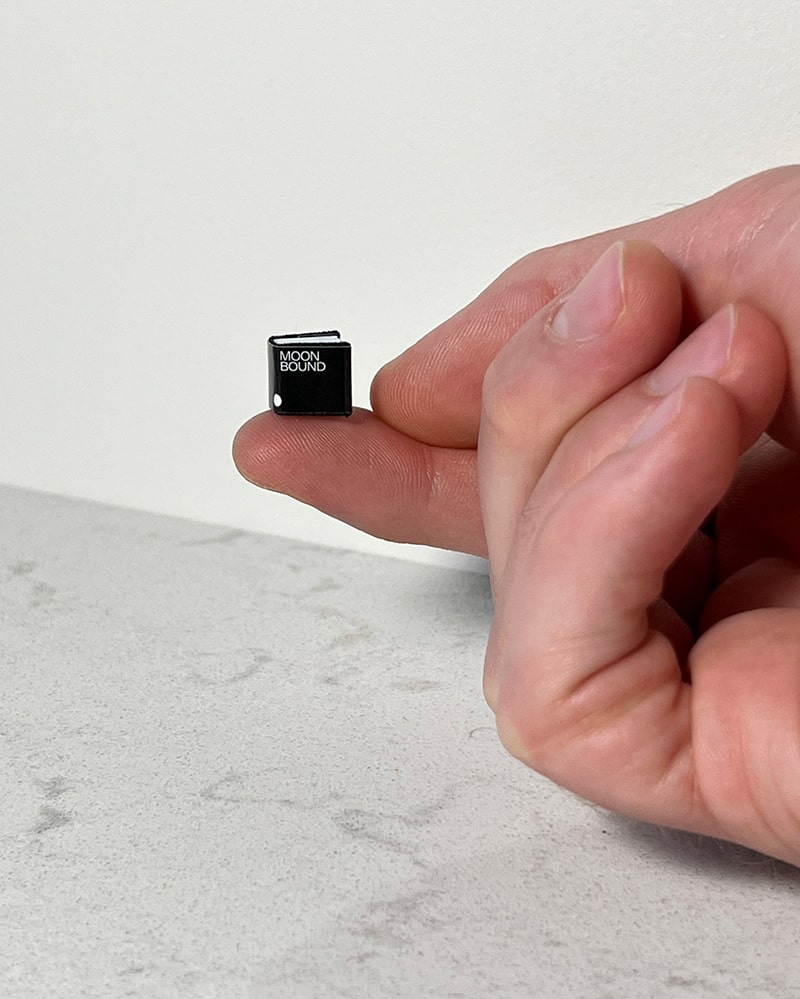
The Moon Gallery Foundation credits Brownie with concept, project management, editing, and texts. Christopher Cokinos, a poet and science writer, is credited as editor; Anna Sitnikova and Elizaveta Glukhova with initiative and management; Luis Bernardo Guzmán with curation; Figure Ten with graphic design; and Art and Such Evan with book development and creation. The one-cubic-centimeter book contains 49 contributions.87
Brownie and Cokinos asked contributors how the Moon sees Earth, using that reversal of viewpoint as their editorial brief.88
The foundation’s 2026 press release states that contributions were selected competitively and contributors did not pay to be included. It describes work in seven languages and a payload placed within a LifeShip container, to travel on Astrolab’s FLIP rover aboard Astrobotic’s Griffin lander. The launch window was not fixed in the release; the project page describes a planned launch in late 2026. As of the public records consulted for this profile, this is a prepared and announced mission, not a book already delivered to the Moon.89
The object and the conversations around it
Brownie and Cokinos initiated and curated a blog around the project, while the foundation described future Earth-based editions for readers.90, 91
The image could not be loaded. View the original using the source link below.
Working within higher education
Her university responsibilities have included writing, teaching, academic quality, curriculum development, and organizing shared research settings.92, 93
The available record describes those professional responsibilities much more fully than the financial arrangements around them. It does not establish salary, publication royalties, project-management fees, or the proportions of income supplied by different activities. The documented Spacewear resources were local and collaborative: a mannequin, a university scanner, an aquarium, public footage, and the expertise of a designer and students. More recent space-art projects introduce different partners and mission dependencies. Those changes in working scale belong to Brownie’s career as much as the changes in the subjects of her books.
The record also retains work in progress. Brownie’s aquarium experiment raised questions it could not answer. Her educational team’s AcrossRCA presentation reported difficulties alongside proposed changes. Moon Bound has an editorial and physical form while its transport remains prospective. At this point in her life, research, teaching, and organizing coexist rather than succeeding one another as separate careers.
Chronological cross-check
The dates below distinguish completed publications and documented activities from announcements and plans. They supplement the narrative rather than provide an alternative biography.
| Date | Documented activity | Source and qualification |
|---|---|---|
| July 2008 | “Fluid Typography” at New Views 2, London | Hertfordshire publication record.94 |
| 2011 | Chapter in Writing Design, edited by Grace Lees-Maffei | Scholarly publication record.95 |
| May–June 2012 | Thesis submission dated May; PhD award recorded 1 June | Thesis and university record.96, 97 |
| 2013 | Parallax conference paper; “Dressing Down”; joint Superman presentation with Graydon | Distinct publication and firsthand conference records.98, 99, 100 |
| 2014–2015 | Transforming Type; subsequent paperback edition | Repository records 2014; paperback publisher date February 2015.101 |
| 2015 | The Superhero Costume; “The Masculinization of Dressing-Up” | Publisher, coauthor, and journal records.102, 103, 104 |
| 2016 | Acts of Undressing; Dictionary Dressings contribution | Repository publication records.105, 106 |
| 2016–2018 | Spacewear book announced; DeMain collaboration, scanning, aquarium tests, and student proposals documented | Project posts; an announced 2017 book date was superseded by actual publication.107, 108, 109, 110 |
| January 2019 | Spacewear published | Publisher record.111 |
| 2020–2022 | Interview, screen-costume and touch research, and methodological essay | FAAR and journal sources.112, 113, 114, 115 |
| July–September 2023 | RCA interview recorded 23 July, published 13 September | The transcript’s August header is not the recording date.116 |
| September 2024 | AcrossRCA teaching case study presented in Singapore | RCA repository and presentation.117, 118 |
| July 2025 | Art in Orbit published | Publisher record.119 |
| 2025–2026 | Miniature anthology assembled; lunar mission announced | Partner credits and press release; launch/landing remain prospective in these sources.120, 121 |
| Current public record | Associate Dean (Education); _Space Research Group co-founder | RCA staff and group pages; exact title-change and group founding dates not independently established.122, 123 |
Sources and limits of the reconstruction
Research consulted public sources in October 2026. Brownie’s thesis, articles, blogs, interview, and teaching case study provide evidence of arguments and methods; institutional pages provide evidence of roles and project descriptions; collaborator accounts reveal some relationships; partner records document the current payload’s organization. These kinds of evidence have different strengths. Institutional ambitions and project publicity have not been treated as independent proof of impact.
The most consequential remaining gaps are her earlier education and personal formation, an exact employment chronology before the clearly documented Hertfordshire roles, the detailed transition to the RCA, and the financial arrangements of publications and collaborations. Contemporaneous work and named relationships establish parts of her intellectual formation; they do not resolve those missing biographical details. Proposed experiments and announced missions remain distinguished from completed flights and landings.
Royal College of Art, “Dr Barbara Brownie”, current staff biography, consulted October 2026.↩︎
Bloomsbury, Transforming Type: New Directions in Kinetic Typography; RCA repository record dates the book 2014, while the linked paperback edition is dated 12 February 2015.↩︎
Brownie and Danny Graydon, The Superhero Costume: Identity and Disguise in Fact and Fiction, Bloomsbury, 2015, publisher description and contents.↩︎
Brownie, Acts of Undressing: Politics, Eroticism and Discarded Clothing, Bloomsbury, 2016, repository description.↩︎
Bloomsbury, Spacewear: Weightlessness and the Final Frontier of Fashion, published 10 January 2019, 176 pages.↩︎
Bloomsbury, Art in Orbit: Art Objects and Spaceflight, published 10 July 2025, 224 pages, description and contents.↩︎
Moon Gallery Foundation, “Moon Bound”, project description, credits, and mission status, consulted October 2026.↩︎
Brownie, “New Mannequin”, 6 July 2017.↩︎
University of Hertfordshire, The Behaviours of Fluid Characterforms in Temporal Typography, doctoral record, award date 1 June 2012.↩︎
Graydon, “Super-Scholarly Comics Research at G2 in Oxford”, 13 October 2013.↩︎
Lee Anderson, “Signals of Change: An Interview with Dr. Barbara Brownie”, FAAR, 10 November 2020.↩︎
Moon Gallery Foundation, “Moon Bound”, project description, credits, and mission status, consulted October 2026.↩︎
Brownie, “The Final Frontier of Fashion: Interdisciplinary Approaches to Design for Microgravity”, Writing Visual Culture 10 (2022); complete issue, essay on printed pages 77–89, editorial discussion on page 10. The repository’s shorter page range is inconsistent with the original issue.↩︎
Benji Jeffrey and Brownie, RCAst interview transcript, dated 7 August 2023; the episode page gives recording on 23 July and publication on 13 September, especially discussion at 6:13–9:51 and 30:14–32:47.↩︎
Brownie, “One Form, Many Letters”, Networking Knowledge 1(2), 30 December 2007. The article identifies her Hertfordshire affiliation.↩︎
University of Hertfordshire, Type Image publication record, Gingko Press, 2011. Book metadata and description checked; not the complete book.↩︎
Brownie, “Fluid Typography: Defining a New Form of Temporal Typography”, New Views 2, London, 9–11 July 2008.↩︎
Brownie, “Fluid Typography: Construction, Metamorphosis and Revelation”, in Grace Lees-Maffei, ed., Writing Design: Words and Objects, Berg, 2011.↩︎
University of Hertfordshire, The Behaviours of Fluid Characterforms in Temporal Typography, doctoral record, award date 1 June 2012.↩︎
Barbara Brownie, The Behaviours of Fluid Characterforms in Temporal Typography, May 2012, especially abstract, acknowledgments, foreword, and methodology. Repository record.↩︎
Barbara Brownie, The Behaviours of Fluid Characterforms in Temporal Typography, May 2012, especially abstract, acknowledgments, foreword, and methodology. Repository record.↩︎
Brownie, “Typographic Parallax in Environmental Space: Real and Unreal Depth”, International Symposium on Typographic Landscaping, Gothenburg, 17–18 June 2013.↩︎
Brownie, “A New History of Temporal Typography: Towards Fluid Letterforms”, Journal of Design History 27, no. 2 (2014), 167–181; DOI.↩︎
Brownie, “Modular Construction and Anamorphosis in Channel 4 Idents: Past and Present”, Journal of Media Practice 14, no. 2, 93–109. The RCA record assigns 2014; bibliographic year conventions around this volume vary.↩︎
Bloomsbury, Transforming Type: New Directions in Kinetic Typography; RCA repository record dates the book 2014, while the linked paperback edition is dated 12 February 2015.↩︎
Brownie, “About,” Costume & Culture, including author reply of 2 June 2013 about referencing.↩︎
Brownie, “Linguistic Determinism: How Fashion Terminology Limits Creativity,” Vestoj, 4 February 2014.↩︎
Brownie, “About,” Costume & Culture, including author reply of 2 June 2013 about referencing.↩︎
Brownie, “Ambiguous Garments: Are We Limiting Our Wardrobe Choices by Categorising Clothes?”, 16 July 2013, including discussion in comments.↩︎
Brownie, “Linguistic Determinism: How Fashion Terminology Limits Creativity,” Vestoj, 4 February 2014.↩︎
Brownie, “Dictionaries and Dress”, 6 January 2016.↩︎
RCA Research Repository, Dictionary Dressings contribution, in Femke de Vries and Ruby Hoette, eds., Dictionary Dressings: Re-Reading Clothing Definitions Towards Alternative Fashion Perspectives, Onomatopee, 2016, 361–367.↩︎
Brownie, “Mangled Mannequins”, 1 July 2013.↩︎
Brownie, “Clothing Memories: Clothes and Personal Archaeology”, 26 June 2013.↩︎
Danny Graydon, “About”, updated biographical text recording teaching and the 2015 book; the page retains an older initial publication date.↩︎
Graydon, “Super-Scholarly Comics Research at G2 in Oxford”, 13 October 2013.↩︎
Graydon, “Academics Assemble! The Superhero—First Global Meeting: Call for Papers”, 22 April 2015; text also reproduced on the author’s homepage.↩︎
Brownie, “Dressing Down: Costume, Disguise and the Performance of Ordinariness”, Clothing Cultures 1, no. 1 (2013), 45–57; DOI.↩︎
Brownie and Danny Graydon, The Superhero Costume: Identity and Disguise in Fact and Fiction, Bloomsbury, 2015, publisher description and contents.↩︎
Brownie, “Spider-Man Sews: How the Hyper-Masculine Superhero Emerges from the Feminine and Domestic Act of Costuming”, 29 June 2014.↩︎
Brownie, “The Masculinization of Dressing-Up”, Clothing Cultures 2, no. 2 (2015), 145–155; accepted manuscript.↩︎
Brownie, Acts of Undressing: Politics, Eroticism and Discarded Clothing, Bloomsbury, 2016, repository description.↩︎
Brownie, “Dressed to Undress”, 12 July 2014.↩︎
Brownie, “The Sounds of Undressing”, 4 October 2015.↩︎
Brownie, “Q&A with Hussein Chalayan”, 30 October 2015, account of discussion with Chalayan, Damien Jalet, and Alistair Spalding at Sadler’s Wells.↩︎
Brownie, “Designing Gestures in Fashion”, 28 February 2017.↩︎
Brownie, “Dressing Up (BBC Podcast)”, 28 September 2016.↩︎
Brownie, “Streaking, Flashing and Mooning”, 24 March 2017.↩︎
Brownie, “Style in Space: The Superficiality of the Public Vote in NASA’s New Mission to Attract Audience-Designers”, 1 May 2014. This is evidence of her critique, not independent evidence of NASA’s motives.↩︎
Lee Anderson, “Signals of Change: An Interview with Dr. Barbara Brownie”, FAAR, 10 November 2020.↩︎
Brownie, “Dressing the Space Tourist”, 11 May 2016.↩︎
Bloomsbury, Spacewear: Weightlessness and the Final Frontier of Fashion, published 10 January 2019, 176 pages.↩︎
Brownie, “The Final Frontier of Fashion: Interdisciplinary Approaches to Design for Microgravity”, Writing Visual Culture 10 (2022); complete issue, essay on printed pages 77–89, editorial discussion on page 10. The repository’s shorter page range is inconsistent with the original issue.↩︎
Brownie, “Dressing the Space Tourist”, 11 May 2016.↩︎
Bloomsbury, Spacewear: Weightlessness and the Final Frontier of Fashion, published 10 January 2019, 176 pages.↩︎
Nicola DeMain, “Initial Approach to Spacewear Design”, 28 February 2017.↩︎
University of Hertfordshire, “Design for Weightlessness”, project record.↩︎
Brownie, “New Mannequin”, 6 July 2017.↩︎
Brownie, “3D Scanning the Mannequin”, 6 July 2017.↩︎
Brownie, “Observing Astronauts’ Clothes”, 14 July 2017.↩︎
Brownie, “Underwater Experiments”, 15 January 2018.↩︎
Spacewear, “Project Profile: Manèges in Motion”, Elyse Jones, 2 March 2018.↩︎
Spacewear, “Project Profile: Underview”, Madison Beith, 2 March 2018.↩︎
Spacewear, “Project Profile: Between Space and Earth”, Eva Macijauskaite, 2 March 2018.↩︎
Spacewear, “Project Profile: Through the Wormhole”, Nicola DeMain, 2 March 2018.↩︎
Lee Anderson, “Signals of Change: An Interview with Dr. Barbara Brownie”, FAAR, 10 November 2020.↩︎
Brownie, “The Final Frontier of Fashion: Interdisciplinary Approaches to Design for Microgravity”, Writing Visual Culture 10 (2022); complete issue, essay on printed pages 77–89, editorial discussion on page 10. The repository’s shorter page range is inconsistent with the original issue.↩︎
Brownie, “Zero-Gravity Wardrobes: The Behaviour of Costume in Weightless Environments”, Film, Fashion & Consumption 9, no. 1 (2020), 5–21; accepted manuscript.↩︎
Brownie, “A Sense of Space: The Separation of Dress and Body in Microgravity”, The Senses and Society 16, no. 3 (2021), 373–378; open-access article.↩︎
Brownie, “Underwater Experiments”, 15 January 2018.↩︎
Royal College of Art, “Dr Barbara Brownie”, current staff biography, consulted October 2026.↩︎
University of Hertfordshire, “Professional Doctorate Arts Leadership”, project dated 14 November 2017–1 November 2018.↩︎
Public ORCID record, linked from the RCA research profile. Employment assertions are self-authored. ORCID starts the academic-quality role on 1 November 2018; the public LinkedIn search index instead displays October 2018. Neither establishes the reason for changing institutions.↩︎
Benji Jeffrey and Brownie, RCAst interview transcript, dated 7 August 2023; the episode page gives recording on 23 July and publication on 13 September, especially discussion at 6:13–9:51 and 30:14–32:47.↩︎
Tom Sowden, Brownie, Sandra Denicke-Polcher, and Martin Newth, The Possibility of Things, Digitally Engaged Learning, Singapore, 26–27 September 2024.↩︎
Brownie, Sandra Denicke-Polcher, Chris Mitchell, Martin Newth, and Tom Sowden, The Possibility of Things, presentation, 2024. The presentation lists Mitchell in addition to the repository’s author list.↩︎
Royal College of Art, “Dr Barbara Brownie”, current staff biography, consulted October 2026.↩︎
Royal College of Art, “Dr Barbara Brownie”, current staff biography, consulted October 2026.↩︎
Bloomsbury, Art in Orbit: Art Objects and Spaceflight, published 10 July 2025, 224 pages, description and contents.↩︎
Jori Finkel, “Trevor Paglen’s Orbital Reflector Sculpture Fails to Deploy”, The Art Newspaper, 2 May 2019.↩︎
Nevada Museum of Art, “Trevor Paglen: Orbital Reflector”, exhibition and production record.↩︎
Barbara Brownie, The Behaviours of Fluid Characterforms in Temporal Typography, May 2012, especially abstract, acknowledgments, foreword, and methodology. Repository record.↩︎
Bloomsbury, Art in Orbit: Art Objects and Spaceflight, published 10 July 2025, 224 pages, description and contents.↩︎
Moon Gallery Foundation, “Moon Bound”, project description, credits, and mission status, consulted October 2026.↩︎
Eduardo Kac, Inner Telescope, project documentation, 2017.↩︎
Royal College of Art, “_Space Research Group”, current group description and project documentation.↩︎
Moon Gallery Foundation, “Moon Bound”, project description, credits, and mission status, consulted October 2026.↩︎
Moon Gallery Foundation, “Moon Bound”, project description, credits, and mission status, consulted October 2026.↩︎
Moon Gallery Foundation, Moon Bound press release, May 2026 upload, especially production credits, selection process, and planned transport. Promotional “first” claims are not adopted here.↩︎
Royal College of Art, “Dr Barbara Brownie”, current staff biography, consulted October 2026.↩︎
Royal College of Art, “_Space Research Group”, current group description and project documentation.↩︎
Brownie, “Fluid Typography: Defining a New Form of Temporal Typography”, New Views 2, London, 9–11 July 2008.↩︎
Brownie, “Fluid Typography: Construction, Metamorphosis and Revelation”, in Grace Lees-Maffei, ed., Writing Design: Words and Objects, Berg, 2011.↩︎
Barbara Brownie, The Behaviours of Fluid Characterforms in Temporal Typography, May 2012, especially abstract, acknowledgments, foreword, and methodology. Repository record.↩︎
University of Hertfordshire, The Behaviours of Fluid Characterforms in Temporal Typography, doctoral record, award date 1 June 2012.↩︎
Brownie, “Typographic Parallax in Environmental Space: Real and Unreal Depth”, International Symposium on Typographic Landscaping, Gothenburg, 17–18 June 2013.↩︎
Brownie, “Dressing Down: Costume, Disguise and the Performance of Ordinariness”, Clothing Cultures 1, no. 1 (2013), 45–57; DOI.↩︎
Graydon, “Super-Scholarly Comics Research at G2 in Oxford”, 13 October 2013.↩︎
Bloomsbury, Transforming Type: New Directions in Kinetic Typography; RCA repository record dates the book 2014, while the linked paperback edition is dated 12 February 2015.↩︎
Brownie and Danny Graydon, The Superhero Costume: Identity and Disguise in Fact and Fiction, Bloomsbury, 2015, publisher description and contents.↩︎
Danny Graydon, “About”, updated biographical text recording teaching and the 2015 book; the page retains an older initial publication date.↩︎
Brownie, “The Masculinization of Dressing-Up”, Clothing Cultures 2, no. 2 (2015), 145–155; accepted manuscript.↩︎
Brownie, Acts of Undressing: Politics, Eroticism and Discarded Clothing, Bloomsbury, 2016, repository description.↩︎
RCA Research Repository, Dictionary Dressings contribution, in Femke de Vries and Ruby Hoette, eds., Dictionary Dressings: Re-Reading Clothing Definitions Towards Alternative Fashion Perspectives, Onomatopee, 2016, 361–367.↩︎
Brownie, “Dressing the Space Tourist”, 11 May 2016.↩︎
Nicola DeMain, “Initial Approach to Spacewear Design”, 28 February 2017.↩︎
Brownie, “3D Scanning the Mannequin”, 6 July 2017.↩︎
Brownie, “Underwater Experiments”, 15 January 2018.↩︎
Bloomsbury, Spacewear: Weightlessness and the Final Frontier of Fashion, published 10 January 2019, 176 pages.↩︎
Lee Anderson, “Signals of Change: An Interview with Dr. Barbara Brownie”, FAAR, 10 November 2020.↩︎
Brownie, “Zero-Gravity Wardrobes: The Behaviour of Costume in Weightless Environments”, Film, Fashion & Consumption 9, no. 1 (2020), 5–21; accepted manuscript.↩︎
Brownie, “A Sense of Space: The Separation of Dress and Body in Microgravity”, The Senses and Society 16, no. 3 (2021), 373–378; open-access article.↩︎
Brownie, “The Final Frontier of Fashion: Interdisciplinary Approaches to Design for Microgravity”, Writing Visual Culture 10 (2022); complete issue, essay on printed pages 77–89, editorial discussion on page 10. The repository’s shorter page range is inconsistent with the original issue.↩︎
Benji Jeffrey and Brownie, RCAst interview transcript, dated 7 August 2023; the episode page gives recording on 23 July and publication on 13 September, especially discussion at 6:13–9:51 and 30:14–32:47.↩︎
Tom Sowden, Brownie, Sandra Denicke-Polcher, and Martin Newth, The Possibility of Things, Digitally Engaged Learning, Singapore, 26–27 September 2024.↩︎
Brownie, Sandra Denicke-Polcher, Chris Mitchell, Martin Newth, and Tom Sowden, The Possibility of Things, presentation, 2024. The presentation lists Mitchell in addition to the repository’s author list.↩︎
Bloomsbury, Art in Orbit: Art Objects and Spaceflight, published 10 July 2025, 224 pages, description and contents.↩︎
Moon Gallery Foundation, “Moon Bound”, project description, credits, and mission status, consulted October 2026.↩︎
Moon Gallery Foundation, Moon Bound press release, May 2026 upload, especially production credits, selection process, and planned transport. Promotional “first” claims are not adopted here.↩︎
Royal College of Art, “Dr Barbara Brownie”, current staff biography, consulted October 2026.↩︎
Royal College of Art, “_Space Research Group”, current group description and project documentation.↩︎