A life in acting, writing, and making
films
Research date: October 3, 2026
Ben Affleck is an American actor, screenwriter, director and producer, born in Berkeley on August 15, 1972, and raised in Cambridge, Massachusetts. Childhood acting preceded Chasing Amy and Good Will Hunting (1997), blockbuster employment, directing, and producing.5
The different occupations have not replaced one another in an orderly progression. Writing initially helped him obtain acting work; acting supplied knowledge of sets and performances; directing required him to learn how to organize other people’s specialties. At different moments he has been a beginner, a bankable leading man, an actor whose celebrity complicated his casting, and a director responsible for a film that failed. Following these changes reveals a practice learned through particular people and circumstances, rather than a career planned from its eventual corporate position.
Cambridge: a household, a school, and a friend
Affleck’s mother, Christopher Anne Boldt, taught school; his father, Timothy Affleck, worked at various times as a mechanic, bartender, and custodian. In a 1997 interview, Affleck described attending Cambridge public schools and his father’s later work in California. His younger brother Casey also became an actor. Their parents divorced when Ben was twelve. These are the circumstances of the household, not sufficient grounds for assigning a single psychological explanation to either brother’s later work. 43 44
Affleck connects Good Will Hunting’s resentment of Harvard privilege to his father’s custodial work there.9 The barroom encounter is fiction shaped by that social divide, not an autobiographical record.
He remembers The Voyage of the Mimi as childhood encouragement. Drama teacher Gerry Speca later urged him and Damon to act, write and direct.9
In 2013 he distinguished childhood comfort on camera from acting truthfully, which Speca demanded.46 Completing the lines was not enough to make a scene convincing.
Damon lived two blocks away. In Damon’s account, their friendship became especially close in high school, when both wanted to act. They pooled earnings in a bank account that helped pay for trips to New York auditions. A commercial could bring useful money even when a performance was removed from the finished advertisement. Before their partnership became an Oscar story, it was an arrangement for affording travel and sustaining repeated attempts to get hired. 45
Affleck’s higher education was interrupted rather than completed. He attended the University of Vermont briefly and then Occidental College in Los Angeles, where he studied Middle Eastern affairs and made student films before leaving. Occidental lists him with the class of 1995 while explicitly noting that he did not graduate. His move west thus involved both college and auditions, rather than an instantaneous passage from Cambridge to professional security. 47 48
Small parts and the independent-film generation
The early Los Angeles years produced work without yet producing a stable identity as a leading actor. Television employment, an uncredited appearance in Buffy the Vampire Slayer, and School Ties preceded the more memorable bully O’Bannion in Richard Linklater’s Dazed and Confused (1993). These parts belong to different kinds of production: television drama, studio youth films, and an ensemble whose reputation grew after its initial release. Affleck did not enter a single coherent artistic movement; he worked across the opportunities available. 47
He recalls delight in School Ties: a job near Lowell, nine lines, and Damon’s company.10 A set mattered before anyone knew the film’s reception.
Linklater supplied another kind of example. Recalling Dazed and Confused in a 2025 Criterion appearance, as reported by the Houston Chronicle, Affleck described a director who invited actors to contribute and improvise. Linklater wanted the completed film to exceed what was on the written page. This was an early experience of a set where participation improved the work, rather than merely implementing a fixed plan. 49
Admiring Clerks, Affleck took Mallrats (1995) while worrying about repeated bully parts and wanting to learn cheap filmmaking. Smith wrote Chasing Amy for him, a trust he felt responsible to repay through the performance.43
Chasing Amy allowed uncertainty and embarrassment beyond the bully parts. Smith’s trust gave Affleck responsibility for a personal story.43 Casting could develop through a filmmaker imagining another possibility in a familiar actor.
These jobs placed Affleck among the American independent filmmakers of the 1990s. Employment also brought introductions that could later help a script reach producers and distributors.
Writing Good Will Hunting, and keeping the chance to act
Damon began the material in Anthony Kubiak’s playwriting class at Harvard. He brought its first act to Los Angeles while pursuing Geronimo, staying with Affleck. In his 2002 Fresh Air interview, Damon recalled that the opening encounter between Will and the therapist survived from the classroom draft, while the sustained collaboration developed later, in the home he shared with Ben and Casey. Writing could begin late at night when one of them proposed an exchange and the other answered it. 45
They improvised exchanges on tape, then shaped a screenplay. Chris Moore joined as producer; Patrick Whitesell took it to studios conditional on both writers acting. Castle Rock bought it in 1994. When development stalled, they had to find a buyer who would repay its investment. Smith helped reach Miramax.6
Rob Reiner and William Goldman advised removing the thriller strand.6a Goldman later denied secretly writing the screenplay.8 Assistance and authorship should retain their separate meanings.
Waiting continued: final-cut disputes delayed Van Sant, and Williams’s commitment helped make production possible.6b The script sale had not secured a completed film or unconditional participation.
During filming they challenged costumes that made working-class characters look destitute. Williams helped secure the L Street Tavern; much shooting occurred in Toronto.6c Remembered Boston life needed practical choices about clothes and locations.
Affleck and Damon won the Academy Award for Original Screenplay in March 1998; Williams won Supporting Actor. Their achievement was substantial, and its conditions were collective: a teacher, an actor-friend, an agent, producers, script readers, a director, a leading older actor, and crews who made a remembered city visible. Neither the award nor their persistence cancels the importance of those people. 7
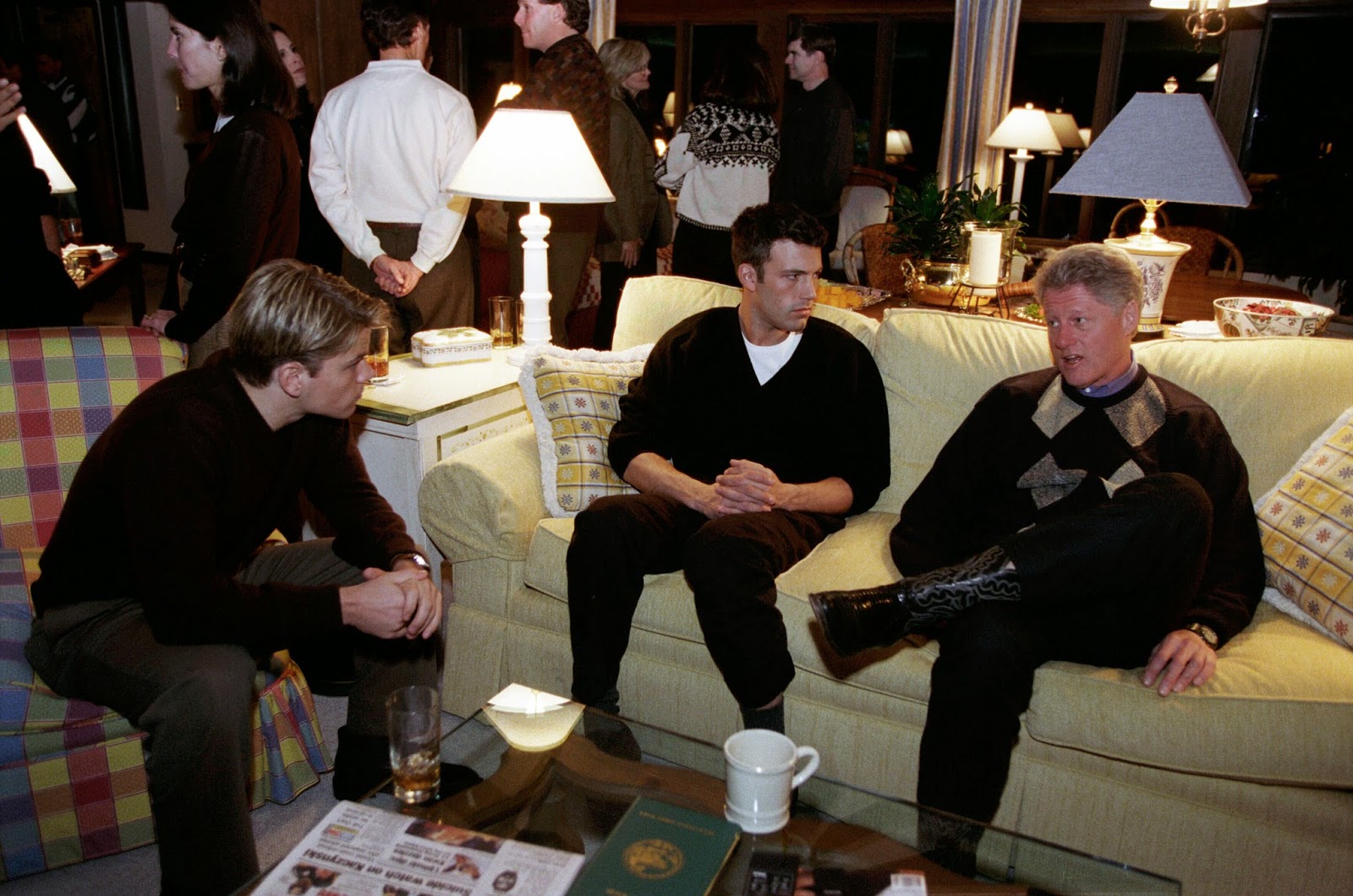
Figure 1. Matt Damon, Ben Affleck, and Bill Clinton at a screening of Good Will Hunting at Camp David, January 11, 1998. The setting records how far the film’s public reception traveled beyond its origins. Barbara Kinney / William J. Clinton Presidential Library, public domain; source and attribution.

Becoming recognizable, and learning what a performance needs
Armageddon (1998), Pearl Harbor (2001) and Daredevil (2003) expanded his studio employment.5 Commercial prominence did not give him a screenwriter’s authority over those productions.
In 2006 Affleck disputed treating critical dislike and financial failure as interchangeable.9 Neither measure alone establishes whether acting work was good.
He wanted Gigli for Martin Brest’s direction, then remembers studio changes and reshoots as the film lost shape. Its failure coincided with invasive Lopez coverage.10 This is a participant’s later account, not an outcome he foresaw.
For George Reeves in Hollywoodland, he studied films, home movies, acquaintances and the stars Reeves emulated. Voice conventions and the cumbersome Superman costume informed the performance.9 Preparing somebody else’s speech and body was work beyond simply appearing as himself.
A first feature: Boston faces, a brother, and an editing room
In Gone Baby Gone (2007), casting Casey as the lead let Ben direct without leading the performance. He learned to answer his brother as an actor, beyond family shorthand.9
The Boston setting mattered through casting and behavior as well as recognizable streets. Affleck valued local faces and the incomplete, unpolished quality of ordinary conversation. When nonprofessional performers became conscious of the camera, he could wait, distract them, or make filming feel less ceremonious. Such methods were not the absence of direction. They were ways of changing the conditions in which a person could produce a believable moment. 11
He remembers fear throughout the debut and disliking its first assembly. Costner’s advice was practical: know the second shot before finishing the first.46 A crew could see preparedness in the transition between tasks.
While waiting for William Goldenberg, he revised footage on Avid. Earlier work selling editing systems and making friends’ reels had supplied familiarity with the tools.12 Watching the cut exposed what the shoot had supplied.
This makes the debut more complicated than a story of a failed actor discovering his real talent. He arrived with useful experience and still faced a new responsibility. The completed film depended on his brother, local performers, an adapted novel, an editor, and repeated decisions about the footage. Directing became possible through these connections and through work done when the first result was disappointing.
The Town and Argo: directing through other people’s specialties
On The Town (2010), Affleck acted, directed, and co-wrote. Returning to Boston did not mean repeating the debut unchanged: the new task combined a central performance with action filmmaking and an ensemble. Its setting was built as much through sound and editing as through what the camera photographed. 5 35
Sound editors Aaron Glascock and Curt Schulkey described a specific Boston soundscape, including local emergency sirens. Editor Dylan Tichenor’s opening surveillance-camera passage withheld sound before the film entered the robbery at full intensity. Affleck also wanted restraint in vehicle sounds: a chase did not need every available cinematic engine effect. The resulting tension was a matter of selection, timing, and contrast. Naming the editors makes visible a practice that the director’s credit alone cannot describe. 35
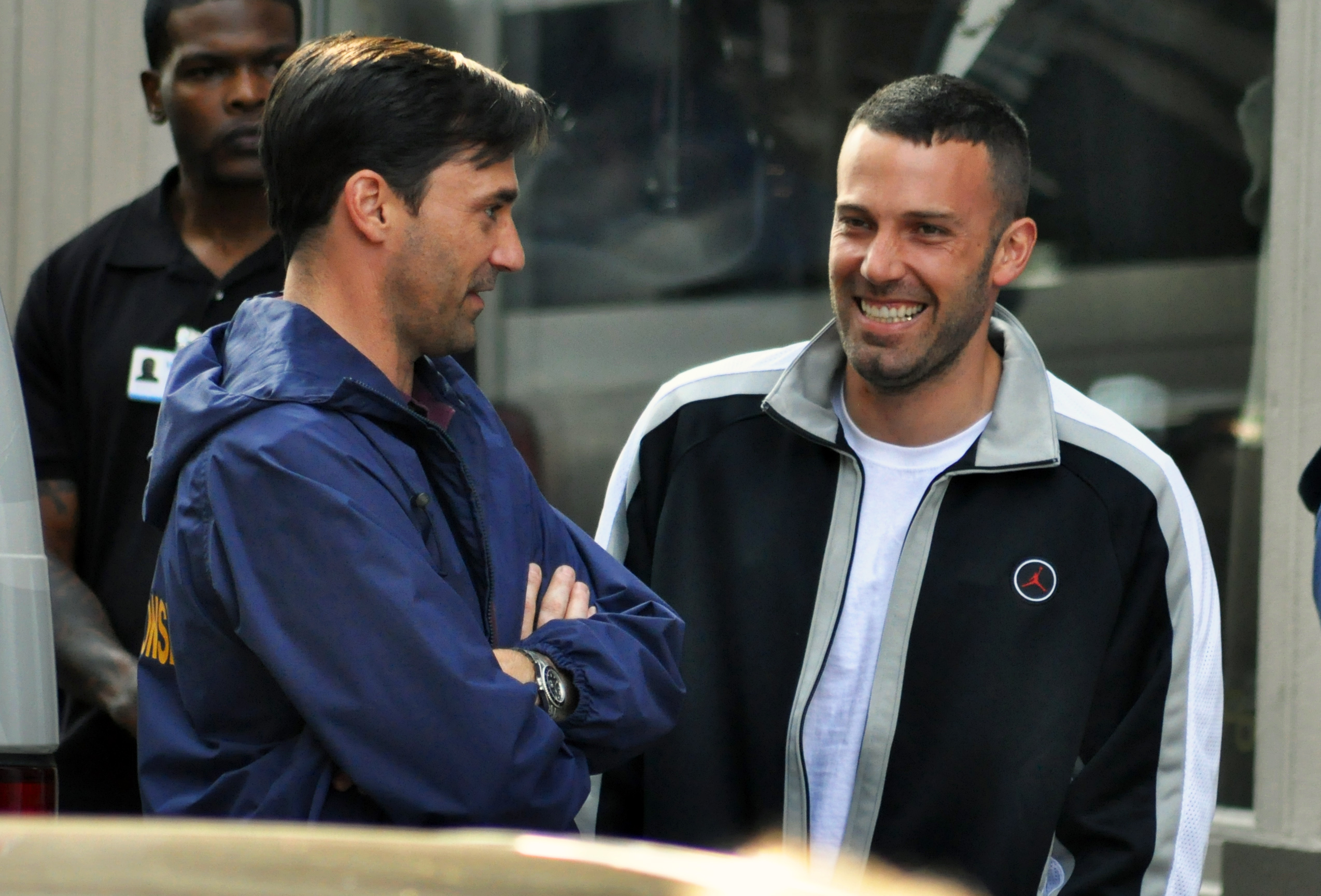
Figure 2. Affleck and Jon Hamm during the filming of The Town in 2009. Chensiyuan, CC BY-SA 4.0; source and attribution.

Argo (2012), scripted by Chris Terrio and produced with George Clooney and Grant Heslov, cast Affleck as Tony Mendez. Los Angeles, Washington and Istanbul filming joined a rescue thriller, Hollywood satire and period reconstruction.12 The dramatization cannot substitute for a history of the revolution or operation.
Affleck sought cinematographer Rodrigo Prieto partly because he admired the work in Babel. Goldenberg returned as editor. In the production interview, Affleck emphasized a cooperative editing relationship and screenings for selected viewers as ways of testing pace and comprehension. His responsibility was to bring the different tones into a film that still felt coherent, rather than to apply the same visual signature to every setting. 12
First assistant director David Webb’s account supplies another dimension. The actors playing the six fugitives were cast early enough to grow period-appropriate hair; large embassy sequences required preparation and coordination of extras. These decisions precede the moments audiences associate with directing. An assistant director translates the desired scene into a day’s executable work, reconciling people, locations, appearance, and time. 36
For Argo, he varied takes in fear, anger, speed and restraint, then judged his performance in the edit. Other actor-directors advised against neglecting his own coverage.46 Usable choices mattered more than apparent modesty on set.
Argo won the Directors Guild’s feature-film award in February 2013 and the Academy Award for Best Picture that month. Affleck’s second Oscar was as one of the producers, not as the screenplay’s author or the Academy’s winning director. The distinction describes the work accurately and avoids letting an award stand for every job on the film. 13 38
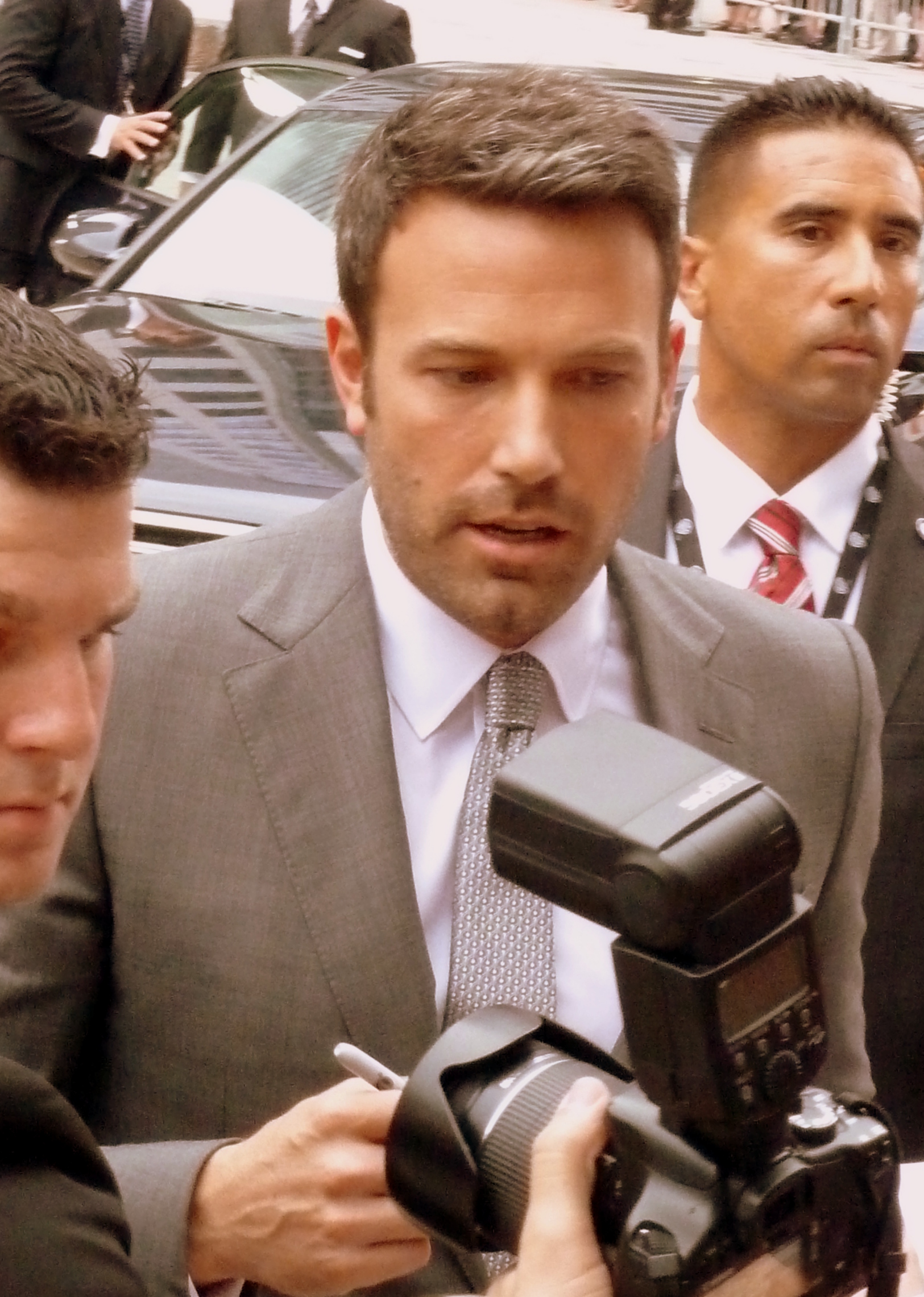
Figure 3. Affleck at the Toronto International Film Festival premiere of Argo, September 7, 2012. GabboT, CC BY-SA 2.0; source and attribution.

Continuing to act, and encountering new limits
Directing did not make Affleck stop learning from directors. David Fincher cast him as Nick Dunne in Gone Girl (2014), a man whose public appearance becomes disastrously legible to other people. In his Film Comment interview, Fincher identified Affleck’s intelligence and understanding of story as well as his experience of public scrutiny. The casting connected an actor’s knowledge to a fictional predicament without making the film an account of his marriage or personality. 14
The collaboration also complicates a familiar evaluation of acting. Nick must be readable enough to attract suspicion and withheld enough to frustrate certainty. An appealing or apparently inappropriate expression can serve the story rather than demonstrate that an actor has failed to express the correct emotion. Fincher’s account offers evidence of a chosen performance function, not proof that every audience response was intended. 14
Affleck’s own Live by Night (2016) brought writing, directing, producing, and leading acting together in an ambitious period crime film. It also became a major commercial disappointment. Contemporary reporting on the studio’s losses is useful because it prevents the accumulation of responsibilities from being mistaken for guaranteed artistic or financial success. More authority can mean more responsibility for a result that does not work. 15
Recalling Justice League in 2022, he described unhappiness and reconsidering desired work.10 This identifies his experience without explaining every production problem or every superhero role.
The contrast with his younger self is considerable. At first the problem was obtaining enough jobs to remain an actor. Later it became possible—and necessary—to distinguish desirable work from work he could obtain. This freedom rested partly on prior success, so it should not be generalized into advice that all actors can simply refuse unsatisfying employment.
Roles in later life: preparation, tone, and co-writing
Gavin O’Connor’s account of The Way Back (2020) describes an actor actively bringing material to a director. Affleck called after reading Brad Inglesby’s script, unaware that O’Connor had previously considered it. For the role, O’Connor supplied performances to study, including Paul Newman in The Verdict and Jack Lemmon in Days of Wine and Roses. Research and discussion remained part of the preparation even where the subject touched Affleck’s publicly discussed experience of recovery. 50
In 2025 he reported over five years’ sobriety and described acting as recombining remembered emotions. He distinguished The Way Back’s fictional losses from his own.21
For The Tender Bar, Clooney’s reminder that giving a car should be fun corrected Affleck’s solemnity. He also valued filming compatible with parenting.10
The Last Duel (2021) returned Affleck and Damon to screenwriting together, with Nicole Holofcener. Directed by Ridley Scott and based on Eric Jager’s book about a medieval French trial by combat, the film recounts a rape and its aftermath through three characters’ perspectives. Holofcener’s account is particularly important because it specifies what collaboration meant. Affleck approached her after the men had developed the three-part structure and begun the men’s sections. 18
Holofcener found that the historical material supplied much more about the men and the legal proceedings than about Marguerite. Her work therefore involved giving the woman daily life, personality, and relationships that the surviving account did not describe. The men seeking a woman collaborator was a decision about whose perspective they were equipped to write, but gender alone did not write the screenplay: Holofcener’s professional judgment and specific inventions did. Shared dialogue and subtly different responses also had to make the assault scenes communicate incompatible understandings without nudity. 18
Affleck’s relatively small acting part allowed writing, performance, and partnership to coexist differently than they had in a film he directed and led. It is useful to regard these arrangements as changing combinations of work. They are not stages on a ladder in which becoming a director necessarily makes supporting acting or co-writing obsolete.
Relationships and an ordinary working life
Damon’s friendship changed its professional form across shared auditions, writing and separate acting careers. Returning to screenwriting did not require repeating the first film. The public accounts preserve particular workings of a long relationship while leaving most private exchanges outside it.
He married Garner in 2005 (divorced 2018) and Lopez in 2022 (divorced 2025).5 He praises co-parenting with Garner and wants Los Angeles office hours compatible with seeing his children after school.21
Another change became public just before this profile’s research date. In a September 2026 conversation with Kerry Washington, as reported by Entertainment Weekly, Affleck said that his parents had died in April and June. He discussed discovering his mother’s letters and seeing more of her aspirations before motherhood. The account adds a later encounter with family history; it does not authorize a diagnosis of his grief or a claim about what caused the deaths. 51
These circumstances should not be used to explain all his artistic decisions. They establish instead that film work takes place within a life whose relationships, available time, and knowledge of the past continue to change. The person who wants to remain near his children is also the person who may need to spend a shoot on location. Building a company can alter that rhythm without removing the competing demands.
Congo: a partnership beyond filmmaking
Affleck co-founded the Eastern Congo Initiative with Whitney Williams in 2010. Its stated approach was to support Congolese organizations rather than have an American celebrity administer local life. In his December 2012 congressional testimony, Affleck discussed organizations including HEAL Africa and Mutaani FM. Williams and Congolese partners therefore belong in the account from the start: they provided expertise and relationships that his name alone could not supply. 40 41
This activity connected several worlds—local civil society, Washington advocacy, development funding, and consumer brands. The Kahawa Bora coffee initiative, involving Starbucks and USAID, attempted to connect agricultural development with a market for Congolese coffee. Affleck’s visibility could draw attention to a region that American entertainment audiences might otherwise encounter mainly through reports of conflict. Attention, however, is one resource within a partnership, not a measure of its results. 41 42
Lisa Ann Richey and Stefano Ponte’s study of the coffee intervention supplies an independent assessment. It examines how celebrity, branding, and development claims work together and finds reasons to question the extent and distribution of benefits for farmers. That research prevents the partnership from becoming a simple story in which public attention automatically repairs local economies. It does not establish that every ECI activity failed, nor does the organization’s own description establish that every project succeeded. 42
Congo is accordingly a substantive part of Affleck’s public practice, with collaborators and an institutional history of its own. It should neither be inflated into proof of benevolence nor reduced to a branding exercise without evidence. The pertinent questions concern what Congolese organizations could do with the support, how partnerships were governed, and what the available evaluations actually measured.
Companies, crews, and a place to work
Affleck and Damon had tried building institutions long before Artists Equity. With Chris Moore and Sean Bailey, they established LivePlanet in 2000; Project Greenlight made the selection and production of a novice filmmaker’s project into television. That format offered access but also made the limits of access unusually visible. A person could win an opportunity and still work within established hierarchies of production, representation, and editorial control. 16 17
Producer Effie Brown’s criticism of the 2015 program concerned who could exercise judgment about representation within the production. Damon’s widely discussed remarks should not be reassigned to Affleck, but neither should a company associated with both men be exempt from scrutiny. In 2018, Fanshen Cox DiGiovanni announced that their production company would adopt inclusion riders. An announcement records a commitment; without implementation records it cannot establish the composition or working conditions of every later crew. 16 17
Artists Equity launched in November 2022 with Affleck as chief executive, Damon as chief creative officer, and RedBird Capital’s Gerry Cardinale as their financing partner. Reporting described at least $100 million in financing. That figure describes backing for a company; it is not the company’s valuation or a fund already distributed to workers. The declared model gave more participants a financial stake in a film’s results. It remained a company financed by an investment firm, with management making production decisions, rather than a cooperative governed by its crews. 19 20
Artists Equity makes films, documentaries and advertising.39 Its September 2026 news describes eight writers developing scripts over twelve weeks, with Affleck, Damon and Eric Roth giving feedback.23
AIR (2023), written by Alex Convery and made with Amazon Studios, Skydance, and Mandalay, was the company’s first released film. It offered a particularly clear view of Affleck’s working habits. Shooting a bar conversation, he used an additional small camera to capture Damon and Marlon Wayans during each other’s close-ups. He thought an actor sometimes relaxed when the principal camera was looking elsewhere. He also acknowledged that his operating was inferior to cinematographer Robert Richardson’s and left Richardson free to reject the footage. 37 1
Richardson’s account places this experiment inside a larger crew’s work. Colorist Élodie Ichter graded footage on set, close to editorial; Affleck reviewed and cut material daily. An initially aggressive period look changed after they watched the images. Richardson recalled a twenty-eight-day shoot against a schedule of roughly thirty-two. The result depended on camera and lens choices, color work, editing access, and adjustment—not simply on a director’s speed or a company’s incentive policy. 2
The Rip (2026), directed by Joe Carnahan and starring Damon and Affleck, supplied a more measurable compensation example. Reporting described a Netflix performance bonus linked to results over ninety days. In May the company publicized payment of bonuses to an approximately 1,200-person cast-and-crew team. Public accounts do not disclose each payment or establish equal shares. A performance bonus is also distinct from contractual residuals, a share of accounting profits, copyright ownership, or shares in Artists Equity. Keeping those distinctions makes it possible to assess what changed for workers without attributing rights that the reported deal did not supply. 22 23 24
InterPositive: a new undertaking, with specific limits
Netflix dates InterPositive’s beginnings to Affleck’s 2022 experiments. A controlled soundstage dataset helped develop tools for adapting production footage; Netflix acquired the company in March 2026, with Affleck becoming senior adviser.4
This was engineering done with a team, not an actor personally implementing every model. Reporting identified a sixteen-person staff, and engineer Jian Ren identifies himself as a founding member and chief scientist. A granted patent lists Affleck as an inventor and describes techniques involving filmmaking information such as focal length, occlusion, and parallax. A patent shows a claimed method and its legal status; it does not independently demonstrate the system’s quality on a difficult production shot. 25 26 27
In the Bloomberg Screentime interview published October 1, 2026, Affleck discussed open models, model weights, and later-stage training, alongside months spent filming material. His account distinguishes several layers: existing foundational models, the company’s controlled filming, and adaptation to a production’s own dailies. These layers should not be collapsed into a claim that everything was trained from scratch on wholly cleared company material. Nor does the available account justify a precise claim that only a final layer was trained. Public statements about a product leave its complete training recipe and contractual permissions undisclosed. 3 4
Advertised operations include relighting, reframing and background repairs.4 These concern modifying footage already captured. Intended workflow is not independent evidence of equally effective operations or mandatory use by Netflix crews.
The acquisition also requires precise accounting. Netflix’s first-quarter 2026 filing reports an unnamed March acquisition for approximately $587 million in cash; The Wrap later identified that purchase with InterPositive. Bloomberg’s earlier report described a potential amount of up to $600 million tied partly to performance. Those are different statements, not enough information to calculate a residual $13 million earn-out, let alone Affleck’s personal proceeds. Ownership shares, taxes, individual distributions, and the complete contractual reconciliation are not public in these sources. 28 29 30
RedBird’s record dates its investment to October 2024 and exit to March 2026. Its description of the company’s formation uses a shorter timeline than Netflix’s account of research beginning in 2022; research, incorporation, and investment need not begin simultaneously, but the available sources do not resolve each event’s date. Separately, Artists Equity signed a Netflix first-look arrangement in March 2026 while maintaining its Sony theatrical agreement. The studio relationship and the acquisition of the technology company are distinct transactions. 31 32
Finally, rights to footage or an output do not by themselves answer questions about a performer’s consent or a worker’s compensation. Collective agreements, including IATSE’s 2024 agreement and SAG-AFTRA’s 2026 TV/theatrical provisions, provide a separate contractual setting for technological change. A product’s promises, a production’s ownership, individual employment terms, and collectively negotiated protections operate at different levels. None can safely be inferred from the acquisition price. 33 34
A practice still made with others
Affleck’s life in film has been sustained by changes in what he could do and whom he could work with. Speca encouraged writing; Damon made it a shared activity; Smith helped carry a script to a buyer; Williams helped make that script a film. Casey, Goldenberg, Prieto, Webb, sound editors, and camera crews made different forms of directing possible. Holofcener brought a developed practice of her own to a screenplay whose historical sources had left a woman underdescribed. These connections are specific, and some have lasted much longer than any one hit.
His career also contains experiences that resist a tidy lesson: work undertaken for good reasons that failed, fame that made acting harder to see, directing authority that did not guarantee success, and family needs that changed the desired working day. Companies and technical tools now form part of that life, but they do not explain its beginning or exhaust its present. The continuing practice is the less spectacular task of choosing material, answering collaborators, preparing performances, revising footage, and arranging a day in which the work can actually be done.
Sources and further reading
Dates below identify publication or broadcast dates where available. Interviews are accounts by participants, including retrospective accounts; company announcements describe the companies’ positions. Award records, filings, and independent research answer different questions and are cited accordingly.
- Jon Fauer, interview with Ben Affleck, Film and Digital Times, June 2023, pp. 60–62. Issue PDF.
- Jon Fauer, “Bob Richardson, ASC on AIR,” July 10, 2023. Film and Digital Times.
- Bloomberg Podcasts, “Ben Affleck on AI and Hollywood Economics,” Screentime interview, published October 1, 2026; relevant discussion around 3:45–6:32. Video.
- Netflix, “Why InterPositive Is Joining Netflix,” March 5, 2026. Company announcement.
- Trond Olav Svendsen and Ann-Sofi S. Emilsen, “Ben Affleck,” updated April 13, 2026. Store norske leksikon. Used for basic biography; the entry’s date for Live by Night is erroneous.
- Janelle Nanos, “Good Will Hunting: An Oral History,” January 2, 2013. Boston magazine, page 1; 6a: screenplay sale and Castle Rock, page 2; 6b: Miramax, Van Sant, and Williams, page 3; 6c: locations, costumes, and performance, page 4.
- Academy of Motion Picture Arts and Sciences, 70th Academy Awards, March 23, 1998. Ceremony record.
- William Goldman interview, 2004. Screenwriters Utopia.
- Terry Gross, “Ben Affleck Talks ‘Hollywoodland’,” September 25, 2006. Fresh Air audio and transcript.
- Matt Damon, interview with Ben Affleck, January 11, 2022. Entertainment Weekly.
- Steve Inskeep, “Ben Affleck on the Reality of ‘Gone Baby Gone’,” October 19, 2007. NPR / WVIA.
- Iain Blair, “Director’s Chair: Ben Affleck, ‘Argo’,” November 5, 2012, in the November issue. Post magazine.
- Directors Guild of America, 65th DGA Awards winners, February 3, 2013. Award record.
- Amy Taubin, interview with David Fincher, September/October 2014. Film Comment.
- Brent Lang, “‘Live by Night’ Flop,” January 26, 2017. Variety.
- Effie Brown interview, October 19, 2015. LAist / The Frame.
- Kevin Slane, production company inclusion-rider announcement, March 13, 2018. Boston.com.
- Lulu Garcia-Navarro, interview with Nicole Holofcener, October 17, 2021. NPR / KOSU transcript.
- Artists Equity / RedBird Capital, founding announcement, November 20, 2022. Press release PDF.
- Kerry Flynn and Hope King, Artists Equity financing and DealBook appearance, November 30, 2022. Axios.
- Zach Baron, “Inside Ben Affleck’s Plan to Remake Hollywood,” March 25, 2025. GQ.
- The Rip performance-bonus arrangement, January 9, 2026. The Wrap.
- Artists Equity, news archive; May 13, 2026 cast-and-crew bonus announcement and September 2026 writers’ room coverage. Company news.
- Jeremy Fuster, The Rip bonus reporting, May 13, 2026. The Wrap.
- Lucas Manfredi, InterPositive acquisition and staff reporting, March 5, 2026. The Wrap.
- Jian Ren, professional biography and research record. Personal site.
- US patent 12,511,904 B1, granted December 30, 2025. Patent text and inventors.
- Netflix, first-quarter 2026 Form 10-Q, filed April 17, 2026, Note 6, “Acquisitions.” SEC filing.
- InterPositive purchase-price reporting, July 17, 2026. The Wrap.
- Netflix / InterPositive purchase-price reporting, March 11, 2026. Bloomberg.
- RedBird Capital, InterPositive investment and exit record. Portfolio page.
- Jeremy Fuster, Artists Equity / Netflix first-look arrangement, March 2, 2026. The Wrap.
- IATSE, 2024 Basic Agreement memorandum of agreement. Contract PDF.
- SAG-AFTRA, 2026 TV/Theatrical Contracts. Contract resources.
- Jake Riehle, interview with Aaron Glascock and Curt Schulkey on The Town, September 28, 2010. Designing Sound.
- “On the Job: David Webb,” DGA Quarterly, Fall 2014. Directors Guild of America.
- Artists Equity, AIR. Project credits.
- Academy of Motion Picture Arts and Sciences, 85th Academy Awards, February 24, 2013. Ceremony record.
- Artists Equity, company description. About.
- Eastern Congo Initiative, organizational history. Our Story.
- U.S. House Committee on Armed Services, “The Security Situation in the Democratic Republic of the Congo,” December 19, 2012; Affleck testimony, printed pp. 36–40. Hearing PDF.
- Lisa Ann Richey and Stefano Ponte, “Brand Aid and Coffee Value Chain Development Interventions: Is Starbucks Working Aid Out of Business?”, World Development 143, 2021. Copenhagen Business School research record.
- Michael McCarthy, interview with Ben Affleck for Cinezine, 1997, republished September 10, 2026. Love Is Pop. A contemporary interview presented in a later reprint.
- Alex Gurley and Samantha Stutsman, “What to Know About Ben Affleck’s Parents,” updated July 24, 2026. People.
- Terry Gross, “Actor Matt Damon,” interview originally broadcast June 19, 2002, rebroadcast July 23, 2004. Fresh Air audio and transcript.
- Terry Gross, “Affleck on ‘Argo’ and the 1979 Hostage Crisis,” January 15, 2013. Fresh Air audio and transcript.
- Ben Affleck biography. Fandango. Used for early employment and college attendance, not as a source of private medical history.
- Occidental College, “Oxy at the Oscars.” Institutional record. Used to confirm attendance and noncompletion; its Oscar-year shorthand is not used for ceremony dates.
- Coverage of Affleck’s Criterion Closet appearance, April 30, 2025. Houston Chronicle.
- Sam Schube, interview with Gavin O’Connor on The Way Back, March 6, 2020. GQ.
- Affleck’s remarks about his parents in Kerry Washington’s The Street You Grew Up On, reported September 30, 2026. Entertainment Weekly; identified interview.