
The image could not be loaded. View the original using the source link below.
The editor of ANY and Log
Cynthia Davidson came to architecture through publishing. A newspaper reporter and arts editor in upstate New York, then an editor of corporate and museum publications in Ohio, she took over Chicago’s Inland Architect in 1983. In the following decade she helped establish Anyone Corporation in New York, organized architectural debate through its conferences and books, and edited the experimental tabloid ANY. In 2003 she founded Log: Observations on Architecture and the Contemporary City, a smaller, quieter-looking journal whose principal medium was the written argument.1, 2, 3
Her readers include architects who build, students learning to design, and people trying to understand what buildings and cities do to their inhabitants. Her work has taken several forms: coaxing practicing architects into criticism, publishing philosophers in translation, teaching designers to write, and commissioning speculative projects for Detroit. Cornell credits her with responsibility for more than forty books, including twenty-eight in the Writing Architecture series with MIT Press. That is a collaborative publishing record, not a claim that she wrote or individually edited every volume.4
Sometimes the work has meant disagreeing over punctuation. When François Roche guest-edited Log in 2012, Davidson objected to his use of ellipses. The issue appeared nonetheless, with her reservations attached: an unusually explicit record of the friction between her standards and a contributor’s ambitions.5
Troy, Akron, Cleveland, Chicago: 1974–91
The contemporary notice announcing her appointment at Inland Architect calls her Cynthia Davidson-Powers. She graduated from Ohio Wesleyan in 1974 and completed the Radcliffe Publishing Procedures program that year. At The Times Record in Troy she moved from reporting into arts and lifestyle editing. In 1977 she became editor of Goodyear Aerospace’s employee newsletter and produced its company magazine. At the Akron Art Museum, where she worked on catalogues and publicity from 1978 to 1980, she cofounded Dialogue, the Ohio arts journal, with museum director John Coplans. She was its managing and then executive editor through 1982, before becoming founding editor of the monthly Old Cleveland Gazette.6
These were different kinds of publications with different obligations: a newspaper’s coverage, a company’s internal communications, an exhibition’s documentation, an arts journal’s selection of work. Davidson entered architectural journalism with almost a decade of production experience behind her. Coplans, a cofounder and former editor of Artforum, also connected the Akron operation to a demanding world of art criticism. Their collaboration preceded the architectural networks with which she would later be identified.7
Her first priority in Chicago was to restore a broken publication schedule. She put out three issues in four months, bringing Inland Architect back on time by its May–June 1983 issue.8 Then she went backward. At the Newberry Library she examined the magazine’s nineteenth- and early-twentieth-century volumes and noticed how much of the writing came from architects themselves. She invited architects from large and small firms to write about their colleagues’ work, and gave Harry Weese, the architect who had hired her, the final page to use as he wished. Modernists and postmodernists could dispute one another within an issue.9
The journal’s geography stayed specific. Davidson recalled that an architect from New York or Los Angeles qualified for coverage by building in the Great Lakes states. Circulation approached ten thousand by the end of her eight-year tenure, extending beyond the region even as the subject remained rooted there. Among the writers she recruited was Blair Kamin, then reporting from the Chicago Tribune’s suburban bureau. His recollection is of an editor needing features, news stories, and criticism—and providing him a place to begin doing that work.10
A Loeb Fellowship at Harvard interrupted her editorship in 1988–89; Anders Nereim took over during her absence. Weese withdrew his financial backing in 1991, the year Richard Solomon became editor. The magazine continued, but with the task of replacing a patron’s subsidy.11, 12 Davidson’s Chicago years had joined the two activities that would remain coupled in New York: developing an editorial program and finding the means to keep it in production.
The available accounts are clearer about these jobs than about the personal circumstances of her move east. They do establish that she was an experienced editor before Anyone’s founding and before the partnership with Peter Eisenman became the familiar frame for describing her. Eisenman was an important collaborator, later her husband; he was not the beginning of her career.13
Establishing Anyone in New York
Anyone Corporation began in December 1990. Its four founders were Davidson, Eisenman, Arata Isozaki, and Ignasi de Solà-Morales: an editor, two architects whose work circulated internationally, and a Spanish architect and critic. The plan had an endpoint. Ten conferences would run from 1991 to 2000, with their publications completed afterward. Davidson served as treasurer on the first board as well as doing the editorial work. The combination put her close to both the arguments and the accounts.14
Eisenman’s previous New York activities, particularly the Institute for Architecture and Urban Studies and its publications, supplied an established milieu of architects and theorists. Frederike Lausch’s history situates Anyone within those connections rather than treating it as an institution invented from nothing. Japanese support, including sponsorship from the construction company Shimizu, was especially important; local hosts and foundations also helped make the conferences possible.15, 16
Each meeting took its title from a compound beginning with “any.” Anyone addressed questions of the individual and authorship in Los Angeles in 1991; Anywhere turned toward place in Yufuin, Japan, in 1992. The sequence continued through Barcelona, Montreal, Seoul, Buenos Aires, Rotterdam, Ankara, and Paris, ending with Anything in New York in 2000. The Barcelona record, for example, locates Anyway at a particular cultural institution, the CCCB, on June 4–6, 1993.17, 18
The meetings generated books containing presentations, discussions, and follow-up letters. The first three were designed by Massimo Vignelli and published by Rizzoli; the later seven used 2x4 and MIT Press. Japanese editions followed. The CCA’s archive retains drafts, proofs, correspondence, recordings, and administrative files from this operation.19 The chain matters to Davidson’s workload: arranging an event did not finish the commission. It produced material that still had to become a publication, with collaborators responsible for design, translation, printing, and distribution.
Giovanna Borasi’s account for the CCA emphasizes the continuing exchanges after the conferences. Among the correspondence catalogued in the archive is a letter to Davidson from Sylvia Lavin concerning the difficulty of interdisciplinary conversation. Even the adequacy of the encounter became something to discuss with the editor afterward.20, 21
ANY and the books beside it
The conferences acquired a magazine in 1993. ANY—Architecture New York—was a tabloid that brought theoretical writing into an emphatically designed object. Davidson’s work now ran on several schedules at once: an annual meeting and book, a magazine, and eventually a separate book series. The archive describes ANY as a financially risky publication that produced little revenue but enlarged the organization’s visibility.22, 23
The magazine’s graphic language changed from Vignelli’s design to the work of 2x4, the firm founded by Michael Rock, Susan Sellers, and Georgianna Stout. Kazys Varnelis, reviewing Sanford Kwinter’s later Far from Equilibrium, traces the book back to Kwinter’s ANY column. Davidson edited the 2008 collection. Davidson and Kwinter selected columns and added other essays, rather than simply reprinting the complete run. Varnelis describes a selection emphasizing resistance and reconsidering the technological enthusiasms of the earlier period. At Actar, editor Michael Kubo and designer Reinhard Steger gave the collection a new graphic treatment, including gatefolds. A magazine column had become a differently organized book, through another round of collaboration.24
The pages could be demanding. Lausch describes a publication positioned between academic and trade journals, using philosophy to stimulate architectural experimentation. It addressed readers willing to encounter unfamiliar concepts alongside unfamiliar graphic arrangements. The ambition was not simply to report what architects had built; the publication was itself one of the places where they proposed what architecture might become.25
Writing Architecture, launched with MIT Press in 1995, offered a different format. Bernard Cache’s Earth Moves examined images, territory, and the frames through which architecture establishes an inside and an outside. Kojin Karatani’s Architecture as Metaphor pursued the desire for systematic order through language, number, and money. Both appeared in English in 1995, edited by Michael Speaks with Davidson; Anne Boyman translated Cache, and Sabu Kohso translated Karatani. The English-language series depended on these editors and translators as well as on its founders.26, 27
Other volumes did not fit a single philosophical program. Sarah Whiting edited and Graham Thompson translated Solà-Morales’s Differences. John Hejduk’s Such Places as Memory collected poems. Criticism and an architect’s poetry occupied the same list as the theoretical books.28, 29
Davidson’s assignments also reached beyond Anyone. With Ismail Serageldin she coedited Architecture Beyond Architecture for the 1995 Aga Khan Award for Architecture; she edited the 1998 award volume, Legacies for the Future. The latter included the rehabilitation of Hebron’s old town, a hospital serving people affected by leprosy in India, and Slum Networking in Indore. Conservation and infrastructure stood alongside buildings as architectural achievements.30, 31
The award’s remit—architecture, planning, preservation, and landscape in societies with a significant Muslim presence—explains some of this breadth.32 These commissions prevent an easy reduction of Davidson’s 1990s career to a New York argument about form. At the same time, a different book assignment is not evidence that Anyone’s conferences had absorbed the social priorities of the award. A participant in those conferences thought they had conspicuously failed to do so.
Karatani’s objection at the final conference
In June 2000, Karatani used the last conference to dispute the premises of the preceding decade. His “Thing as Other” recalled the 1995 meeting in Seoul after the Kobe earthquake: apart from Isozaki and himself, he said, participants had not addressed the catastrophe. For him, thousands of deaths made architecture’s responsibility to shelter people more urgent than another theoretical discussion of deconstruction.33
He also objected to the treatment of politics in Montreal in 1994. He recalled being alone in raising the arrest of an executive at Shimizu, Anyone’s principal sponsor. His broader complaint was that architectural discussions could suspend the practical, economic, and political circumstances of construction, then forget to restore them. Yet he credited Anyone with enabling Architecture as Metaphor and acknowledged that interactions there had contributed to the thinking behind Transcritique. The institution had mattered to him; his dissatisfaction was part of that relationship.34
Lausch’s research offers a related criticism of how French poststructuralist ideas traveled into architectural culture: political concepts could become instruments of formal invention detached from their earlier context.35 Neither account establishes that every participant shared one position. They do make it impossible to describe Davidson’s conference project as an uncomplicated success in bringing disciplines together. The assembled people did not necessarily agree about what required discussion, even when they continued to meet and publish.
Starting again with Log: 2003
The Any conferences and ANY ended in 2000. Davidson did not immediately replace them with another magazine. In the account accompanying her 2013 SCI-Arc lecture, she recalled not wanting to undertake one. What changed her mind was the debate over the World Trade Center rebuilding competition, in which architectural images had become objects of intense public persuasion. Log was her response.36
It launched at Urban Center Books in New York on September 30, 2003.37 Michael Bierut designed its spare format; images were relatively few. Compared with ANY’s visual experimentation, the new journal asked for sustained reading. The SCI-Arc synopsis records Davidson’s distinction between the earlier magazine’s activist ambition and Log’s intention to observe.38
The first issue shows how widely an “observation” could range. Alongside Davidson’s opening statement were Hubert Damisch’s essay on architecture, translated by Julie Rose; Rose’s report on SARS and Hong Kong; and Davidson’s exit interview with Bernard Tschumi. An architectural journal could follow a disease through a city, discuss a school’s leadership, and publish a theoretical fable in the same number.39
Log settled into three issues a year, mixing open numbers with thematic ones. Its guidelines invite unsolicited submissions, favor essays over academic papers or project statements, and distinguish a short observation of 100–300 words from a longer essay, rarely above 5,000. Authors must supply image captions and credits, and the editorial process includes working with them to refine accepted texts.40, 41 Those rules describe a reader-facing publication, but an unusual guest issue would soon test what “refine” could mean.
Editing François Roche: Log 25
The French architect approached Davidson after hearing her mention guest editing at a lecture. She later recalled wanting to register the current represented by his work and related investigations.42 His summer 2012 issue, catalogued by the publisher as Resistance, opened with his text “Reclaim Resi[lience]stance,” a title combining resistance and resilience.43, 44
In the February 2014 interview, Davidson recalled struggling with Roche over writing that she thought made complex ideas less accessible. She said she wrote a disclaimer rather than endorse work she did not fully understand. This is her account of the dispute; no marked-up draft has been located to show each proposed alteration.45
The published writing lets a reader see what was at issue. Roche’s opening begins, “I am an imposter.” His prose proceeds through repeated ellipses, fragments, literary references, and sudden changes of register. On its second page he makes a case for expressions that resist exactness, rather than treating the difficulty as an accidental defect. The tension was therefore more substantive than an author neglecting a style sheet: a convention that Davidson associated with legibility was something Roche was deliberately testing.46
The issue’s contents bring robotic fabrication, computational processes, political resistance, and bodily questions into proximity. Its contributors include Sylvia Lavin, Sanford Kwinter, Antonio Negri, and Patricia J. Williams. The published product retained Roche’s unconventional prose and the opening text’s compound title.47, 48 Davidson had admitted a body of work she found difficult to accept, while making her reservations part of its presentation.49
The ordinary submission instructions require careful editing, Chicago style, and separate text and image files. The current version also disallows AI-generated text and requires credit for translations not made by the author.50
Reading, teaching, and handing over an issue
Asked in 2020 where her ideas began, Davidson answered with reading. A newspaper, an email, a building facade, or a novel could start a train of thought; Robert Musil’s The Man Without Qualities offered possible subjects she might assign to another writer. During the pandemic, however, she found herself reading too many alerts and emails and doing little writing. Her immediate creative work had become revising Cornell’s “Writing the City” syllabus for students confined indoors. She introduced Beatriz Colomina’s X-Ray Architecture and Foucault’s discussion of plague and spatial control, making the course more reading-heavy when its students could no longer encounter the city in the same way.51
In published excerpts from a 2023 interview, she describes a different classroom problem at Pratt. Students in her required “Image and Text” course tended to describe what a viewer could already see. She wanted their words to explain a project’s ambition—something the image could fail to communicate. Her interest in the difference between writing in, on, and for architecture similarly asks writers to locate their relationship to a subject.52 Cornell’s current biography also identifies her teaching at Princeton.53
Other editors have brought distinct research agendas into Log. Elisa Iturbe’s Overcoming Carbon Form, issue 47 in 2019, moved beyond the energy performance of individual buildings to examine the spatial and cultural arrangements sustained by fossil fuels. Among its contributions were an interview with Green New Deal policy thinker Rhiana Gunn-Wright and writing about private property, air-conditioning, and carbon infrastructure.54
Bryony Roberts’s Expanding Modes of Practice, issue 48 in 2020, examined collaboration, care, and situated work. Interviews with practices including Assemble, Borderless Studio, HECTOR, and LA-Más put organizational methods near the center. Davidson contributed an interview with Mirko Zardini about the museum.55 Darell Wayne Fields’s Black Is … an’ Black Ain’t …, issue 57 in 2023, argued for changes in architectural method and pedagogy, not merely an increase in the number of Black people inside existing institutions. It included student projects as well as essays and built work.56
Iturbe, Roberts, and Fields determined these issues’ arguments. Davidson’s own contributions and continuing editorship sat alongside their guest leadership.
The budget, the office, and the fees
In a 2025 essay about editorial salaries, Melis Uğurlu recalled interviewing at Log in August 2017. The operation occupied part of Eisenman’s New York office. She remembered a proposed salary of $37,500 and three staff members who also packed and mailed the journal. This is one applicant’s account of a particular employment conversation, not evidence of present staffing or every employee’s terms.57
The more recent financial record is also small in scale. Anyone Corporation’s Form 990 data for the fiscal year ending September 2024—the latest return displayed by the consulted database—reports:58
| Item | Amount |
|---|---|
| Total revenue | $239,192 |
| Contributions | $124,709 |
| Program-service revenue | $106,132 |
| Royalties | $8,345 |
| Total expenses | $231,292 |
| Annual surplus | $7,900 |
| Net assets at year-end | $80,851 |
| Davidson’s reported compensation from Anyone | $30,000 |
Contributions supplied about 52 percent of revenue and program services about 44 percent. These are the nonprofit’s accounts, not Log’s separate budget, and Davidson’s reported compensation is not her total earnings or household income. The preceding year makes clear why one surplus should not be read as a general guarantee: the 2023 return recorded $205,550 in revenue against $361,509 in expenses.59
As checked in November 2026, Log offers $75 for unsolicited one-page observations and $125–250 for longer pieces; it also works with accepted authors on necessary image-rights costs.60 An annual print subscription starts at $45.61 The 2026 advertising kit gives a typical print run of more than two thousand, subscribers in over fifty countries, and holdings in over 150 institutions. A single full-page advertisement is listed at $800 for a corporate advertiser or $600 for a nonprofit. These are the publisher’s circulation and rate claims, not an independent readership audit.62 These sums place limits on what writing for the journal can finance. An extended essay’s research and composition cannot ordinarily be supported by its honorarium alone.
Anyone’s named benefactors include Eisenman, Phyllis Lambert, Harrison Atelier, Elise Jaffe and Jeffrey Brown, and the Legado Emilio Ambasz Fundación. Its current staff page names Davidson as executive director and Winfred Ovur as managing editor.63 The same architectural world supplies authors, readers, donors, and board members. This is a visible dependence on relationships, not evidence that a named patron dictated a particular editorial decision.
Detroit and Venice: The Architectural Imagination
In 2016 Davidson and Monica Ponce de Leon cocurated the United States Pavilion at the Venice Architecture Biennale. They selected twelve teams to propose projects for four sites in Detroit. Their premise was that architects could reveal possibilities beyond a developer’s immediate brief. The projects would be speculative, represented through models, drawings, and other exhibition materials; Log would become their catalogue.64
The practical brief was unusually compressed. Davidson told Yale’s Paprika! that the advisory board had suggested twenty sites, including one of 165 acres. The curators chose smaller ones so that teams could produce programs, drawings, and models in about three months. Three proposals for each site were intended to show alternatives rather than prescribe a single plan. She described conversations with local people as part of developing the work.65
The curators’ Archinect interview also explains the institutional machinery: a Detroit advisory board, site visits, meetings, historical material in the catalogue, and an intended return of the exhibition to Detroit after Venice. They understood speculation as a way to raise possibilities that government or commercial development might not otherwise consider.66 But the people involved in choosing and interpreting those possibilities became the central dispute.
Detroit Resists challenged the description of the advisory board as community activists. Its published response named officials, cultural institutions, and development organizations represented on the board and argued that their priorities could conflict with residents resisting displacement, austerity, and privatization. Meeting a development-oriented nonprofit was not, in its view, equivalent to hearing the aspirations of the neighborhood. Its objection concerned who was being allowed to stand for “community,” not simply whether an unbuilt proposal was useful.67
Davidson, meanwhile, objected when a student critic dismissed the pavilion as “misguided” without giving reasons. In Paprika! she asked for criticism that explained its judgment. She defended architectural imagination while discussing concrete proposals, including A(n) Office’s Promised Land Air, which linked housing for displaced residents to improving air quality.68 The proposal offered a program linking two needs; it was not a built demonstration of either result.
Mitch McEwen, who participated through A(n) Office and maintained a Detroit practice, complicated the apparent division between curators and local opposition. In an interview with Leah Wulfman she criticized architectural autonomy for hiding the discipline’s social commitments. Yet she also objected to critics adopting Detroit Resists’ account in place of examining projects and speaking to longstanding local groups themselves. She resisted the implication that aesthetic ambition was something imported into Black Detroit by outsiders.69
These positions should remain distinguishable. Davidson and Ponce de Leon were defending the value of proposing alternatives; Detroit Resists was contesting their representative authority; McEwen was questioning both disciplinary isolation and a criticism that could deny local people a desire for invention. The sources establish the work’s ambitions and the disagreement, not an improvement in residents’ material circumstances. Davidson’s methods had moved into a setting where selecting contributors was inseparable from deciding whose account of a city received international attention.
Anyspace and Model Behavior: 2017–22
Davidson began Anyspace in 2017 as an exhibition initiative using changing New York venues. Its first show, This Future Has a Past, presented Katherine Lambert and Christiane Robbins’s work on Gregory Ain’s 1950 Museum of Modern Art exhibition house at the Center for Architecture. Their investigation brought architectural history into contact with records of political surveillance.70, 71
In 2018, Drawings’ Conclusions occupied a pop-up space in Tribeca. Its sixty drawings by thirteen architects spanned the transition from hand drawing to digital representation. Jeffrey Kipnis curated it; Andrew Zago and Laura Bouwman produced it, and it had first been shown at SCI-Arc. Davidson’s initiative gave the collaborative project a New York venue.72
A later project developed more directly from Log. Issue 50, Model Behavior, appeared in 2020 with thirty-nine authors considering models well beyond the familiar miniature building. Financial, scientific, computational, and behavioral models joined architectural ones. The shift in scale was intellectual as well as physical: a model can establish expectations and organize decisions, not only represent a future object.73
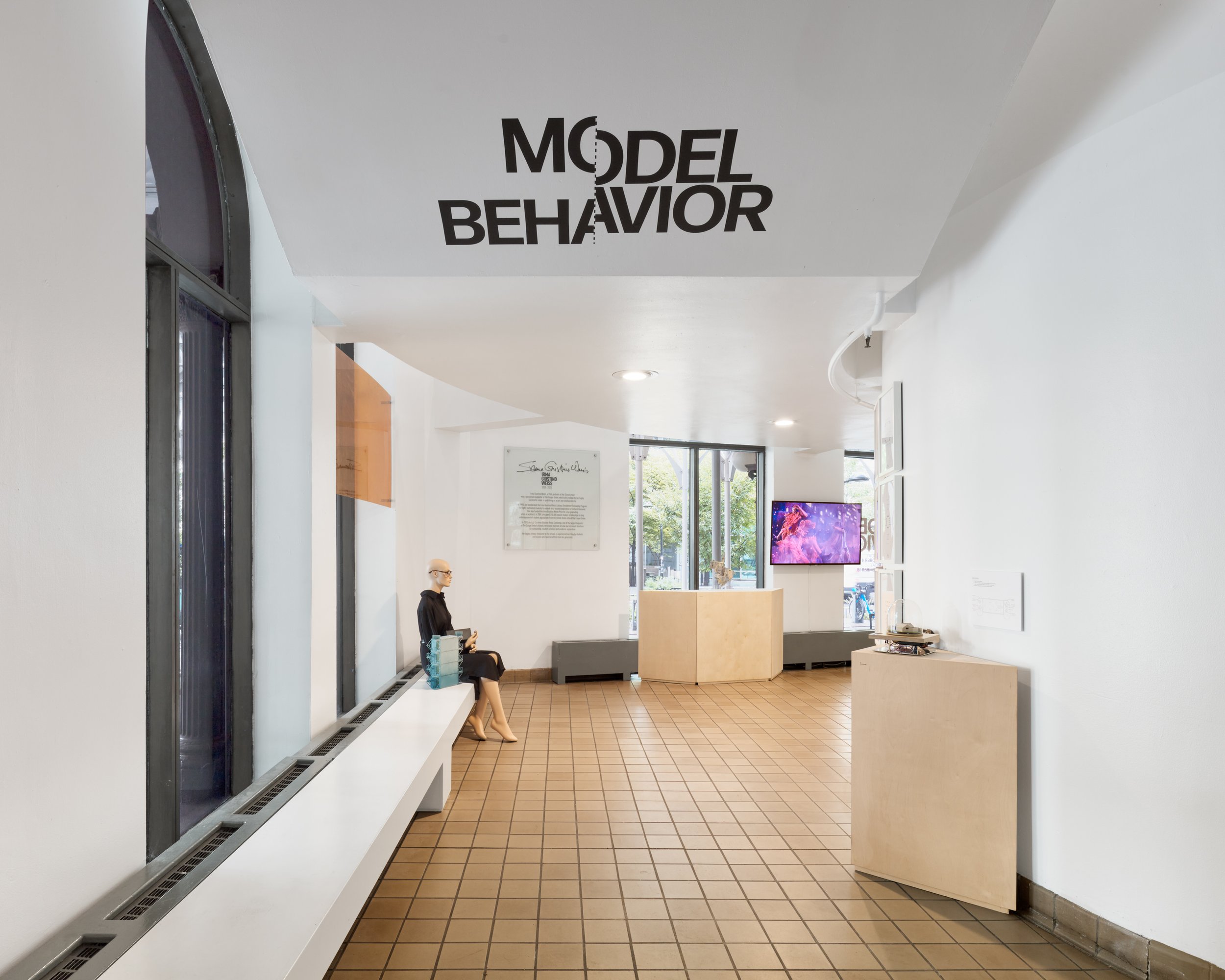
In 2022 Davidson curated an exhibition of the same name at Cooper Union, designed by New Affiliates, the practice of Ivi Diamantopoulou and Jaffer Kolb. It juxtaposed architectural models with objects from other fields, including film, fashion, and toys. Six installations were commissioned for the street-level colonnade. The later catalogue documented fifty-five exhibited works.74, 75
Log 56 became the catalogue, with photographs, project descriptions, essays, and Davidson’s epilogue, “The Aisle of Models.”76 A question first assembled in a journal had become an exhibition and then another publication. Her signed review of the CCA’s The Museum Is Not Enough supplies a companion concern: how can an architecture museum address social, environmental, and technological problems when so much of what it exhibits consists of representations of buildings? The review asks what an institution’s formats can adequately show, without assuming its cultural standing supplies the answer.77
The image could not be loaded. View the original using the source link below.
The continuing books and the next editor
The books continued while Davidson edited and taught. Mario Carpo’s The Second Digital Turn (2017) examined computation’s changing role in design. Pier Vittorio Aureli’s Architecture and Abstraction (2023) examined abstraction through labor, land, geometry, and money. The series had continued to follow changes in computation and the politics of architectural work.78, 79 Eisenman’s Rewriting Alberti followed in 2025, with contributions by Aureli, Carpo, and Daniel Sherer: a longstanding collaborator returning to Renaissance architecture in the company of later voices on the list.80
Davidson received the American Academy of Arts and Letters’ Architecture Award in 2014.81 Recognition has not wholly displaced the habit of describing her work through Eisenman’s. In a 2026 Society of Architectural Historians conference abstract, Cathelijne Nuijsink reports Davidson’s frustration at being treated as though her husband controlled her choices. Nuijsink proposes to recover the editorial and organizational work behind the Any project. The published abstract sets out a project for reassessing her contribution.82
By Anyone’s founding, Davidson had already spent sixteen years making publications. The Chicago editorship, the international books, and the argument with Roche identify her own decisions within a career that also depended on Eisenman’s collaboration and support.
As of November 1, 2026, a transition is announced. Julie Cirelli, director of Park Books and a former editorial director at Harvard’s Graduate School of Design, is to take over Log with issue 69, the winter 2027 number. Davidson will remain executive director of Anyone and editor of Writing Architecture, and plans to give more time to her own writing and teaching.83
Her final issue as editor, Log 68, is being made with managing editor Winfred Ovur, who will stay with the journal. Titled Gardens, it completes a sequence she began with House and Home and Walls: how people live, what divides them, and how they care for the planet. Although designated fall 2026, it is scheduled to become available in early January 2027. The handover and publication are plans, not accomplished events at this profile’s revision date.84
For now, the last issue still requires editing. The next editor has been named, the managing editor is continuing, and the books remain Davidson’s responsibility. Her departure from one role is therefore also a concrete change in how the small organization will divide its work.
An accessible route into the work
- Start with the Cornell interview on “Writing the City” for Davidson speaking about reading and teaching.
- Compare the publisher’s account of Log 25 with Roche’s publicly posted issue PDF. The opening’s punctuation makes the editorial disagreement visible; the PDF does not include all the original front matter.
- Read Karatani’s “Thing as Other” beside the CCA’s account of Anyone.
- For Detroit, read the curators’ interview, Detroit Resists’ critique, and McEwen’s interview. Each addresses a different part of the dispute.
- Try Davidson’s review of The Museum Is Not Enough for a short example of her signed criticism.
Research note
This account is strongest on adult formation, editorial projects, institutions, and publicly stated methods. It does not infer childhood, household finances, daily routines, or private motives. The Roche episode is supported by Davidson’s retrospective interview and the published writing; it is not a reconstruction from marked-up manuscripts. Archive finding aids identify records but do not substitute for reading their contents. Book descriptions establish credits and subjects, not full-text critical assessments. The SCI-Arc lecture is used through its institutional synopsis, and the Khōrein interview through published excerpts. Financial data is dated, and the announced 2027 handover remains prospective.
Sources and notes
“Inland Architect Editor Named,” Focus, Chicago Chapter, American Institute of Architects, June 1983, p. 5. Contemporary source for education, early employment, and her initial production priorities at Inland Architect. The name appears as Cynthia Davidson-Powers.↩︎
Anyone Corporation, “About Any Publications”. Primary organizational chronology for the ten conferences and ANY magazine. Issue numbers should not be confused with the number of physical issues, because the run includes combined and specially numbered issues.↩︎
SCI-Arc, “Cynthia Davidson: Image/Word: A Critical Context”, October 15, 2013. The institutional synopsis, rather than an independently transcribed recording, is the source used.↩︎
Cornell University College of Architecture, Art, and Planning, “Cynthia Davidson”, faculty biography rechecked November 1, 2026. Source for current roles, the forty-plus-book and twenty-eight-volume counts, and the 2014 award.↩︎
Cynthia Davidson, interview dated February 24, 2014, New York City, in François Roche / New-Territories’ public collected texts and interviews, PDF pp. 403–405. The first-person account describes their meeting, the dispute over ellipses, and her disclaimer. No marked-up manuscript was available.↩︎
“Inland Architect Editor Named,” Focus, Chicago Chapter, American Institute of Architects, June 1983, p. 5. Contemporary source for education, early employment, and her initial production priorities at Inland Architect. The name appears as Cynthia Davidson-Powers.↩︎
John Coplans Trust, “Biography”; Getty Union List of Artist Names, John Coplans. These sources establish his editorial and institutional background; they do not establish a comprehensive account of his influence on Davidson.↩︎
“Inland Architect Editor Named,” Focus, Chicago Chapter, American Institute of Architects, June 1983, p. 5. Contemporary source for education, early employment, and her initial production priorities at Inland Architect. The name appears as Cynthia Davidson-Powers.↩︎
Elizabeth Blasius, “The Highs and Lows of Inland Architect,” MAS Context, 2026. A history drawing on interviews and the magazine’s institutional circumstances, including Davidson’s recollections.↩︎
Elizabeth Blasius, “The Highs and Lows of Inland Architect,” MAS Context, 2026. A history drawing on interviews and the magazine’s institutional circumstances, including Davidson’s recollections.↩︎
Loeb Fellowship Alumni Association, “Classes”, class of 1989; Harvard Graduate School of Design, Loeb Fellowship Alumni Directory, 2022. Read alongside Blasius for the leave from Inland Architect.↩︎
Elizabeth Blasius, “The Highs and Lows of Inland Architect,” MAS Context, 2026. A history drawing on interviews and the magazine’s institutional circumstances, including Davidson’s recollections.↩︎
Frederike Lausch, Gilles Deleuze und die Anyone Corporation, 2021, especially the organizational history around p. 50. Consulted for the founding milieu and the Davidson–Eisenman relationship, rather than used as evidence of every participant’s intellectual position.↩︎
Canadian Centre for Architecture, “Anyone Corporation fonds”. The institutional history and scope notes distinguish the conferences, their publications, ANY, and the Writing Architecture series.↩︎
Frederike Lausch, Gilles Deleuze und die Anyone Corporation, 2021, especially the organizational history around p. 50. Consulted for the founding milieu and the Davidson–Eisenman relationship, rather than used as evidence of every participant’s intellectual position.↩︎
Frederike Lausch, “Direktflug oder von Frankreich über die USA nach Deutschland? Französischer Poststrukturalismus in ANY und ARCH+,” Dokumente der Architektur. Source for financing relationships and a critical account of theoretical transfer.↩︎
Anyone Corporation, “About Any Publications”. Primary organizational chronology for the ten conferences and ANY magazine. Issue numbers should not be confused with the number of physical issues, because the run includes combined and specially numbered issues.↩︎
Centre de Cultura Contemporània de Barcelona, “Anyway”, June 4–6, 1993. Local institutional record of the Barcelona conference.↩︎
Canadian Centre for Architecture, “Anyone Corporation fonds”. The institutional history and scope notes distinguish the conferences, their publications, ANY, and the Writing Architecture series.↩︎
Giovanna Borasi, “Another Way of Building Architecture,” Canadian Centre for Architecture. An interpretation of Anyone as an alternative institutional form of architectural practice.↩︎
Canadian Centre for Architecture, “Anyone journal texts and transcripts”. The catalogue describes Lavin’s letter; the underlying letter was not inspected.↩︎
Anyone Corporation, “About Any Publications”. Primary organizational chronology for the ten conferences and ANY magazine. Issue numbers should not be confused with the number of physical issues, because the run includes combined and specially numbered issues.↩︎
Canadian Centre for Architecture, “Anyone Corporation fonds”. The institutional history and scope notes distinguish the conferences, their publications, ANY, and the Writing Architecture series.↩︎
Kazys Varnelis, “Not the Last Word”, review of Sanford Kwinter’s Far from Equilibrium, edited by Cynthia Davidson, Actar, 2008; also in Cite, summer 2008. Source for the relation between the column, magazine design, and later book.↩︎
Frederike Lausch, “The Staging of French Theory in ANY: The Anyone Corporation’s Magazine from 1993 to 2000,” Critical Architecture, 2020. Lecture abstract describing the magazine’s position and visual-intellectual program.↩︎
Bernard Cache, Earth Moves: The Furnishing of Territories, translated by Anne Boyman, edited by Michael Speaks with Cynthia Davidson, MIT Press, 1995. Publisher record and description.↩︎
Kojin Karatani, Architecture as Metaphor: Language, Number, Money, translated by Sabu Kohso, edited by Michael Speaks with Cynthia Davidson, MIT Press, 1995. Publisher record; see also Karatani’s publication list.↩︎
Ignasi de Solà-Morales, Differences: Topographies of Contemporary Architecture, edited by Sarah Whiting, translated by Graham Thompson, MIT Press; linked paperback edition, 1997. Bibliographic credits are also recorded in the arq review.↩︎
John Hejduk, Such Places as Memory: Poems 1953–1996, foreword by David Shapiro, MIT Press; linked paperback edition, 1998. The profile treats its inclusion as evidence of the series’ scope, without claiming a close reading of the poems.↩︎
Cynthia C. Davidson and Ismail Serageldin, eds., Architecture Beyond Architecture: Creativity and Social Transformations in Islamic Cultures, Academy Editions for the Aga Khan Award for Architecture, 1995. See also the official AKDN publication preview.↩︎
Cynthia C. Davidson, ed., Legacies for the Future: Contemporary Architecture in Islamic Societies, Thames & Hudson, 1998; AKDN publication record. The official preview documents the editor and selected projects.↩︎
Aga Khan Development Network, “Aga Khan Award for Architecture”. Used for the award’s remit and institutional procedure, rather than as an independent evaluation of awarded projects.↩︎
Kojin Karatani, “Thing as Other”, June 2000. A participant’s critical assessment of the Any conferences, published on his own website. Its judgments are attributed to him.↩︎
Kojin Karatani, “Thing as Other”, June 2000. A participant’s critical assessment of the Any conferences, published on his own website. Its judgments are attributed to him.↩︎
Frederike Lausch, “Direktflug oder von Frankreich über die USA nach Deutschland? Französischer Poststrukturalismus in ANY und ARCH+,” Dokumente der Architektur. Source for financing relationships and a critical account of theoretical transfer.↩︎
SCI-Arc, “Cynthia Davidson: Image/Word: A Critical Context”, October 15, 2013. The institutional synopsis, rather than an independently transcribed recording, is the source used.↩︎
Princeton Humanities Council, “The Conversation Pit: 20 Years of Log”, March 28, 2024. The event description records the September 2003 launch.↩︎
SCI-Arc, “Cynthia Davidson: Image/Word: A Critical Context”, October 15, 2013. The institutional synopsis, rather than an independently transcribed recording, is the source used.↩︎
Log 1, fall 2003, table of contents. Contents and credits, not a claim to have read the complete issue.↩︎
Anyone Corporation, “About Log”. Primary account of the journal’s orientation, publishing rhythm, and mix of open and thematic issues.↩︎
Anyone Corporation, “Submissions”, rechecked November 1, 2026. Source for forms, length, editorial requirements, image credits, and honoraria. Current issue-specific deadlines are not used as historical evidence.↩︎
Cynthia Davidson, interview dated February 24, 2014, New York City, in François Roche / New-Territories’ public collected texts and interviews, PDF pp. 403–405. The first-person account describes their meeting, the dispute over ellipses, and her disclaimer. No marked-up manuscript was available.↩︎
Anyone Corporation, Log 25: Resistance, summer 2012. Primary record for guest editor, date, title and contents.↩︎
François Roche, “Reclaim Resi[lience]stance //……R²,” Log 25, summer 2012, opening pages; issue PDF posted by New-Territories. The opening was read in text and visually checked. This posted copy omits some front matter; the statement about Davidson’s disclaimer rests on her 2014 interview, not an assertion that its original printed page was inspected.↩︎
Cynthia Davidson, interview dated February 24, 2014, New York City, in François Roche / New-Territories’ public collected texts and interviews, PDF pp. 403–405. The first-person account describes their meeting, the dispute over ellipses, and her disclaimer. No marked-up manuscript was available.↩︎
François Roche, “Reclaim Resi[lience]stance //……R²,” Log 25, summer 2012, opening pages; issue PDF posted by New-Territories. The opening was read in text and visually checked. This posted copy omits some front matter; the statement about Davidson’s disclaimer rests on her 2014 interview, not an assertion that its original printed page was inspected.↩︎
Anyone Corporation, Log 25: Resistance, summer 2012. Primary record for guest editor, date, title and contents.↩︎
François Roche, “Reclaim Resi[lience]stance //……R²,” Log 25, summer 2012, opening pages; issue PDF posted by New-Territories. The opening was read in text and visually checked. This posted copy omits some front matter; the statement about Davidson’s disclaimer rests on her 2014 interview, not an assertion that its original printed page was inspected.↩︎
Cynthia Davidson, interview dated February 24, 2014, New York City, in François Roche / New-Territories’ public collected texts and interviews, PDF pp. 403–405. The first-person account describes their meeting, the dispute over ellipses, and her disclaimer. No marked-up manuscript was available.↩︎
Anyone Corporation, “Submissions”, rechecked November 1, 2026. Source for forms, length, editorial requirements, image credits, and honoraria. Current issue-specific deadlines are not used as historical evidence.↩︎
Cornell AAP NYC, “Writing the City: Interview with Cynthia Davidson”, May 7, 2020. Primary interview on reading, editing, and teaching.↩︎
Petar Bojanić, Snežana Vesnić, Marko Ristić, and Manuel Orazi, interview with Cynthia Davidson, Khōrein 1, no. 2 (2023), pp. 89–97; discussed and excerpted in Jaehee Shin, “On Writing in, on, and for Architecture,” Women Writing Architecture, February 11, 2026. See the original interview’s bibliographic record. The full interview was not available for this profile.↩︎
Cornell University College of Architecture, Art, and Planning, “Cynthia Davidson”, faculty biography rechecked November 1, 2026. Source for current roles, the forty-plus-book and twenty-eight-volume counts, and the 2014 award.↩︎
Anyone Corporation, Log 47, Overcoming Carbon Form, fall 2019, guest editor Elisa Iturbe. Issue description and contents.↩︎
Anyone Corporation, Log 48, Expanding Modes of Practice, winter/spring 2020, guest editor Bryony Roberts. Issue description and contents.↩︎
Anyone Corporation, Log 57, Black Is … an’ Black Ain’t …, winter/spring 2023, guest editor Darell Wayne Fields; Fields’s account of the issue.↩︎
Melis Uğurlu, essay on the editor salary debate, October 19, 2025. The publicly accessible portion contains the recollection of the 2017 interview; it is used as an attributed personal account.↩︎
ProPublica Nonprofit Explorer, Anyone Corporation, EIN 13-3599589, extracted Form 990 data for the fiscal year ending September 2024, filed June 20, 2025, rechecked November 1, 2026; the same page supplies the 2023 comparison. Amounts describe Anyone Corporation, not Log alone or Davidson’s private finances.↩︎
ProPublica Nonprofit Explorer, Anyone Corporation, EIN 13-3599589, extracted Form 990 data for the fiscal year ending September 2024, filed June 20, 2025, rechecked November 1, 2026; the same page supplies the 2023 comparison. Amounts describe Anyone Corporation, not Log alone or Davidson’s private finances.↩︎
Anyone Corporation, “Submissions”, rechecked November 1, 2026. Source for forms, length, editorial requirements, image credits, and honoraria. Current issue-specific deadlines are not used as historical evidence.↩︎
Anyone Corporation, Log subscriptions, rechecked November 1, 2026. The starting price varies by subscription choice; the page describes present fulfillment from the printer.↩︎
Anyone Corporation, Log 2026 advertising kit, pp. 3–4, retrieved November 1, 2026. Primary publisher claims for print run, geographical reach, institutional holdings, and advertised rates; not independently audited circulation or evidence of actual advertising revenue.↩︎
Anyone Corporation, “About Anyone Corporation”, rechecked November 1, 2026. Primary source for current staff, board, and named benefactors.↩︎
Nicholas Korody, “Previewing the 2016 Venice Biennale: The United States’ ‘Architectural Imagination,’” Archinect, May 17, 2016. Interview with Davidson and Monica Ponce de Leon; their claims about consultation are treated as their account.↩︎
Wes Hiatt and Luke Studebaker, “The Imaginary and the Critical: A Conversation with Cynthia Davidson,” Paprika!, December 1, 2016.↩︎
Nicholas Korody, “Previewing the 2016 Venice Biennale: The United States’ ‘Architectural Imagination,’” Archinect, May 17, 2016. Interview with Davidson and Monica Ponce de Leon; their claims about consultation are treated as their account.↩︎
Detroit Resists, “Let’s Get Serious: ‘Community’ and ‘Activism’ in the Architectural Imagination”, September 22, 2016, republishing an earlier commentary. Primary source for the group’s critique, not a neutral account of every participant.↩︎
Wes Hiatt and Luke Studebaker, “The Imaginary and the Critical: A Conversation with Cynthia Davidson,” Paprika!, December 1, 2016.↩︎
Leah Wulfman, “Designing for Hungers That Are Already There: A Discussion with Mitch McEwen,” Point Line Projects, August 2, 2017. Primary interview offering a distinct participant’s criticism of both architectural autonomy and the exhibition’s reception.↩︎
Anyone Corporation, “Anyspace”. Primary explanation of the initiative’s changing venues and exhibition remit.↩︎
Anyone Corporation, Anyspace exhibitions, entries for This Future Has a Past (2017) and Drawings’ Conclusions (2018). Used for dates, contents, and collaborative credits; historical statements about the later fate of Ain’s house are not carried forward as current facts.↩︎
Anyone Corporation, Anyspace exhibitions, entries for This Future Has a Past (2017) and Drawings’ Conclusions (2018). Used for dates, contents, and collaborative credits; historical statements about the later fate of Ain’s house are not carried forward as current facts.↩︎
Anyone Corporation, Log 50, Model Behavior, fall 2020. Issue description and contents.↩︎
Cooper Union, “New Exhibition Questions the Impact of Architectural Models on Behavior”, 2022. Exhibition announcement with curatorial and design credits. Its advance count (more than seventy works and objects by forty-five contributors) differs in framing from the later catalogue’s fifty-five exhibited works; the latter is used in the body.↩︎
Anyone Corporation, “Log 56: The Model Behavior Exhibition,” e-flux announcement, February 23, 2023. Its count of fifty-five exhibited works is distinguished from the host’s advance count of works and objects.↩︎
Log 56, fall 2022, JSTOR issue record. Used for the catalogue’s contents and Davidson’s epilogue title, not as evidence of full-text reading of all essays.↩︎
Cynthia Davidson, review of The Museum Is Not Enough, Architectural Record, February 2020. A signed critical text, distinct from institutional summaries of her work.↩︎
Mario Carpo, The Second Digital Turn: Design Beyond Intelligence, MIT Press, 2017; Anyone Corporation, Writing Architecture past releases.↩︎
Pier Vittorio Aureli, Architecture and Abstraction, MIT Press, 2023. The thematic account follows the publisher’s description.↩︎
Peter Eisenman, Rewriting Alberti, MIT Press, 2025; Anyone Corporation, past releases. Source for bibliographic identity and contributors.↩︎
Cornell University College of Architecture, Art, and Planning, “Cynthia Davidson”, faculty biography rechecked November 1, 2026. Source for current roles, the forty-plus-book and twenty-eight-volume counts, and the 2014 award.↩︎
Cathelijne Nuijsink, “The Slow Space of Her Page: Cynthia Davidson’s Editorial Pedagogies,” in Society of Architectural Historians, 79th Annual International Conference: Book of Abstracts, 2026, p. 135. A conference abstract reporting research and interviews; distinguished here from a completed published monograph or article.↩︎
Anyone Corporation, “Log Names New Editor”, retrieved November 1, 2026. Primary announcement specifies Cirelli’s first issue as Log 69, winter 2027, Davidson’s continuing roles, Ovur’s continued managing editorship, and the early-January 2027 availability of Gardens. Corroborated by Architectural Record, “Cynthia Davidson Logs Off the Theory Journal ‘Log’”. These are announced arrangements, not a completed handover.↩︎
Anyone Corporation, “Log Names New Editor”, retrieved November 1, 2026. Primary announcement specifies Cirelli’s first issue as Log 69, winter 2027, Davidson’s continuing roles, Ovur’s continued managing editorship, and the early-January 2027 availability of Gardens. Corroborated by Architectural Record, “Cynthia Davidson Logs Off the Theory Journal ‘Log’”. These are announced arrangements, not a completed handover.↩︎