From network engineering and Khan Academy to a livelihood in hands-on education
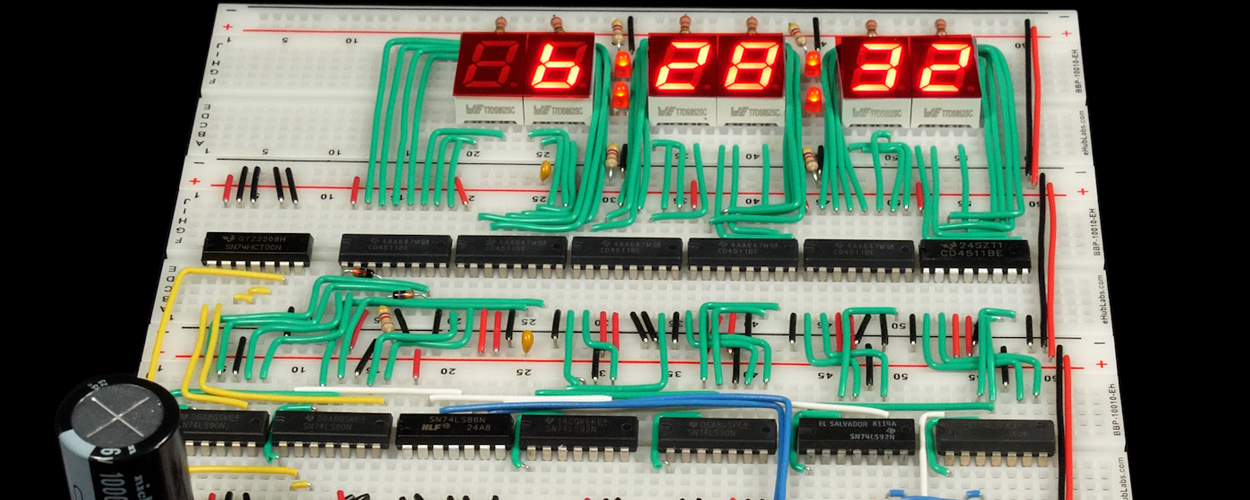
Ben Eater is a software engineer and independent educator whose best-known lessons turn the inside of a computer into something a viewer can build. Chips, wires and lights spread across solderless breadboards become a working eight-bit processor, or CPU; alongside the videos, he publishes schematics, code and parts lists. He also makes interactive mathematical explanations and sells hardware kits for learners who want to follow the construction themselves.1
Before this, Eater worked in networking and ran a technical business, then developed mathematics exercises and managed engineering at Khan Academy. He had studied computer science but left college without a degree. That difficult educational experience became one reason for his interest in teaching.2
1. Technical curiosity and an uneven education
As a child, Eater bought components at RadioShack and experimented with electronics. In high school he made hardware that connected to a PC, including parallel-port projects and an expansion card for an older PC bus. Building a computer from logic gates remained an idea he hoped to pursue.3
School presented a different experience. In his 2013 NCWIT talk, he recalled remedial mathematics placement, reaching college without calculus, and repeated failure in calculus courses. A high-school speech-recognition project had already brought him into signal processing, but that practical interest did not make the classroom material intelligible.4
He subsequently found work at an Internet service provider and a large networking-equipment manufacturer. He credited the dot-com period with making technical employment accessible without a degree.5
Eater’s network-security work included a patent with Robert F. Jaeger, filed in 2002 and assigned to Juniper Networks. Their method concerned identifying the source of network attacks; the patent was issued in 2012. His technical work was entering a company’s intellectual-property system as well as the practical world of operating networks.6
He later started a business making network-analysis equipment. When customers struggled to understand its benefits, he looked for a better explanation of Poisson processes, a statistical model, and found Khan Academy’s mathematics videos.7 The device had to work, and buyers had to understand its use.8
The experience also changed his view of his own education. Eater describes the failure to diagnose missing prerequisites as a reason for wanting to improve the system.9

The image could not be loaded. View the original using the source link below.
2. Becoming an educator inside Khan Academy
Eater began volunteering for Khan Academy in fall 2011, making exercises while continuing his networking business. Over the following months, an activity undertaken in spare time became a competing commitment. After about six months of contributions, he moved across the country to join the organization full time.10
He recalled initially rejecting job offers, including one from Sal Khan. A flexible contract let him contribute without immediately giving up his business. He became increasingly absorbed in the exercises; friends who remembered his college difficulties helped validate the eventual decision to leave a reasonably successful company for a nonprofit.11
He developed more than a hundred interactive mathematics modules, then tools that let other educators create content, and later managed platform engineering.12 Software became a way to enable other people’s teaching as well as produce his own lessons.13
That expansion depended on a team. In January 2013, Khan Academy credited Eater alongside Marcia Lee, Stephanie Chang, Jason Rosoff, Matt Wahl, Elizabeth Slavitt, Sal Khan and others for reorganizing the site into short tutorials combining videos and practice exercises. A lesson now involved its place in a navigable learning environment: what a learner watched, what they tried afterward, and how those activities were connected.14
A partnership with Phillips Academy Andover makes his role more concrete. Mathematics chair Bill Scott, with colleagues Chris Odden and Matt Lisa, visited Khan Academy’s California headquarters after noticing gaps in its advanced calculus material. Eater built a tool that allowed Andover instructors to upload problems without mastering JavaScript. At the school, Lisa and Lisa Joseph coordinated assignments; Deb Olander and Mike McHugh gathered problems, and emeritus instructor David Penner checked their accuracy. The teachers’ subject knowledge and the engineer’s authoring tool had different jobs. Bringing them together enlarged the course without requiring every excellent teacher to become a programmer.15
This is a substantial change in his practice. His technical knowledge was no longer only the content being explained. It could remove an obstacle that kept someone else’s knowledge from reaching a learner. The Andover teachers supplied problems, hints and judgments about mathematical accuracy; Eater supplied part of the system through which those contributions could circulate.16
In April 2016, he announced Khan Academy’s revised engineering career-development guide. Khan Academy’s first career ladder had helped managers discuss hiring, pay and performance, but its compressed descriptions left engineers dependent on managers to explain how to advance. Eater described revising the guide so staff could understand their options and participate in planning their development. He connected that concern to student agency: good recommendations alone were insufficient if learners could not understand the path they were on. Management involved making the conditions of growth visible to the person expected to grow.17
The workplace also had a less formal culture of experimentation. In 2015, a wooden puzzle led Eater, John Sullivan and several colleagues to write competing solvers. Eater drew the shapes directly on screen and finished a brute-force implementation early; Sullivan and Emily Eisenberg used different representations and pruning to make their searches much faster. Jamie Wong, who had brought in the puzzle, challenged their conclusion that it was impossible. The episode gives a glimpse of colleagues comparing representations, costs and assumptions around a shared problem.18
Hardware remained present too. In a Khan Academy lesson with Karl Wendt, Eater demonstrated changes to Wendt’s Spider robot: circuit-board material replaced missing sticks, clips made batteries removable, and the changes made the small robot easier to maintain. Here he was a tester and modifier of another educator’s design. The interaction shows him improving another educator’s design through ordinary sourcing and maintenance problems.19
3. The computer that had to be built twice
The breadboard computer began with a long-standing ambition and a manageable model. Albert Paul Malvino’s Digital Computer Electronics described a small SAP-1, or Simple As Possible, architecture. Eater used it as the basis for a hackathon build, filming while he worked. The machine functioned, but his plan to turn the footage into one explanatory video did not. He started again, building a second machine for a component-by-component series over several years.20
The important failure was in the explanation. Having made something work did not mean he had made its construction understandable. Starting over allowed the learning sequence to become part of the build rather than a commentary added to the finished object.21
By April 2017, Hackaday was reporting roughly eight hours of lessons, with separate tests for the modules before they were joined. Al Williams regarded the machine as an impractical way to obtain computing power, while recognizing its value as a way to learn CPU architecture. The project was reaching a specialist audience that understood why its large physical footprint and slow operation could be useful.22
Eater imagined his fourteen-year-old self as the audience. Among his educational references, he named Seymour Papert’s Mindstorms and Carol Dweck’s Mindset.23 His learner was curious enough to keep asking why, but should not have to accept every block in a diagram on trust. Figuring something out could itself provide motivation to attempt the next problem.
Making the next question answerable
The introductory lessons move from semiconductors to transistors, logic gates, latches and flip-flops. A viewer can follow the assembly of the larger machine after first seeing how a switch or stored bit behaves. The course selects a system small enough to keep those relationships in view.24
Eater begins the computer’s construction with a 555-timer clock. It can run at an adjustable speed or advance manually with a button. Single-stepping is a teaching decision embodied in hardware: the learner can pause between operations and examine the machine’s state. The first module supplies both a required signal and a way of investigating everything built afterward.25
Storage and arithmetic then acquire concrete responsibilities. The A and B registers hold values, while the instruction register stores the current instruction. The register lessons explain controlled transfers over shared wires and tri-state outputs, which allow one device to drive the bus while others remain inactive.26 The arithmetic unit adds or subtracts A and B; binary addition and two’s-complement representation precede its construction. Design, wiring, troubleshooting and testing are distinct parts of the sequence.27
The basic machine has only sixteen bytes of random-access memory, or RAM, addressed with four bits. Program instructions and data occupy that same tiny space. The limit makes the connection between a stored byte and its use unusually easy to follow, while sharply restricting what can be programmed.28 The program-counter lessons add a temporal problem: binary counting depends on when storage elements change. Racing and master–slave flip-flops are introduced before the final counter is wired.29
These are successive demands on the teacher as well as the builder. A diagram of boxes would hide how a value is held, how a device is allowed to speak on the shared connection, and when the next operation begins. Eater gives each difficulty a local demonstration before asking the learner to keep it in mind as part of the whole.30, 31, 32
Decimal output requires another translation. Instead of leaving a binary result visible only on LEDs, Eater uses lookup data in rewritable memory chips, or EEPROMs, to drive seven-segment displays. Building the Arduino-based EEPROM programmer becomes a lesson of its own. The construction now includes a tool needed to prepare part of the computer, making the support work visible alongside the finished display.33
The bus is tested before control logic is added. Eater’s instructions emphasize checking modules individually so that the first encounter with the assembled system is not an undifferentiated failure.34 Control then coordinates the signals that make an instruction happen. Later lessons add microcode changes, flags and conditional jumps. The learner reaches programming through the operations the hardware must perform, rather than encountering machine code as an unexplained endpoint.35
Making a filmed process usable afterward
A video’s order also shapes Eater’s software archive. His EEPROM-programmer repository keeps separate Arduino sketches for particular lessons, accepting duplicated code so a viewer can find the version used on screen. The circuit uses shift registers to compensate for the Arduino’s limited pins. Code and schematic are MIT-licensed.36
He separately provides the complete computer’s schematics and a KiCad circuit-design project. Those files offer a compact reference after the filmed sequence has established what the connections mean.37 The course thus has more than one working form: demonstration, circuit diagram, source code and physical build. Their relationship matters most when something does not behave as expected. A learner can compare representations instead of replaying the entire course in search of one wire.

The image could not be loaded. View the original using the source link below.
4. A lesson becomes a material business
The video practice overlapped with his institutional career before it acquired its present independent form. In November 2016, he announced that Patreon charging would switch to a per-video basis. Support was being organized around releases rather than simply the passage of another month.38
Eater funds the videos primarily through community support on Patreon, supplemented by one-time donations, kit sales and affiliate commissions. He explains that recurring backing helps him plan future projects, while bulk component purchasing can make kits competitive with individually sourced parts. These mechanisms pay for different parts of the same practice: making public explanations, preparing constructions people can reproduce, and maintaining a route between them.39
The eight-bit machine is sold as four kits matching stages of the course, or as a bundle. The bundle includes the Arduino Nano and power supply used in the build; the learner still needs wire-working tools, and Eater recommends a multimeter. He provides alternatives to the minor soldering shown in some videos. Selling the course’s materials brings decisions about equipment and accessibility into the teaching arrangement.40
Component quality became part of his responsibility. He compares the internal contacts in boards of different quality and explains how poor grip creates unreliable connections. He now sells high-quality boards he has commissioned as well as recommending the BB830 from BusBoard Prototype Systems. This gives the shop a role beyond collecting familiar part numbers: it can address a material condition that determines whether a patient learner is able to make the lesson work.41
Availability changes the lesson too. The published design substitutes a 74LS107 for the increasingly hard-to-find 74LS76 while warning that the pinout differs. Eater also encourages people who cannot obtain a component to understand its function and find another way to implement it. A parts list is therefore a starting arrangement in an actual supply environment, rather than a guarantee that the recording and every future purchase will match.42
He warns builders to expect frustrating faults and directs them to Reddit, YouTube comments and the site’s discussions. Understanding is expected to come partly through diagnosis.43 That expectation has a practical limit. Order and shipping questions have a dedicated email route, while technical troubleshooting is directed toward the public community because Eater cannot answer each case individually.44
Kits ship from California, and international buyers face local taxes, import duties and sometimes collection fees. Meanwhile, the public videos can be used without buying a box from his shop.45 Digital circulation and material circulation have different barriers. A builder needs obtainable parts, tools and time. The business reduces some coordination work without removing those requirements.46
5. Returning to networks and working with other educators
Hardware teaching did not erase his earlier subject knowledge. His Internet sequence follows communication from a signal on a wire through encoding, framing, Ethernet, IP, address resolution, routing and TCP. Each layer addresses a problem that emerges as communication becomes more elaborate. A later lesson uses Facebook’s prolonged outage to examine how the system can fail. The network engineer’s old problem reappears here: reliable exchange depends on several forms of coordination, even when a user sees only that a message has arrived.47
After reaching the initial goals of the eight-bit project, Eater explicitly introduced error detection as an area he wanted to explore next. Parity, checksums, Hamming distance and cyclic redundancy checks connect mathematical reasoning with communication hardware. Some installments run close to an hour, including the hardware implementation of CRC calculation.48 His accompanying repository retains transmitter and receiver code at different stages, letting the learner distinguish a new experiment from a new explanation of the same apparatus.49
His independent educational world also included conversation with peers. Ben Stenhaug announced Ben, Ben and Blue in 2017, a podcast made with Eater and Grant Sanderson, the creator of 3Blue1Brown. Education and the work of making content were shared subjects.50 Sanderson had also worked at Khan Academy, producing mathematics material before concentrating on his own channel at the end of 2016.51 The connection puts Eater among educators who combine software and public explanation in different proportions.
In 2018, Eater and Sanderson collaborated on explorable quaternion lessons. Sanderson’s subject was a four-dimensional number system used to describe three-dimensional rotation; the presentation allowed a viewer to explore the geometry alongside the explanation.52 For Eater, it was an experiment in a new kind of educational media.53 A browser could perform part of the function played by wires and LEDs: give the learner something to manipulate and a result to inspect.
For Destin Sandlin’s Smarter Every Day, Eater built an OODA-loop simulation in which two aircraft repeatedly turn toward one another. Their speed and turning rate remain equal; the adjustable difference is how often they reconsider their heading. The limited model makes that particular variable examinable. Its assumptions are published with the demonstration, keeping the explanation connected to what the software actually does.54
The flocking simulation associated with Sandlin’s episode 234 changes the scale of the problem. Cohesion, separation and alignment rules produce collective behavior; sliders alter the rules and the range over which each simulated bird responds to neighbors. Eater invites further changes, such as predators or wind.55 He supplies reusable browser code under the MIT license, so someone can move from changing parameters to changing the model.56
These collaborations give the engineer another role in educational media. His software makes another creator’s explanation explorable. The artifact can contain distinct forms of expertise, without requiring one person to become equally authoritative in electronics, mathematics and animal behavior.57, 58

The image could not be loaded. View the original using the source link below.
6. In 2019 a different computer creates a longer course
On 30 August 2019, Eater introduced a 6502 series to Patreon supporters. A familiar introductory programming task, displaying “hello world,” would require constructing the hardware before writing its software. He proposed adding ROM, an LCD, RAM, a stack, buttons and interrupts. Kits were being prepared alongside the videos, but the public release would wait until he was confident about the design and component availability. Publication made hardware decisions difficult to undo for people following along.59
The new project moved the boundary of explanation. Instead of constructing the processor’s internal logic, he began with a manufactured CPU and its datasheet. The initial lesson exposed its pins, used single-step clocking and an Arduino Mega to reveal the fetch-and-execute cycle. The old architecture became a starting point for learning how a processor interacts with the hardware around it.60
That summer, he was also constructing a VGA video card, beginning with timing signals that would persuade a monitor to accept an input before a picture appeared.61 Its kit includes counters, logic, EEPROM and an oscillator, with components for connecting it to the 6502 machine. The monitor and EEPROM programmer are separate requirements.62 The deliberately modest “world’s worst video card” exposes the coordination hidden behind a familiar display connection.
The kit uses a W65C02 processor, a W65C22 interface chip, EEPROM, SRAM and an LCD. It excludes the EEPROM programmer and power supply, and its instructions are the videos rather than a separate printed manual.63 Western Design Center describes the W65C02S as a fully static eight-bit processor with a sixteen-bit address bus. A commercially supplied, documented implementation of the older architecture lets a builder work with ordinary obtainable components.64
Eater recommends the 6502 as a simpler hardware build with more room for extensions, while the eight-bit project goes deeper inside the CPU. He advises watching the videos before choosing.65 The projects offer different starting boundaries for what a learner wants to investigate.66
Scott Hanselman supplied an early account of what following the new course felt like. In December 2019, he described buying the kit for the convenience of assembled parts and spending four or five hours wiring and pausing for each hour of video. A wrong byte eventually led him to two crossed wires. Moving between signals, binary and hexadecimal made the mistake discoverable.67 The lesson’s apparent pace on screen was only one part of the learner’s time.

The image could not be loaded. View the original using the source link below.
7. Keeping the machine useful as the explanation moves into software
The 6502 base gave Eater somewhere to return. Keyboard lessons in 2021 followed the PS/2 interface through shift registers and clock conditioning. An everyday peripheral opened questions about what a received signal meant and when to sample it.68 A serial peripheral interface, or SPI, lesson used a BME280 environmental sensor to expose the exchange usually handled by a software library.69 Extending a working machine supplied new reasons to examine timing and communication, instead of requiring a new computer for every topic.
The serial-interface kit subsequently added a W65C51 ACIA, MAX232 line driver and connector. The USB-to-RS-232 adapter was a separate requirement.70 Connecting the breadboard computer to another machine opened the project to software input and output beyond its original buttons and small display.
Audience requests also shaped the teaching. In June 2023, Eater introduced a line-by-line explanation of Steve Wozniak’s WozMon, asking supporters to report issues before public release. He kept that explanation focused on the original monitor program and considered a shorter follow-up about adapting it to his own computer. The early audience participated in checking a lesson, while he retained responsibility for how much it should contain.71
By 2024, he was adapting Microsoft BASIC. He worked from an existing reconstruction led by Michael Steil, with contributions from Martin Hoffmann-Vetter and material from Bob Sander-Cederlof’s AppleSoft II disassembly. That project brought several historical machine-specific versions into one source tree. Eater’s task was to make the inherited interpreter work with his own hardware. He kept code versions for the successive lessons on buffering, flow control, modification and reverse engineering, so a learner could follow each stage of the adaptation.72
The practical goal of running BASIC then generated another problem: communicating with the attached LCD. He moved from basic output to an added LCDPRINT command and then into string parsing and expression evaluation. A useful extension required understanding more of the interpreter’s internal organization; by April 2025 the completed lessons were receiving specialist coverage.73 What began as connecting chips had become an investigation of how a language turns input into operations.
Sound extended that connection in another direction. He used a W65C22 timer to generate a waveform, an LM386 amplifier to drive a speaker, and an added BEEP command in BASIC. Eater measured the signal with an oscilloscope and finished with a program that played a tune.74 A language command, a hardware timer and an audible result now belonged to one chain the learner could inspect.
This gives the independent practice a distinctive duration. A finished computer does not end the teaching. Once its basic behavior is understood, peripherals and inherited programs provide further work. The architecture is modest enough to remain manageable while supporting an explanation that can move across several levels.75, 76
8. What other people make of the lessons
Other builders become authors of modifications and explanations. Mike Sutton published an adaptation of Eater’s EEPROM programmer in 2020 to handle larger devices and software data protection. He described changing control connections, adding decoupling capacitors after instability, and publishing code and schematics. His account also acknowledges limited testing and uncertainty about a chip’s provenance.77 Such reports add practical knowledge without making every builder’s circuit interchangeable with Eater’s original.
Troy Schrapel, based in South Australia, dates his Eater-inspired breadboard computer to 2019 and subsequently developed an emulator.78 In April 2020, Hackaday reported on his character-display Snake game, browser emulator and Wi-Fi program loading.79 The original teaching machine had become a platform for a named maker’s games and tools in another country.
In August 2022, Kiran Tomlinson, then a Cornell computer-science doctoral student, described buying the 6502 kit and revising the memory map, board layout and display interface. He wanted a machine with his own architecture and accepted more complex address decoding to get it.80 An experienced learner could use the simple starting design to understand the consequences of departure from it.
The lessons also became material for an institutional project in France. UniLaSalle Amiens’s makerspace supports fabrication within its engineering campus.81 A 2023 assignment, supervised by Pierre Douay, named Cyril Audinelle, William Mbongue and Hector Fontaine as students proposing to reconstruct Eater’s eight-bit computer on PCBs as a teaching platform. Component availability was already a reason to change the design.82
These users do different work. Hanselman followed the construction and diagnosed a wiring error. Sutton adapted a tool, Schrapel developed an alternative way to run programs, Tomlinson revised an architecture, and students in Amiens proposed a new physical implementation. The public files allow these departures, while the departures produce explanations that no longer belong to Eater alone.83, 84, 85, 86
9. In 2025 and 2026 the work reaches other systems
In 2026, a new digital-clock sequence moved from building the clock in March to shaping a square wave, dividing a signal, building minutes and seconds, and setting the time by July.87 The kit offers twelve- or twenty-four-hour display and timing derived from fifty- or sixty-hertz AC, with regional adapter choices.88
The construction uses a low-voltage AC adapter and comparator, with hysteresis to clean glitches observed on an oscilloscope.89 This familiar household function gives Eater another setting in which a usable result depends on understanding an imperfect physical signal. Here, an oscilloscope makes events visible that occur too quickly for the learner to watch directly.
Flying remains another part of his life. He lists pilot and flight-instructor qualifications.90 A September 2025 lesson announcement on how aircraft systems communicate brought an aviation subject into the public teaching repertoire.91 The topic brings his flying interest and communications knowledge into the same teaching project.
Software has also continued to make educational collaboration possible. Sanderson identifies Eater as the builder of Criblate, a service through which communities can review, edit and contribute video subtitles.92 Its own site credits Eater and 3Blue1Brown and describes a workflow of reviewing machine translations, submitting corrections and obtaining a creator’s approval before publication to YouTube.93
This is another kind of educational infrastructure. The problem is no longer how to show a CPU operating, but how to let someone else’s explanation remain understandable across languages. Translators supply judgments about idiom and tone; the creator retains approval over what becomes an official subtitle. Eater’s software organizes that relationship.94
The image could not be loaded. View the original using the source link below.
10. What holds the career together
In his 2016 management essay, Eater argued that engineers needed to understand their career options and participate in deciding how to develop. The later teaching practice gives learners a related responsibility: the parts and explanations are supplied, but diagnosis and revision become their own work. Guidance acquires value when the person receiving it can begin to make decisions.95, 96
The independent arrangement retains constraints. Eater directs topic suggestions to a shared Reddit thread because high-quality videos take time and he cannot pursue every request. Ben, Ben and Blue is on indefinite hiatus.97 A channel, a store and a collection of software projects offer considerable control over what he makes, while also concentrating decisions about publication and support around limited attention.
Community backing is not identical to institutional employment. His public funding model has tied payment to new videos, and the shop supplies materials for lessons people can watch freely. Patreon announced a mandatory transition away from legacy billing models by November 2026, illustrating that a creator’s funding arrangement also depends on a platform’s rules.98 The relationship between patient production and predictable support has to be maintained within those conditions.
Across these changes, the work has kept one practical demand. Eater has learned to make more than a convincing demonstration: he makes conditions under which someone else can investigate it. A slow clock, a separately tested module, a matching code version and a reliable contact each remove a different obstacle. The vocation joins engineering and teaching through those specific arrangements, and remains most persuasive where the learner gains enough understanding to change what they have been shown.99, 100, 101, 102
Notes and sources
Sources checked through 5 October 2026. Undated project pages describe the published resources; dated announcements establish the chronology where available.
Ben Eater, project catalog, including the quaternion partnership. The introductory description combines the public projects and linked shop.↩︎
Ben Eater, About. Retrospective self-report. Its “previous seven years” does not establish an exact Khan Academy departure date; the college duration differs from his 2013 account.↩︎
Chris Gammell with Ben Eater, The Amp Hour 444, 27 May 2019. Publisher transcript; autobiographical recollections.↩︎
Ben Eater, Educational Disruptions, NCWIT Summit, 2013, publisher transcript. Educational history and recruitment account are retrospective.↩︎
Ben Eater, Educational Disruptions, NCWIT Summit, 2013, publisher transcript. Educational history and recruitment account are retrospective.↩︎
Benjamin C. Eater and Robert F. Jaeger, US Patent 8,281,400 B1, filed 5 September 2002, issued 2 October 2012. The record does not supply his job title or full tenure.↩︎
Ben Eater, Educational Disruptions, NCWIT Summit, 2013, publisher transcript. Educational history and recruitment account are retrospective.↩︎
Ben Eater, Educational Disruptions, NCWIT Summit, 2013, publisher transcript. Educational history and recruitment account are retrospective.↩︎
Ben Eater, About. Retrospective self-report. Its “previous seven years” does not establish an exact Khan Academy departure date; the college duration differs from his 2013 account.↩︎
NCWIT, historical speaker biography. Fall 2011 marks volunteer involvement; the six-month interval is this institutional account’s wording.↩︎
Ben Eater, Educational Disruptions, NCWIT Summit, 2013, publisher transcript. Educational history and recruitment account are retrospective.↩︎
Ben Eater, About. Retrospective self-report. Its “previous seven years” does not establish an exact Khan Academy departure date; the college duration differs from his 2013 account.↩︎
Ben Eater, About. Retrospective self-report. Its “previous seven years” does not establish an exact Khan Academy departure date; the college duration differs from his 2013 account.↩︎
Khan Academy, Khan Academy Tutorials, 11 January 2013. The displayed 2025 date reflects a later site update.↩︎
Phillips Academy, Khan Academy and Phillips Academy break ground with innovative partnership, 11 October 2013, despite the 2018 URL directory.↩︎
Phillips Academy, Khan Academy and Phillips Academy break ground with innovative partnership, 11 October 2013, despite the 2018 URL directory.↩︎
Ben Eater, Engineering career development at Khan Academy, 11 April 2016. His account of management practice, not an independent evaluation.↩︎
John Sullivan, How wooden puzzles can destroy dev teams, 6 July 2015. A coworker’s account of a particular experiment.↩︎
Karl Wendt with Ben Eater, Ben Eater’s Spider, publisher transcript. The available record does not securely date the demonstration.↩︎
Chris Gammell with Ben Eater, The Amp Hour 444, 27 May 2019. Publisher transcript; autobiographical recollections.↩︎
Al Williams, 8-Bit Breadboard Computer Is Up To 8 Hours, Hackaday, 10 April 2017.↩︎
Al Williams, 8-Bit Breadboard Computer Is Up To 8 Hours, Hackaday, 10 April 2017.↩︎
Chris Gammell with Ben Eater, The Amp Hour 444, 27 May 2019. Publisher transcript; autobiographical recollections.↩︎
Ben Eater, eight-bit course overview. Introductory curriculum and demonstration index.↩︎
Ben Eater, clock module. Adjustable operation, manual stepping and 555-timer lessons.↩︎
Ben Eater, register lessons. Storage, transfers and tri-state sequence.↩︎
Ben Eater, arithmetic logic unit. Theory, construction and separate tests.↩︎
Ben Eater, RAM module. The sixteen-byte limit describes this basic teaching architecture.↩︎
Ben Eater, program counter. Counting and flip-flop timing sequence.↩︎
Ben Eater, register lessons. Storage, transfers and tri-state sequence.↩︎
Ben Eater, arithmetic logic unit. Theory, construction and separate tests.↩︎
Ben Eater, program counter. Counting and flip-flop timing sequence.↩︎
Ben Eater, output register. Display decoding and EEPROM-programmer lessons.↩︎
Ben Eater, Bringing it all together. Modular testing and bus integration.↩︎
Ben Eater, CPU control logic. Instruction coordination, microcode, flags and jumps.↩︎
Ben Eater, EEPROM-programmer repository, README copyright 2017. Separate lesson versions and MIT-licensed code/schematic.↩︎
Ben Eater, schematics and KiCad project. Companion reference files.↩︎
Ben Eater, Patreon post archive. Confirms the 24 November 2016 funding-announcement title and 2026 clock-post dates; the 2016 post’s full text was unavailable in this pass.↩︎
Ben Eater, Support my work. Public description of funding, donations, bulk purchasing and affiliate payments; no audited income, margins or staffing data.↩︎
Ben Eater, eight-bit kits. Packaging, equipment, construction alternatives and distinct order/technical support routes.↩︎
Ben Eater, My thoughts on breadboards. Contact comparison and commissioned-board description; listed prices are not used here as current quotations.↩︎
Ben Eater, parts list. Substitution and sourcing guidance; undated cost estimates are omitted.↩︎
Ben Eater, Start here. Builder introduction and public help routes.↩︎
Ben Eater, eight-bit kits. Packaging, equipment, construction alternatives and distinct order/technical support routes.↩︎
Ben Eater, FAQ. Project choices, shipping, limited attention and podcast hiatus; these do not establish his exact residence.↩︎
Ben Eater, eight-bit kits. Packaging, equipment, construction alternatives and distinct order/technical support routes.↩︎
Ben Eater, Internet series. The connection to his prior occupation is interpretation based on subject continuity.↩︎
Ben Eater, error-detection series. His stated next direction and published lesson sequence.↩︎
Ben Eater, error-detection repository, README copyright 2018–2019. Preserved experimental stages and MIT license.↩︎
Ben Stenhaug, Ben, Ben, and Blue, 1 August 2017. First-person podcast announcement; it does not date Eater’s departure from Khan Academy.↩︎
Grant Sanderson, About 3Blue1Brown. Sanderson’s own career chronology and attribution of Criblate to Eater.↩︎
Grant Sanderson, Quaternions and 3d rotation explained interactively, 26 October 2018. The available record does not completely apportion programming, visual design and mathematical authorship.↩︎
Ben Eater, project catalog, including the quaternion partnership. The introductory description combines the public projects and linked shop.↩︎
Ben Eater, OODA-loop demonstration, associated with Smarter Every Day 212. A deliberately simplified simulation, not empirical evidence of real combat or media outcomes.↩︎
Ben Eater, boids demonstration, associated with Smarter Every Day 234. Controls, rules and proposed extensions.↩︎
Ben Eater, boids repository, copyright 2020. Its MIT license is not a blanket license for all Eater videos and products.↩︎
Grant Sanderson, Quaternions and 3d rotation explained interactively, 26 October 2018. The available record does not completely apportion programming, visual design and mathematical authorship.↩︎
Ben Eater, OODA-loop demonstration, associated with Smarter Every Day 212. A deliberately simplified simulation, not empirical evidence of real combat or media outcomes.↩︎
Ben Eater, First video from a new series on the 6502 processor, 30 August 2019. Public production announcement and provisional plan.↩︎
Dan Maloney, Riding the Nostalgia Train With a 6502 From the Ground Up, Hackaday, 19 September 2019.↩︎
Brian Benchoff, Low Res Video Card Is Still Amazing Since It’s Made Out of Logic Chips, Hackaday, 7 July 2019. Disputed numerical specifications are omitted.↩︎
Ben Eater, VGA kit. Commercial specification and exclusions.↩︎
Ben Eater, 6502 kit. Current included components, excluded equipment and video instructions.↩︎
Western Design Center, W65C02S documentation. Manufacturer specification.↩︎
Ben Eater, FAQ. Project choices, shipping, limited attention and podcast hiatus; these do not establish his exact residence.↩︎
Ben Eater, FAQ. Project choices, shipping, limited attention and podcast hiatus; these do not establish his exact residence.↩︎
Scott Hanselman, Learning low-level computing with Ben Eater’s 6502 kit, 19 December 2019. First-person construction account.↩︎
Dan Maloney, Keyboard interfaces at the gate level, Hackaday, 7 April 2021.↩︎
Jim Heaney, Taking a Deep Dive Into SPI, Hackaday, 16 September 2021.↩︎
Ben Eater, 6502 serial-interface kit. Component and equipment specification.↩︎
Ben Eater, How WozMon works, 30 June 2023. Public explanation of lesson scope and request for early feedback.↩︎
Ben Eater, Microsoft BASIC repository. Fork of Steil’s reconstruction, with original contributor credits and lesson-specific commit links; the dated archive in note 24 establishes the 2024 sequence.↩︎
Elliot Williams, Ben Eater Vs. Microsoft BASIC, Hackaday, 5 April 2025. Date of coverage, not original publication of every lesson.↩︎
John Elliot V, Ben Eater Makes Computer Noises, Hackaday, 19 June 2025. The original Patreon sound post is dated 1 March 2025 in note 24.↩︎
Ben Eater, Microsoft BASIC repository. Fork of Steil’s reconstruction, with original contributor credits and lesson-specific commit links; the dated archive in note 24 establishes the 2024 sequence.↩︎
John Elliot V, Ben Eater Makes Computer Noises, Hackaday, 19 June 2025. The original Patreon sound post is dated 1 March 2025 in note 24.↩︎
Mike Sutton, The Ben Eater EEPROM Programmer, 28C256 and Software Data Protection, 10 August 2020. His modified implementation and testing limits.↩︎
Troy Schrapel, visrealm profile. Self-described location and project chronology.↩︎
Sven Gregori, Breadboard Computer Plays Snake on Character Display Also in a Browser, Hackaday, 26 April 2020.↩︎
Kiran Tomlinson, Origins of the KiT 1, 27 August 2022. University-hosted individual project, not Cornell curricular adoption.↩︎
Hub Makerspace, Informations. Institutional account of the engineering-campus makerspace.↩︎
Hub Makerspace, Un ordinateur 8-bit DIY, 2023 assignment. It is listed as a new project; the record does not establish completion or kit purchases.↩︎
Mike Sutton, The Ben Eater EEPROM Programmer, 28C256 and Software Data Protection, 10 August 2020. His modified implementation and testing limits.↩︎
Sven Gregori, Breadboard Computer Plays Snake on Character Display Also in a Browser, Hackaday, 26 April 2020.↩︎
Kiran Tomlinson, Origins of the KiT 1, 27 August 2022. University-hosted individual project, not Cornell curricular adoption.↩︎
Hub Makerspace, Un ordinateur 8-bit DIY, 2023 assignment. It is listed as a new project; the record does not establish completion or kit purchases.↩︎
Ben Eater, Patreon post archive. Confirms the 24 November 2016 funding-announcement title and 2026 clock-post dates; the 2016 post’s full text was unavailable in this pass.↩︎
Ben Eater, digital breadboard clock kit. AC timing and regional adapter choices; these are not interchangeable-voltage claims.↩︎
Nick Bild, Ben Eater’s Digital Clock Uses AC Power for Timing, Hackster. Relative publication-date display is not used to date the project’s launch.↩︎
Ben Eater, About. Retrospective self-report. Its “previous seven years” does not establish an exact Khan Academy departure date; the college duration differs from his 2013 account.↩︎
Ben Eater, How do aircraft systems communicate, 30 September 2025. Public title and date; the member-only post body was not accessed.↩︎
Grant Sanderson, About 3Blue1Brown. Sanderson’s own career chronology and attribution of Criblate to Eater.↩︎
Criblate. Public product description and creator credits. No launch date or independent effectiveness evaluation is established here.↩︎
Criblate. Public product description and creator credits. No launch date or independent effectiveness evaluation is established here.↩︎
Ben Eater, Engineering career development at Khan Academy, 11 April 2016. His account of management practice, not an independent evaluation.↩︎
Ben Eater, Start here. Builder introduction and public help routes.↩︎
Ben Eater, FAQ. Project choices, shipping, limited attention and podcast hiatus; these do not establish his exact residence.↩︎
Patreon, legacy billing and iOS purchases FAQ, updated 28 September 2026. Platform policy; it does not establish Eater’s individual migration plans.↩︎
Ben Eater, clock module. Adjustable operation, manual stepping and 555-timer lessons.↩︎
Ben Eater, Bringing it all together. Modular testing and bus integration.↩︎
Ben Eater, EEPROM-programmer repository, README copyright 2017. Separate lesson versions and MIT-licensed code/schematic.↩︎
Ben Eater, My thoughts on breadboards. Contact comparison and commissioned-board description; listed prices are not used here as current quotations.↩︎