The Federal Reserve is the United States’ central bank, established by Congress in 1913. Its headquarters is the Board of Governors in Washington, but much of its work takes place in twelve regional Federal Reserve Banks. Together they conduct monetary policy, supervise financial institutions, operate payment services, monitor financial stability, and undertake consumer and community research. The familiar interest-rate announcement is one output of a much larger organization: examiners, payments specialists, lawyers, economists, statisticians, programmers and administrative staff all help keep it working.1
One of the more revealing things the institution produces is an argument against its own intellectual habits. In September 2021, Board economist Jeremy Rudd published a working paper asking why economists believed inflation expectations were so important to actual inflation. He argued that the proposition rested on weaker theoretical and empirical foundations than its central place in policy discussion suggested. The Federal Reserve itself distributed the paper, with the standard warning that its conclusions belonged to the author rather than to the Board or the rest of the staff.2
The distinction matters. This was neither a declaration that the Fed had abandoned its framework nor a whistleblower’s disclosure of a concealed decision. It was research: a named economist making a contestable argument on an institutional platform. Publicly questioning a central banking convention could be part of the job.
That possibility makes the Fed an unusual place to spend a working life. Economists can build reputations through papers whose findings policymakers may never adopt. They can also spend days on a confidential memorandum that affects an important discussion but will not become an academic publication. A calculation must sometimes be ready for a meeting rather than for a journal referee. The people making it must distinguish what they know, what a model assumes, and what an official has the authority to decide.
To understand this institution, it helps to follow those distinctions through the organization. There is no single research arm standing behind a single decision-maker. There is a federation of research departments, connected to universities and professional economics, embedded in a public authority that must act before its arguments are settled.
Why there are so many research departments
The geographical arrangement began as a political compromise, not an experimental design for economics. The panic of 1907 had exposed a banking system dependent on improvised private rescues. Reformers disagreed about how much power to concentrate in Washington or in the financial industry. The legislation signed by Woodrow Wilson in December 1913 combined regional Reserve Banks with a central supervisory board. It authorized between eight and twelve districts; the subsequent organizing process settled on twelve.3
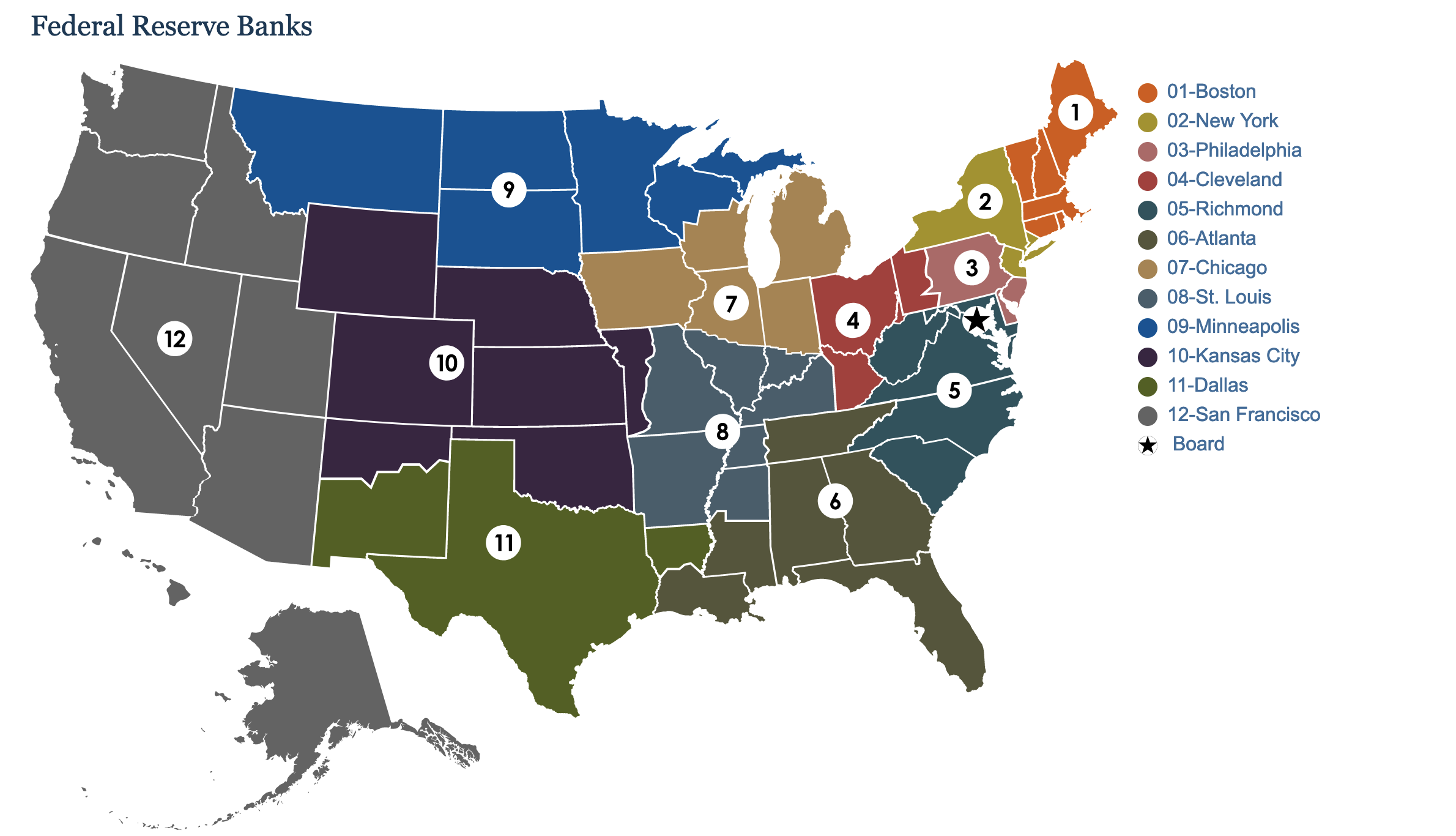

Decentralization also produced coordination problems. The Banking Act of 1935 strengthened the Washington Board and the machinery for national monetary decisions after the failures of the Depression. It established the seven-member Board of Governors and reshaped the Federal Open Market Committee, or FOMC. The system retained its regional institutions while making monetary policy increasingly a collective national responsibility.4
Today the FOMC brings together the governors and all twelve Reserve Bank presidents. Its voting membership comprises the seven Board seats, the New York president, and four other presidents serving on rotation. The presidents without a vote still participate in deliberations. The chair has exceptional agenda-setting and communicative influence, but the research departments do not report to a single national research director who determines what everyone must think.5
The Board is a federal agency: its governors are nominated by the US president and confirmed by the Senate, with staggered appointments to fourteen-year terms. The Reserve Banks are separately incorporated, with stock held by member commercial banks, but that statutory stockholding is not ordinary ownership of a profit-seeking company. A Bank’s president is appointed by its eligible Class B and C directors—the directors representing the public—subject to the Board of Governors’ approval. Regional research therefore has a local executive sponsor within a system whose authority comes from Congress.6
A Reserve Bank therefore needs economists who can help its president assess the whole economy, not simply report local conditions to Washington. Regional research also has other clients: bank supervision, community development, the Bank’s directors, and public readers. Boston’s department, for example, describes work ranging from FOMC briefings to regional business interviews for the Beige Book and advice concerning the discount rate.7
Some of these departments acquired distinct intellectual identities. Under research director Homer Jones and president Darryl Francis, St. Louis became an important center of monetarist criticism in the 1960s and 1970s. Its economists challenged explanations of inflation that minimized the role of monetary policy. Historical research by Michael Bordo and Edward Prescott argues that the Banks’ semi-independent position, strengthened research departments and connections to universities helped sustain this competition in ideas. That is an interpretation of the system’s development, not proof that every region always shelters a distinctive or dissenting school.8
Minneapolis offers a more concrete instance. A group formed in 1970 with University of Minnesota economists set out to build a useful macroeconomic policy model. Neil Wallace and Thomas Sargent were among its participants. Encountering Robert Lucas’s work on expectations changed their assessment of the enterprise: behavior observed under one policy regime might not remain stable after the policy rules changed. In spring 1973, the group abandoned its existing model-building project. The collaboration became a route through which rational-expectations research entered central banking discussion.9
This was an institutional achievement of a particular kind. The Bank had supported a project, allowed its premises to be challenged, and retained a relationship with the researchers after they changed direction. Such freedom required people who controlled salaries, appointments and access to policy discussions to tolerate work that could invalidate an earlier investment.
The resulting plurality should not be confused with equal power. Washington prepares the central staff forecast. New York executes market operations and has a permanent FOMC vote. Presidents and governors possess decision rights that staff economists do not. Regional independence creates additional places where an argument can develop; it does not erase the hierarchy through which that argument must travel.
The people behind the forecast
At the Board, the research work is divided principally among four economic divisions, with economists also employed elsewhere. Research and Statistics studies the domestic economy and develops statistical information; its sections range from labor markets and prices to household finances and financial accounts. International Finance follows foreign economies, trade, cross-border capital and international financial institutions. Monetary Affairs studies monetary strategy, implementation, financial conditions and the transmission of policy, and supports FOMC communications and records. Financial Stability investigates vulnerabilities and the ways shocks could propagate through the financial system.10
These divisions overlap in their subjects because the problems overlap. A bank’s losses can affect lending, employment and monetary transmission. A foreign conflict can alter energy prices, trade and financial risk. “Domestic,” “international” and “financial” are assignments of responsibility, not impermeable borders around reality.
The financial-stability organization also records a lesson from institutional failure. An Office of Financial Stability Policy and Research was established in 2010 under Nellie Liang and became a division in 2016. Its remit explicitly brought economists together with supervisory and market expertise. The point was to build a continuing capacity to investigate systemic vulnerabilities rather than rely exclusively on the study of individual banks or aggregate inflation and output.11
The Reserve Banks maintain their own arrangements. New York’s Research and Statistics Group separates research, data and statistics, and shared services. Its economists work on subjects including financial intermediation, macroeconomics, labor markets, international economics, and money and payments. This research group is not the trading desk, even though both contribute to the same Bank’s policy responsibilities.12
A staff directory reveals another division of labor that disappears when the Fed is described as a gathering of economists. The Board lists research-library specialists, including Adrienne Hieb as a metadata librarian, alongside economists and financial analysts. Boston explicitly includes computing technicians, editors, librarians and administrative staff in its research department. The Board describes professional support for finding data, managing large datasets and maintaining research computing.13
The implications are practical. Someone must determine which series a researcher actually used, preserve the documentation, resolve inconsistent identifiers, maintain access to licensed material, or make a table intelligible outside its originating team. These are not incidental services attached to an otherwise self-sufficient thinker. They help turn an analysis into something another person can check, update and use.
From a revised number to a decision
A policy forecast is not simply a large model being switched on. In a 2017 account of the Board’s forecasting process, vice chair Stanley Fischer described a judgmental baseline assembled from sector specialists, statistical relationships, models and other information. Formal models also supported alternative scenarios and comparisons of policy paths. Their discipline mattered, but their output did not automatically become the staff’s best assessment.14
One important tool, FRB/US, has been in use since 1996. It represents households, firms, financial markets and the public sector in a large model of the US economy. It allows different assumptions about how people form expectations, including expectations based on past statistical relationships and expectations consistent with the model itself. Its equations, data and software are publicly available. Another Board model, EDO, uses a different, dynamic stochastic general-equilibrium framework. Maintaining several models makes it possible to ask how much a result depends on a particular account of behavior.15
This does not remove judgment. Someone still chooses the shock, the scenario, the relevant comparison and the assumptions about policy. Model pluralism is useful only if people examine the differences rather than treating several similar answers as independent confirmation.
The premeeting staff work is gathered in the Tealbook, created in 2010 by combining the earlier Greenbook and Bluebook. Part A covers economic and financial conditions and the outlook; Part B develops monetary policy alternatives. It is an internal briefing product, distinct from a working paper submitted for academic criticism and distinct from the eventual committee decision.16
The sequence was described from a participant’s perspective by governor Elizabeth Duke in 2010. Following a report on financial markets, Board staff presented the domestic and international outlook. Policymakers questioned the staff and gave their own assessments in an economic go-round. Monetary Affairs then presented policy alternatives before the policy discussion and vote. Different chairs have organized their interventions differently; Duke’s account documents a particular period rather than an immutable script. It nevertheless makes the allocation of work clear: staff structure the available evidence and options, while officials assess and choose.17
August 2011 shows why that separation matters. The outlook had deteriorated. In Fischer’s retrospective account, the staff forecast and model exercises both pointed toward a longer period of very low interest rates, although the approaches did not produce identical paths. The staff exhibit reproduced here compares the June and August forecasts, with uncertainty bands that make the central projection visibly only one possible course.18, 19
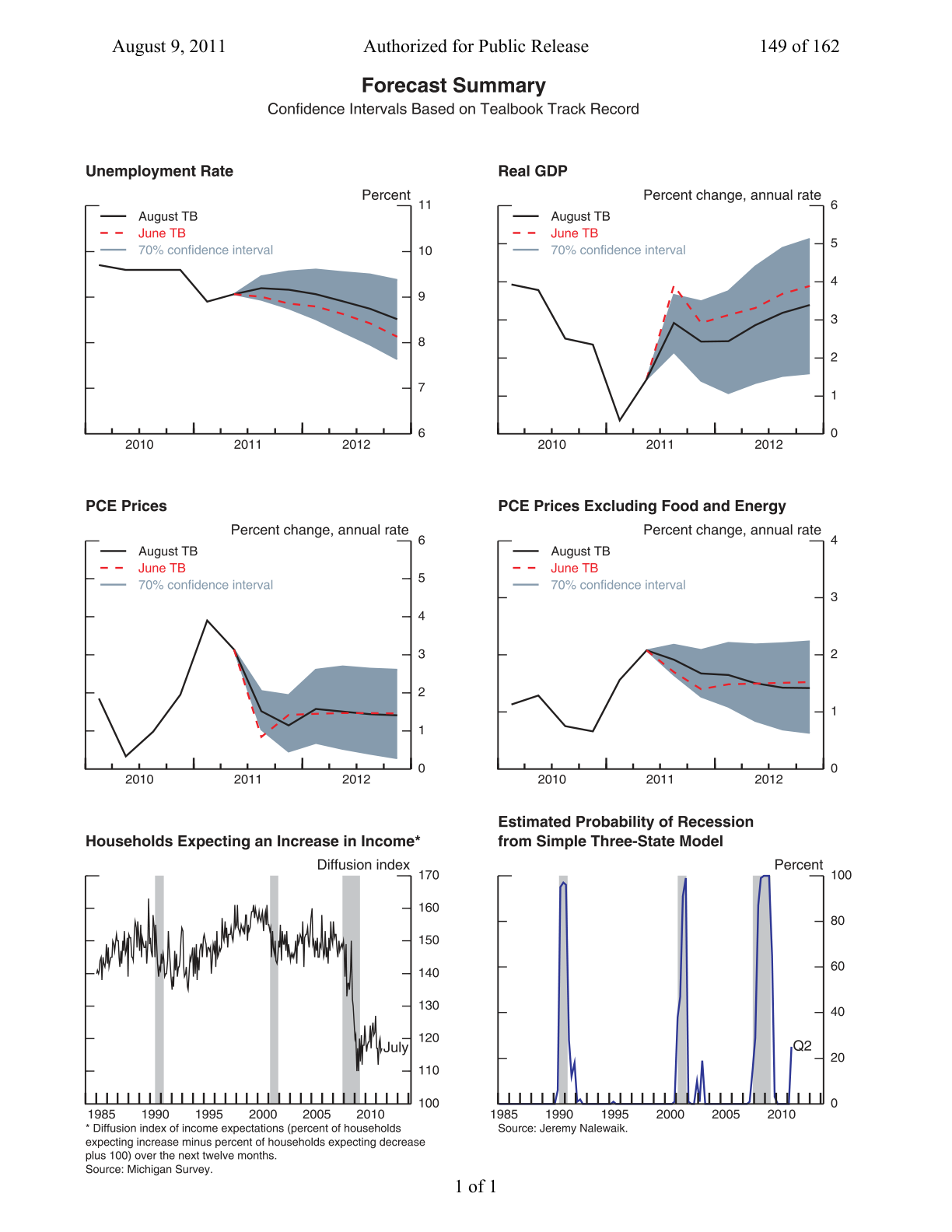
On August 9 the FOMC kept its target range at 0 to ¼ percent and said economic conditions were likely to warrant exceptionally low rates at least through mid-2013. Three members—Richard Fisher, Narayana Kocherlakota and Charles Plosser—dissented, preferring the previous, less date-specific language. Seven voted for the statement. A shared body of analysis had supported a consequential decision without eliminating disagreement over what the central bank should promise.20
Nor should the published “dot plot” be mistaken for the staff forecast. The Summary of Economic Projections collects individual participants’ projections, made under their own assessments of appropriate policy. It is not a single committee forecast or a binding commitment to a future rate path. The distinction between staff analysis, participants’ views and an adopted decision is essential to reading the institution.21
There are limits to what an outside observer can reconstruct. Statements are released promptly, minutes usually three weeks later, but detailed historical transcripts and staff materials appear with a much longer lag, ordinarily around five years. As of this study’s November 2026 research date, the Board’s historical archive extends through 2020. The 2011 episode can be examined through released materials; the current Tealbook cannot. No claim here rests on access to an unreleased forecast.22, 23
Two clocks in the same working life
The tension between scholarship and immediate service is openly acknowledged inside the Fed. In May 2025, governor Christopher Waller contrasted academic research with directed policy work. As a former St. Louis research director, he had had to explain why a central bank should support papers that were not directly answering its president’s current questions. His case was that academic engagement builds expertise and exposes work to criticism beyond the institution.24
The distinction becomes sharp when an unexpected event creates a deadline. Waller described the questions generated by the tariff announcements of April 2025: what would happen to inflation, employment and activity? Staff had to respond despite limitations in existing models and available microdata. There was no time to construct an entirely new research program and wait for peer review. He also acknowledged a less flattering consequence of this tempo: once attention moves on, the careful postmortem of an earlier analysis may never happen.25
Long research can nevertheless furnish tools for a sudden question. Board economists Dario Caldara and Matteo Iacoviello developed a geopolitical-risk index using newspaper text, separating discussion of threats from reporting of adverse events. The work required definitions, search procedures and validation, including checks against manually assessed articles. Their paper thanked research-library staff and a succession of research assistants, as well as seminar audiences and referees. The instrument was a collective production even though two names headed the paper.26
After Russia’s invasion of Ukraine, Caldara and Iacoviello joined Sarah Conlisk and Maddie Penn in a May 2022 analysis of effects on global activity and inflation. They used the existing index alongside evidence from corporate earnings calls. A measurement project built over years had become available for a fast-moving policy problem.27
The limits travel with the tool. Newspaper coverage measures attention to events through particular publications; it is not the conflict itself. A model-based estimate of the war’s effects depends on a counterfactual that cannot be directly observed. The note demonstrates the reuse of research infrastructure, not that its estimates were certain or that the FOMC subsequently voted according to them.
At a more senior level, the boundaries between research and service can run through one person’s job. In January 2026, Monetary Affairs senior adviser Annette Vissing-Jorgensen described responsibilities including helping guide and edit the Tealbook, preparing FOMC memoranda, contributing to minutes, and maintaining links with academic research. Her presentation also listed unresolved questions about inflation, labor-market slack and monetary transmission. Proximity to the policy process did not mean the underlying economics had become settled.28
There is a bureaucratic challenge here as well as an intellectual one. A 2021 Inspector General review found weaknesses in planning, communication and feedback across the Board’s economic divisions, including inconsistent ways of tracking work and obtaining policymakers’ responses. It recommended more structured processes. The audit explicitly excluded independent research and did not evaluate the quality or usefulness of the research itself. Its finding was narrower and important: even capable analysts need a functioning system for deciding which questions to pursue and whether their answers reached the people who needed them.29
Entering the profession, and doing the uncredited work
For economists, the Fed is part of the same professional world as university departments. The Board’s recruitment materials seek completed or nearly completed doctorates, a research paper and academic references, alongside the capacity to contribute to policy analysis. Staff publish in journals, attend conferences, host visiting researchers and take part in seminars. Board working papers circulate through the Finance and Economics Discussion Series and International Finance Discussion Papers, providing public outlets before or alongside journal publication.30 These connections give employees interlocutors whose approval is not controlled by the officials they advise.31
That external reputation has an institutional function. A central bank needs people whose expertise will remain credible when their immediate employer wants an answer. It also creates competing demands: the skills rewarded in an academic publication are not identical to those required to explain an uncertain result clearly in a short policy memorandum. The job contains both kinds of performance, without a universal formula for dividing the day between them.
An important entry route operates before the doctorate. The Board’s research-assistant program normally lasts two years and recruits people with quantitative undergraduate or master’s training. Its published duties include maintaining and analyzing data, writing code, checking charts and tables, reviewing literature and helping prepare research and policy material. The Board requires US citizenship for this program; that should not be generalized into a single hiring rule for every Reserve Bank. New York has its own two-year research-analyst program, with work spanning policy questions and longer research projects.32
Such positions expose the difference between knowing a statistical method and making an analysis dependable. A result may turn on a revised series, a sample restriction or a unit conversion. Checking those details is intellectually consequential, even when it does not earn a prominent place in the final text. In the geopolitical-risk project, Conlisk and Penn appear in the larger paper’s research-assistance acknowledgments and as coauthors of the subsequent Ukraine note. The documents show a specific movement between forms of contribution; they do not establish a universal promise of authorship for junior staff.33, 34
Recruitment pages are useful for identifying formal routes and stated duties. They are much weaker evidence of how much autonomy, recognition or satisfaction every employee actually experiences. The public record does not support an invented composite day in which all Fed economists spend the morning doing pure research and the afternoon advising a governor. Divisions, seniority, deadlines and supervisors matter.
Collaboration also has a social structure. Deepa Datta and Robert Vigfusson studied Board economist rosters and working-paper coauthorship from 2003 to 2022. They found more same-gender collaboration than random matching would predict, with research interests unable to explain the pattern fully. Where women form a minority, such patterns can affect access to potential collaborators. The authors did not claim that the Board was uniquely exclusionary compared with universities; they also noted features of its gender composition that differed from the familiar academic “leaky pipeline.”35
This is a useful corrective to the idea that an intellectual workplace is governed solely by the strength of an argument. Research depends on invitations, repeated contact, complementary skills and trust. An institution can offer substantial scholarly freedom while still distributing access to collaboration unevenly. A directory counts who is employed; a coauthorship network begins to reveal who gets to make knowledge with whom.
What the Fed gives away, and what it must protect
Some of the institution’s most durable contributions are useful to people who never read an FOMC statement. FRED, the St. Louis Fed’s economic-data service, grew out of an earlier practice of circulating statistics. In May 1961, Homer Jones sent tables of monetary growth to a small mailing list and invited responses. The electronic service began in April 1991 as a dial-up bulletin board. Its origins connect the research department’s intellectual commitments with a decision to make the underlying numbers more widely available.36
FRED now offers a common interface to data from many originating organizations; it should not be mistaken for a claim that the Federal Reserve collected every series. The related ALFRED service preserves historical vintages. That distinction is especially valuable for understanding policy work: the unemployment rate or national-income estimate visible to a researcher on a particular day may differ from the revised number available years later. An archive of vintages allows a forecast to be assessed against information that was actually available when it was made.37
The institution also creates data that require a very different kind of labor. The Survey of Consumer Finances examines family assets, debts, income and financial arrangements. NORC at the University of Chicago conducts the interviews for the Board, with specialized sampling and substantial effort to reach households across the wealth distribution. The 2025 survey’s results were released on October 9, 2026. Behind the public tables are respondents deciding to participate, interviewers eliciting difficult financial details, and researchers making incomplete and unevenly distributed information usable.38
Public availability does not mean unrestricted exposure. The Board’s participant information states that respondents’ names are kept from Federal Reserve staff and separated from their answers. Public files and documentation permit research without granting access to identified households. Here confidentiality is part of the mechanism by which knowledge becomes possible: an institution asking detailed questions about wealth must make credible promises about what will not be disclosed.39
Other boundaries arise because the Fed supervises institutions and deliberates about policy. A staff member may know confidential supervisory information or an unpublished policy analysis that cannot be placed in a seminar slide. Publication series allow findings to circulate, but the standard authors-only disclaimer separates a scholarly claim from an institutional commitment. Release delays, anonymization and publication rules make different kinds of information public on different terms. They also mean the public cannot continuously inspect every assumption circulating inside the policy process.40, 41
The result is a mixed public presence. A librarian’s cataloging, an analyst’s code or an interviewer’s persistence may have a wider and longer life than a particular rate decision, while attracting far less notice. The Fed’s knowledge work includes maintaining resources through which outsiders can scrutinize the economy—and sometimes the Fed itself.
When information does not become understanding or action
A large research organization can still share a narrow frame. In their study of the failure to anticipate the financial crisis, sociologists Neil Fligstein, Jonah Stuart Brundage and Michael Schultz argued that FOMC participants interpreted emerging problems through a macroeconomic framework that made it difficult to connect housing, securitization and the financial system. This is an independent scholarly interpretation of the deliberations, not a finding that nobody anywhere in the Fed noticed danger. Its force lies in the distinction between possessing pieces of information and recognizing the mechanism that joins them.42
The subsequent creation of a dedicated financial-stability unit was one organizational response to that broader problem. Yet adding a subject to a research agenda cannot by itself ensure that warnings will produce action.
Silicon Valley Bank’s failure in March 2023 exposed a different break in the chain. The Government Accountability Office reported that supervisors had identified concerns, but the San Francisco Fed continued to rate the bank satisfactory until 2022. An enforcement action begun later that year was not finalized before the bank failed. The issue was not simply whether a clever enough model existed; identified problems had not been corrected in time.43
The interpretation remains contested within the institution. The review led by vice chair for supervision Michael Barr in April 2023 blamed bank management, supervisory failures, regulatory tailoring and a less assertive supervisory approach. In September 2026, his successor Michelle Bowman presented preliminary findings from a commissioned external review that rejected the earlier account of regulatory tailoring and emphasized delayed escalation, unclear decision rights and organizational risk aversion. The later review was preliminary, and its commissioning context should not be mistaken for a settled resolution of the dispute.44
These accounts differ over causes and responsibility, but the episode makes a common institutional difficulty visible. A warning must cross boundaries: from an examiner to a supervisor, from an analytical finding to an escalation, from a concern to an enforceable requirement. Research skill is only one part of that process. The decision-maker must have both the authority and the organizational support to act.
Plurality therefore has two sides. Several research centers can challenge a dominant view. They can also circulate within the same profession, use related methods and rely on similar ideas about what counts as evidence. More papers do not automatically produce more independent ways of seeing. Seminars, outside criticism, specialist knowledge and examination of past errors have to be maintained as working practices, not invoked as proof that groupthink is impossible.
Who pays for the room to think
The Fed’s research capacity rests on a distinctive financial and political arrangement. It does not depend on annual congressional appropriations. The Reserve Banks finance their operations, and assessments on them fund the Board; the 2025 audited financial statements describe that mechanism. Congress nevertheless establishes the institution’s statutory responsibilities, and the Board reports to Congress. Independence concerns the exercise of delegated authority within government, not the absence of public obligations or political conflict.45
This funding structure helps sustain permanent data collections, specialized staff and research whose value may take years to emerge. It also moves many choices about scale and priorities inside the institution. Officials and managers decide which capabilities deserve continued support. Financial autonomy cannot determine whether a model is adequate, a department is well managed or a line of research deserves protection.
Those arrangements were under active reconsideration at the research date. Kevin Warsh, who became chair in May 2026, announced five task forces in June covering communications, the balance sheet, data, technological change and inflation frameworks. Their recommendations were intended to inform the FOMC rather than replace its authority. At his October 28 press conference, he described a plan to retain eight meetings in 2027 while dedicating one fall meeting to broader strategy, without an anticipated rate decision or policy statement. That was an announced plan, not an already completed change to the institution’s working year.46
The proposal gives a contemporary form to the problem Waller described: how to preserve time for re-examining assumptions when another decision is always approaching. Rearranging a calendar may create space. Whether that space produces better questions depends on the people invited into it, the evidence they can use, and what happens when their conclusions are inconvenient.
Rudd’s paper remains a useful measure of the distinction. Its publication demonstrated that a staff economist could challenge a widely accepted proposition. It did not demonstrate that the institution had changed its mind. The more demanding question is what happens between those two events: whether objections receive serious attention, whether data and models can be revised, and whether a decision-maker is willing to alter a course of action.
For someone working inside this world, the attraction is unusually concrete. A well-made dataset can become public infrastructure. An obscure measurement problem can matter when a crisis arrives. A paper can enter a professional argument while a memorandum enters a policy meeting. The costs are concrete too: urgent deadlines, uneven visibility, restricted disclosure, and the obligation to give a useful answer without pretending that uncertainty has disappeared.
Sources and scope
This study uses public institutional records, released historical policy materials, staff research and accounts of working practices, supplemented by independent scholarship and oversight findings. Official descriptions establish formal responsibilities and stated procedures; recruitment pages are not treated as independent evidence of employee experience. Historical episodes are dated rather than presented as observations of today’s office life. Current organization and releases were checked on November 2, 2026. The account does not claim access to unreleased Tealbooks, confidential supervisory records or private staff interviews.
Board of Governors, “Who We Are”, The Fed Explained, organizational structure and five functions. See also 2025 Federal Reserve Banks Combined Financial Statements, introductory statement of functions.↩︎
Jeremy B. Rudd, “Why Do We Think That Inflation Expectations Matter for Inflation? (And Should We?)”, FEDS 2021-062, September 23, 2021; full paper, abstract and introduction. The paper’s argument and its publication are not evidence of adoption by the FOMC.↩︎
Federal Reserve History, “Federal Reserve Act Signed into Law”, on the 1907 panic, competing reform proposals and the 1913 compromise. This is institutional historical interpretation, not a contemporary record of every participant’s motives.↩︎
Gary Richardson, Alejandro Komai and Michael Gou, “Banking Act of 1935”, Federal Reserve History. The discussion here does not attribute today’s permanent New York FOMC seat to the 1935 legislation.↩︎
Board of Governors, “Federal Open Market Committee”, membership and organization, updated October 28, 2026; Elizabeth A. Duke, “Come with Me to the FOMC”, October 19, 2010, discussion of chairs’ influence and participants’ roles.↩︎
Board of Governors, “Who owns the Federal Reserve?”, “Who are the members of the Federal Reserve Board, and how are they selected?”, “How is a Federal Reserve Bank president selected?”, and “Overview: Federal Reserve System Boards of Directors”, checked November 2, 2026. Fourteen years is the full statutory term of a Board seat; appointments can fill an unexpired portion. Member-bank stockholding is distinct from ordinary ownership of a commercial company.↩︎
Federal Reserve Bank of Boston, “Research”, departmental responsibilities and staff categories.↩︎
Federal Reserve Bank of St. Louis, “History of the St. Louis Fed’s Headquarters”, centennial discussion of Homer Jones, Darryl Francis and monetary-policy debate; Michael D. Bordo and Edward S. Prescott, “Federal Reserve Structure and the Production of Monetary Policy Ideas”, Cleveland Fed Working Paper 23-29, November 2023. The latter is an authors’ historical argument, coauthored by a Reserve Bank economist, not independent certification of the system’s effectiveness.↩︎
Federal Reserve Bank of Minneapolis, “Greater Than the Sum”, 2000, “Seeds of collaboration”; see also “Rational Expectations—Fresh Ideas That Challenge Some Established Views of Policy Making”, 1978. The 2000 article is a retrospective institutional account, including participants’ recollections.↩︎
Board of Governors, current staff and responsibility pages for Research and Statistics, International Finance, Monetary Affairs, and Financial Stability, checked November 2, 2026. Staff listings are snapshots, not a claim that all related work is contained in these four divisions.↩︎
Board of Governors, “Federal Reserve Board announces Office of Financial Policy and Research has been designated a division of the Board and renamed Division of Financial Stability”, May 11, 2016. The office was established in November 2010; divisional status dates to 2016.↩︎
Federal Reserve Bank of New York, “Research and Statistics”, organizational description, checked November 2, 2026.↩︎
Board of Governors, Research and Statistics staff directory, Research Library section; “Research Support”, description updated 2017; Boston Fed, “Research”. The older support page is used for durable occupational functions, not its dated software inventory.↩︎
Stanley Fischer, “I’d Rather Have Bob Solow Than an Econometric Model, But…”, February 11, 2017, “How the Fed Makes Monetary Policy,” “Models and the Modeling of Monetary Policy,” and “One Monetary Policy Decision: August 2011,” including figures derived from the 2011 Tealbook.↩︎
Board of Governors, “FRB/US Project” and “Estimated Dynamic Optimization (EDO) Model”. Model documentation establishes available structures and tools, not which model dominated any unreleased policy discussion.↩︎
Board of Governors, “Transcripts and other historical materials”, explanations of the Greenbook, Bluebook, Tealbook, minutes and transcripts. Public releases can contain redactions of confidential third-party information.↩︎
Duke, “Come with Me to the FOMC”, October 19, 2010, sequence of market, economic and policy discussions. This is a governor’s account of the Bernanke-era procedure, not direct observation of a 2026 meeting.↩︎
Stanley Fischer, “I’d Rather Have Bob Solow Than an Econometric Model, But…”, February 11, 2017, “How the Fed Makes Monetary Policy,” “Models and the Modeling of Monetary Policy,” and “One Monetary Policy Decision: August 2011,” including figures derived from the 2011 Tealbook.↩︎
Board of Governors, FOMC presentation materials, August 9, 2011, PDF page 8, transcript page 149, “Forecast Summary”; accessible tables and descriptions. The reproduced page is a historical staff projection, not a chart of realized outcomes.↩︎
Board of Governors, FOMC statement, August 9, 2011, decision, guidance and recorded votes.↩︎
Board of Governors, “Transcripts and other historical materials”, description of the Summary of Economic Projections; Fischer, February 11, 2017 speech, distinction between staff projections and participants’ assessments.↩︎
Board of Governors, “Transcripts and other historical materials”, explanations of the Greenbook, Bluebook, Tealbook, minutes and transcripts. Public releases can contain redactions of confidential third-party information.↩︎
Board of Governors, historical-materials archive index, updated January 16, 2026 and checked November 2, 2026; latest listed year 2020.↩︎
Christopher J. Waller, “The Role of Economic Research in Central Banking”, May 14, 2025, academic versus directed research, April 2025 tariff questions, and the difficulty of carrying out postmortems. These are Waller’s account and argument, not a survey of all staff experience.↩︎
Christopher J. Waller, “The Role of Economic Research in Central Banking”, May 14, 2025, academic versus directed research, April 2025 tariff questions, and the difficulty of carrying out postmortems. These are Waller’s account and argument, not a survey of all staff experience.↩︎
Dario Caldara and Matteo Iacoviello, “Measuring Geopolitical Risk”, International Finance Discussion Paper 1222r1, March 2022, author-dated November 15, 2021, especially opening acknowledgments and sections I–II on construction and validation. Updated data and replication materials are linked from the paper.↩︎
Dario Caldara, Sarah Conlisk, Matteo Iacoviello and Maddie Penn, “The Effect of the War in Ukraine on Global Activity and Inflation”, FEDS Notes, May 27, 2022. Its estimates are conditional analytical results, not observed causal effects or evidence of policy adoption.↩︎
Annette Vissing-Jorgensen, “Remarks for Fed Panel: How Economists Can Help Inform Monetary Policymaking”, January 3, 2026, slides 2–15. A named economist’s description of her responsibilities, not a universal job specification.↩︎
Office of Inspector General, The Board Economics Divisions Can Enhance Some of Their Planning Processes for Economic Analysis, report 2021-MO-B-001, February 24, 2021, executive summary and scope. The review excluded independent research and did not assess research quality or utility; this study makes no claim that its findings remain unresolved in 2026.↩︎
Board of Governors, “Economic Research”, public series, research tools and publication disclaimers; historical-materials release policy. The discussion distinguishes public research, confidential supervision and policy deliberations rather than assuming a single disclosure rule covers all three.↩︎
Board of Governors, “Economists”, recruitment requirements, updated October 6, 2026; “Seminars and Workshops”, description of academic seminars and internal workshops. The seminar page is descriptive and dated 2017, not a current events calendar.↩︎
Board of Governors, “Research Assistants”, duties, length and citizenship requirement; Federal Reserve Bank of New York, “Research Analysts”, separate program and responsibilities. Recruitment materials describe intended roles rather than independently verified employment outcomes.↩︎
Dario Caldara and Matteo Iacoviello, “Measuring Geopolitical Risk”, International Finance Discussion Paper 1222r1, March 2022, author-dated November 15, 2021, especially opening acknowledgments and sections I–II on construction and validation. Updated data and replication materials are linked from the paper.↩︎
Dario Caldara, Sarah Conlisk, Matteo Iacoviello and Maddie Penn, “The Effect of the War in Ukraine on Global Activity and Inflation”, FEDS Notes, May 27, 2022. Its estimates are conditional analytical results, not observed causal effects or evidence of policy adoption.↩︎
Deepa D. Datta and Robert J. Vigfusson, “Measuring Inclusion: Gender and Coauthorship at the Federal Reserve Board”, FEDS 2024-091, November 7, 2024, abstract, sample construction and discussion of gender composition. Historical sample: March 2003–April 2022. The findings do not supply a 2026 headcount or establish a single causal explanation for collaboration patterns.↩︎
William Poole, “Data, Data, and Yet More Data”, October 16, 2006, subsequently published in the Federal Reserve Bank of St. Louis Review, March/April 2007, pp. 85–89; “Origins” and “The Evolution of St. Louis Fed Data Services.” FRED began as a bulletin board in 1991, not as a website.↩︎
Federal Reserve Bank of St. Louis, FRED and ALFRED documentation, real-time periods and revisions; ALFRED, historical-vintage service. These resources preserve released data, not unreleased internal information.↩︎
NORC, “Survey of Consumer Finances”, fieldwork and sampling; Board of Governors, release of 2025 SCF results, October 9, 2026; SCF data and documentation.↩︎
Board of Governors, “Information for Potential Participants”, 2025 SCF, confidentiality and separation of identities; SCF data and documentation. The participant page describes the 2025 collection; its older leadership references are not used as current facts.↩︎
Board of Governors, “Transcripts and other historical materials”, explanations of the Greenbook, Bluebook, Tealbook, minutes and transcripts. Public releases can contain redactions of confidential third-party information.↩︎
Board of Governors, “Economic Research”, public series, research tools and publication disclaimers; historical-materials release policy. The discussion distinguishes public research, confidential supervision and policy deliberations rather than assuming a single disclosure rule covers all three.↩︎
Neil Fligstein, Jonah Stuart Brundage and Michael Schultz, “Seeing Like the Fed: Culture, Cognition, and Framing in the Failure to Anticipate the Financial Crisis of 2008”, American Sociological Review 82(5), 2017, pp. 879–909. The characterization here is limited to the authors’ publicly accessible abstract and its stated argument; it is not a claim of access to the paywalled full article.↩︎
US Government Accountability Office, Bank Regulation: Preliminary Review of Agency Actions Related to March 2023 Bank Failures, GAO-23-106857, May 24, 2023, testimony on supervisory ratings and escalation before SVB’s failure.↩︎
Board of Governors, release of the review led by Michael Barr, April 28, 2023, and executive summary; Michelle W. Bowman, “Initial Findings from Independent Review of Silicon Valley Bank”, September 18, 2026, discussing preliminary findings of the commissioned review. The competing accounts are attributed rather than reconciled into an unsupported consensus.↩︎
Board of Governors, “What does it mean that the Federal Reserve is ‘independent within the government’?”, updated May 28, 2026; 2025 Federal Reserve Banks Combined Financial Statements, note 3(t), “Assessments,” printed p. 22 (PDF p. 25). The financing description is not a claim that recent Reserve Bank net earnings or remittances to Treasury have been positive.↩︎
Board of Governors, Kevin Warsh biography; June 17, 2026 press-conference transcript, pp. 2–4; October 28, 2026 preliminary press-conference transcript, p. 3. The latter describes an intended 2027 meeting arrangement, not a completed reform or a change in statutory authority.↩︎