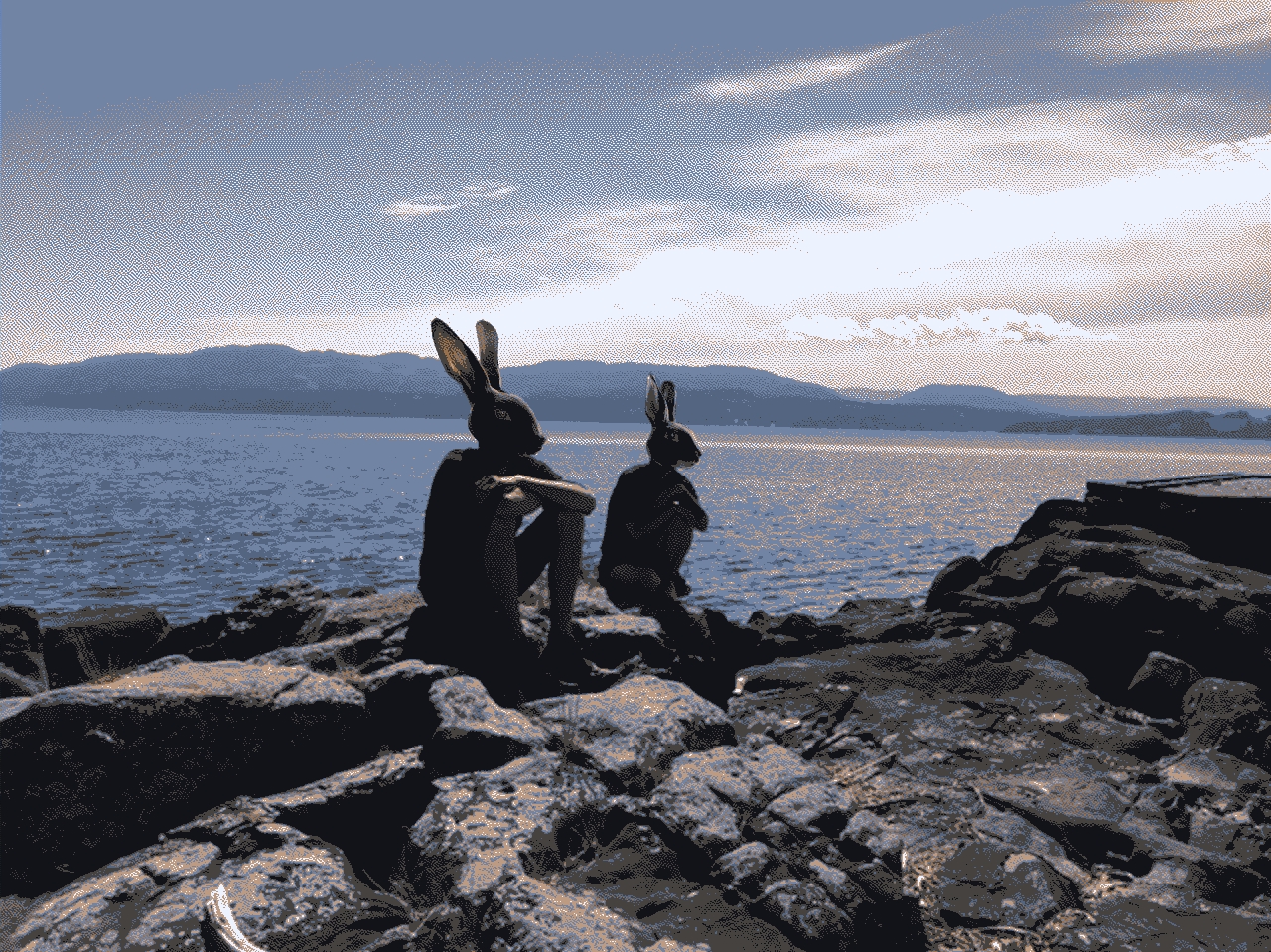
Hundred Rabbits is the shared practice of two Canadian artists, Rek Bell and Devine Lu Linvega, who live aboard a small sailboat and make drawings, books, games, music, software, and unusually detailed accounts of how they keep all of it working. Rek is a writer, illustrator, and cartoonist; Devine is a programmer, visual artist, and musician. Both use they/them pronouns. Their home and workshop is Pino, a ten-metre Yamaha sailboat built in 1982. They moved aboard in 2016, sailed a circuit of the Pacific, and subsequently concentrated on the waters of western Canada and nearby regions.1, 2, 3
Someone encountering them for the first time can reasonably wonder what the principal activity is. Are they game developers who happen to sail? Sailors financing their travels through art? Environmentalists demonstrating another way to live? Computer preservationists? There is evidence for each description, but none explains the whole arrangement.
Their central undertaking, as I read it, is to make a creative life whose requirements they can understand, meet, and repair. The things they publish are outcomes of that undertaking, and also instruments for continuing it. A text editor makes a novel possible. A failed refrigerator changes how they cook. An exhausting software update changes which computers they program for. A dangerous passage becomes a handwritten record, then a freely readable online log, then a carefully edited book that helps pay for the next season.
This is not an experiment in being untouched by other people or by industrial society. Pino contains manufactured equipment; the studio uses outside hosting and payment services; its work depends on donors, readers, programmers, machinists, boatyards, and friends. The interesting question is how they organize those dependencies—and which demands they are willing to accept in exchange for keeping their time.
The following profile starts before the boat, then follows the domestic, artistic, technical, and economic workings of the life they built. No knowledge of sailing or programming is assumed.
Research scope: public sources checked through 19 September 2026, including the studio’s current documentation and monthly logs, older interviews, technical specifications, contemporary game coverage, and institutional records. The latest complete monthly studio report consulted is August 2026; individual project pages contain later updates where noted. This is a research synthesis, not an interview with the artists. Descriptions of books and software distinguish published documentation from direct reading of the available voyage logs; no claim is made to have played every game, read every complete book, or audited their finances. Practical examples explain their arrangements rather than supplying a sailing, electrical, or food-safety manual.
The image could not be loaded. View the original using the source link below.
1. A first map of their world
There are several names worth keeping straight:
| Name | What it is | Why it matters |
|---|---|---|
| Hundred Rabbits / 100R | Rek and Devine’s collective and shared public archive | The connection between making art, maintaining a home, and documenting experiments |
| Pino | Their 1982 Yamaha 33 sailboat | Home, transport, workspace, and the source of many practical constraints |
| Kokorobot | Rek’s personal website | Drawings, comics, fiction, and accounts of artistic process |
| XXIIVV | Devine’s personal wiki | Music, invented worlds and languages, programming research, and technical documentation |
| Aliceffekt / Neauoire | Names associated with Devine’s music and online presence | Routes into a practice that predates the sailing project |
| Uxn / Varvara | A small virtual processor and its surrounding computer specification | A way to keep their programs running across different physical machines |
| Orca | A visual programming environment often used for making music | An example of software designed as a creative medium |
| Merveilles | A wider community of artists and technically curious makers | An important source of exchange, collaboration, and mutual help |
These are overlapping activities, not separate companies with departments. Their public work is spread across personal sites, the studio wiki, software repositories, itch.io, music releases, and books. Its dispersed form reflects the scale of the undertaking: two people making things they need, then giving those things a life among others.4, 5, 6, 7, 8
The distinction between living on the water and living at sea is especially important. In a 2021 interview, Devine corrected the interviewer’s assumption: they usually live near coasts, seek shelter, and cross open ocean occasionally. The spectacular crossing is an interruption of ordinary life as much as its culmination. Much of the sustained drawing, coding, cooking, and repair occurs while anchored or moored.9
3. Two different makers, with different needs
Rek’s professional background includes children’s-book illustration, game art, and work in a Japanese animation studio. In a 2016 interview draft preserved on their own account, Rek described moving between freelance illustration and the ambition to make independent work. Their artistic role has never been confined to decorating Devine’s software: characters, narrative situations, books, and the experiential record of the voyages are substantial projects in their own right.13, 14
A 2019 tools interview makes this especially clear. Rek wrote almost as much as they drew. They used a repaired MacBook assembled from donated machines for illustration, an old iPad with a finger as the drawing instrument for simpler work, and a Raspberry Pi for writing. Cooking and travel fed their other creative activities; long passages could become time to think through future projects. The desired future setup was a repairable, low-power computer and enough control over their tools to leave expensive closed software behind.15
Devine’s route was through web and interface work, experimental music, and a growing fascination with programming as a medium for constructing worlds. In a 2018 interview, they traced their design interests to game interfaces—flight simulators, role-playing games, and later games in which much of the experience happens inside a system of controls. They also recalled online art communities such as Shadowness and Depthcore.16
That history helps explain why Devine’s programs often look like environments to explore rather than neutral office utilities. Their personal wiki, developed over many years, is part notebook, part workshop, part fictional and conceptual territory. In 2019 they described their musical activity as making programs that make music, a formulation that captures the intimacy between composition and tool design.17, 18
The music also has an imaginative life independent of any particular software tool. Devine describes Aliceffekt as following a character, Neonev, through the fictional world of Dinaisth, with albums remembering different places and periods. The project catalogue includes remixes and contributions associated with electronic-music labels and compilations as well as self-released work. Its vocabulary combines travel, invented names, and world-building; the voyages did not originate with Pino. The four-track Ver’Iytsl, released in September 2025, shows this musical practice continuing alongside the technical research.19, 20
Their needs are related but not identical. A satisfactory tool for manipulating geometric images may be inadequate for an illustrator’s brushwork. A programmer can enjoy writing an editor while a writer mainly needs the editor to stop obstructing a manuscript. The history of Hundred Rabbits repeatedly turns on this productive difference.
4. Japan and Oquonie: making estrangement playable
From 2012 to 2014, they lived in Japan, with Rek working in animation and Devine in software. Independent projects occupied evenings and weekends. Their first major joint game, Oquonie, was released for iOS on 14 February 2014. Their current account describes approximately six months of concentrated work; a contemporary interview gives a longer, roughly eight-month development span. The important point is the working arrangement: a substantial shared project built around paid employment.21, 22, 23
Oquonie is a textless, isometric puzzle game. The player moves through interconnected rooms and encounters peculiar beings whose communications do not come with a readable translation. Changing form is part of learning how to progress. An isometric view presents the space at an angle, making rooms appear as compact three-dimensional structures on a flat screen. Its world is at once diagrammatic and inhabited.24, 25
The artists identify two direct sources: the experience of finding their way through Japan with incomplete linguistic understanding, and Junji Ito’s story “A Town Without Streets,” with its oppressive architecture of interconnected interiors. The game does not merely depict an unfamiliar place. It places the player in the position of having to infer how that place works.26
Rek drew the art; Devine wrote the code and music. Their friend and collaborator Rez Mason helped with subsequent additions and ports. In 2015, Oquonie became a finalist for the Independent Games Festival’s Excellence in Visual Art award. Contemporary coverage emphasized the tension between its appealing creature designs and its unsettling world.27, 28
The game establishes an enduring artistic concern: how to make someone curious enough to remain with what they do not yet understand. That question later reappears in unfamiliar programming languages, illustrated fictional cultures, and comics that lead into practical knowledge. The aim is not always immediate ease. Sometimes the invitation is to learn a place.
5. Choosing a boat changed more than their address
The initial attraction of sailing was not a detailed computing doctrine. They wanted to combine travel with making things, spend more time outside, and stop repeatedly acquiring and discarding the necessities of a household as they moved between Canada and Japan. Online accounts by sailors including David Welsford, Teresa Carey, and Nike Steiger made the possibility imaginable. They had no substantial sailing background when they began considering it.29
In a 2020 French-language interview, they recalled Tokyo as a cycle of expensive rent and long working days. The proposed boat would hold the home constant while its surroundings changed. This was a way of rearranging expenditure, attention, and mobility together.30
The timing mattered. Their early public answers locate a practical opening after returning from Tokyo to Montreal in 2014, when they could sell their possessions again. A December 2015 Motherboard report still presents a studio preparing for its voyage: Patreon support, travel videos, and remote creative income are central to the plan. Their own later chronology places the purchase of Pino in British Columbia in January 2016.31, 32, 33
The names reveal the continuity with imaginative culture. Pino is named after the android in the anime Ergo Proxy. Hundred Rabbits refers to the vessel in the same series, the Centzon Totochtin. The immediate source is a fictional world; the names were not retrospective branding applied to an already rationalized sustainability project.34
They initially expected to continue using familiar professional tools aboard. The boat was supposed to accommodate the practice. What followed was a much more consequential reversal: the practice had to accommodate the boat.
6. The Pacific was an apprenticeship, not a continuous holiday
Their route from 2016 to 2020 ran from western Canada down the US west coast to Mexico, across to French Polynesia, through the Cook Islands, Niue and Tonga, then New Zealand, Fiji, the Marshall Islands, Japan, and back across the North Pacific to Canada. This was a circuit of the Pacific rather than a circumnavigation of the globe.35, 36
Each location presented different combinations of price, weather, language, supplies, and technical help. Near urban docks, shore electricity could conceal weaknesses in their onboard energy system. At anchor, those weaknesses became visible. A part readily available in a city might be difficult to replace on an island. Internet access varied with local infrastructure and with how many other people were using a connection.37, 38
They reached New Zealand on 31 October 2017 and stayed for nine months. Their account of that period is dominated by repairs: batteries, sails, plumbing, windows, rigging, steering, and communications equipment. Travel became secondary because the home had to be made fit for the next passage.39
That long stop is crucial to understanding how the practice works. The usual image of the digital nomad assumes that the laptop is the principal productive asset and the surrounding location is interchangeable. For Hundred Rabbits, the surrounding system can demand months of work. It can interrupt production completely, but it also teaches skills that alter the subsequent art and engineering.
The period after 2020 should not be described as the same Pacific loop continuing indefinitely. Their recent history includes repeated seasons in the Salish Sea and a 2024 journey up the British Columbia coast to southeast Alaska. In 2026, their monthly notes again describe leaving Victoria for quieter northern anchorages. The life became more geographically concentrated without ceasing to be exploratory.40, 41, 42
7. Pino is a small collection of interdependent systems
Pino is a Yamaha 33, a fibreglass sailing vessel built in 1982. The “33” refers approximately to its length in feet. It is a masthead sloop: a single-masted boat whose principal forward sail attaches near the top of the mast. It also has a diesel engine. Sailing is the main movement ideal, but the actual vessel is not free of engines, manufactured components, or fuel.43, 44
The easiest way to understand the boat is to separate the jobs it must perform:
- Stay afloat and remain sound: hull, openings through the hull, seals, fittings, and regular inspection.
- Move and stop safely: sails, lines, steering, engine, and anchoring equipment.
- Support two human bodies: drinking water, food, cooking, toilet, bedding, warmth, and ventilation.
- Maintain awareness: position, weather information, lights, and communication.
- Support creative work: computers, electricity, dry storage, tools, and a means of distributing finished work.
These functions compete for room, money, weight, and attention. A larger battery can extend computer use but adds weight. An additional panel needs mounting space and creates another object exposed to wind and waves. A sophisticated convenience can save effort until a proprietary part fails far from a supplier.45, 46
Their response has often been subtraction. Pino has no operating refrigerator, electric anchor windlass, pressure-water faucet, or water heater. A windlass is the mechanism that hauls up an anchor and its chain; dispensing with an electric one shifts work onto human strength and technique. None of these removals makes the underlying task disappear. It makes the task more direct, and sometimes harder, while reducing the systems required to accomplish it.47
The governing question is therefore less “How little can two people own?” than “Which arrangements can these two people keep functioning under the conditions they actually encounter?”
8. Electricity: the sun sets part of the working day
Their current boat description lists two 100-watt solar panels and lead-acid batteries. Older accounts give different panel configurations and capacities; they describe earlier installations rather than a permanent specification. A 2025 talk independently describes the two-panel arrangement and four six-volt batteries.48, 49
The current equipment page names Rek’s principal machine as a 2013 MacBook Air and Devine’s as a ThinkPad T580, both running Manjaro Linux. Most of the laptops were donated; the ThinkPad was bought secondhand. These are reused manufactured computers, maintained and repurposed, rather than custom-built physical Uxn machines.50
Some elementary distinctions clarify why this matters. A watt measures the rate at which energy is being used or produced. A watt-hour measures an amount of energy. If a computer draws 30 watts for four hours, it consumes 120 watt-hours. Two such computers consume 240 watt-hours. That is an illustrative calculation, not a measurement of their current laptops.
Likewise, a panel labelled “100 W” does not supply 100 watts continuously all day. Output changes with sunlight, angle, shade, and the electrical system. A sailboat also turns around its anchor, and its mast can cast a shadow across a panel. The relevant budget is the usable energy gathered and stored, less the needs of lights and other onboard equipment.51
Hundred Rabbits organizes work around that budget. Sunny periods can support demanding computer tasks; dull weather favours writing, planning, coding with light tools, reading, or manual work. They can use the engine alternator when necessary, but describe a preference for waiting for sunlight instead of treating an uninterrupted electronic workday as mandatory.52
The shift is intellectual as well as practical. On shore, the cost of a program often appears to be its price and whether the computer feels fast. Aboard Pino, software has a duration: how much of the battery, and therefore of the day, will running it consume?
It is tempting to turn this into a universal claim that every newer machine is worse or every small program is greener. The evidence does not establish that. Their achievement is more concrete: they have made resource demands perceptible within their own working environment, then used that feedback to change the work.
9. Water: knowing the cost of a turn of the tap
Water makes the same principle tangible. They do not carry a desalination plant. They obtain fresh water ashore, carry it when necessary, and store it aboard. Their manual pumps make each use perceptible; their general account describes roughly 60 millilitres per pump movement. The task that disappears behind an ordinary household tap becomes a sequence of acquiring, carrying, storing, and dispensing.53
Dividing supplies also has a protective function. Contamination in one container need not spoil every container. Smaller portable bins can be carried from shore when Pino cannot come alongside a water source. The appropriate arrangement depends on the passage and anchorage, not simply on maximizing a single tank’s volume.54
A particularly revealing 2026 project complicates the story of perpetual subtraction. In May, they installed a 105-litre tank in the cockpit locker, retained the existing 170-litre tank, and reconfigured the galley around the new arrangement. Moving water storage aft helped redistribute weight. A friend supplied marine plywood; they reused other wood, reinstated a stored foot pump, repaired its seals, and adapted the locker lid so the new tank would not make another storage space inaccessible. The recorded total was CAD 416, including tax.55
This is a small design project with several interacting goals: more useful storage, better weight placement, continued access to tools, a workable route for hoses, and easier washing. The final arrangement uses separate faucets and pumps for the two tanks.
The lesson is not that additional capacity is forbidden. Their own practice allows an increase when it answers a real problem and can be incorporated into an understandable system. What they resist is the assumption that buying more capacity should always precede examining use.
10. Food without a refrigerator is an organizational practice
The refrigerator first became untenable during the early voyage down the US coast. Two demanding laptops and refrigeration exceeded the available power. Temporarily switching the fridge off at night produced its own moisture problems. Eventually they stopped using it, then learned to organize meals around that decision.56
Their plant-based diet is important here. Their food notes concern the ingredients they actually use, rather than promising that any household’s food habits can be transferred unchanged to an unrefrigerated boat. Their stores include grains, legumes, dried vegetables, preserved foods, seasonings, and fresh produce selected and consumed with attention to how it keeps.57, 58
They inspect supplies and use more perishable items earlier. Storage is divided into containers so a problem in one batch need not ruin everything. Glass jars fit tightly into shelves or are protected from movement; labels, lids, moisture, and light all become practical concerns. Their pantry is therefore partly a physical layout and partly a timetable.59
Cooking gives this system imaginative variety. Japanese ingredients such as dried shiitake, kombu, and freeze-dried tofu extend what can be done with a compact store. Fermentation, drying, and sprouting appear throughout their records. GrimGrains, their plant-based cooking site, turns these experiments into recipes and reference material.60, 61
What looks from outside like giving up a convenience also entails acquiring a body of knowledge. The cost includes shopping, observation, preparation, and willingness to vary meals. It can be satisfying work, but it is still work.
The connection with software is more than a metaphor. Both practices ask how a useful result can remain available without a continuously supplied service. Yet the analogy has limits: preserving food involves biological hazards, while preserving a program involves different failure modes. Their archive is most useful when read as situated experience, not as a guarantee that every published household method is suitable everywhere.
11. Cooking with sunlight: an experiment that continued to break
Beginning in 2023, they experimented with an evacuated-tube solar cooker. Instead of turning sunlight into electricity and then back into heat, the device concentrates sunlight onto a cooking chamber insulated by a vacuum. Food sits in a narrow tray inside the tube. The process uses direct solar heat.62, 63
The mechanics alter meal planning. Beans may need soaking the night before a promising forecast. A clear day can accommodate a slow dish in the morning and baking later. Cloud, a mountain blocking the sun, or the boat turning can change the result. They describe adjusting what they cook to the available conditions rather than demanding a fixed meal at a fixed time.64
This was not a device installed once and forgotten. In June 2026, the stainless-steel tray began failing at its seams. A friend took it to attempt a repair. Meanwhile, they improvised another tray and changed their cooking because it could not reliably hold liquid. Legumes could be ground into flour and made into a thicker mixture rather than cooked as beans submerged in water. A subsequent update records another revision when the temporary tray became difficult to clean.65
The improvised materials are not presented here as a recommendation. The significant point is the sequence of adaptation: a component fails; they understand which capability is lost; they keep some of the device useful; the menu changes; a friend participates in repair; the public account is updated.
This sequence is more revealing than a photograph of a solar cooker on a sunny deck. It shows why their preferred technologies are those whose failures leave room for further action. It also shows that maintaining such a life is a continuing activity, not the reward for completing the right shopping list.
13. Learning to repair also meant learning when to ask
The New Zealand refit is a concrete case of their education. When a part of the headsail furler was lost, they first used an improvised repair to complete the voyage. The furler rolls the forward sail around its supporting stay so the sail can be reduced or put away. Once in a place with appropriate help, they measured the missing component, drew it, and had a local machinist make a replacement.68
The relevant skill was not the ability to manufacture every object personally. It was the ability to diagnose enough of the problem to work intelligently with someone who could solve the next part.
Other lessons were less flattering. During a haul-out, cleaning exposed a grease fitting on the propeller that they had not known required attention. A neighbour lent the needed equipment and showed them how to proceed. Replacing batteries involved buying from a local supplier, moving heavy units through a dinghy, and arranging disposal of the old ones. These are networks of competence, material handling, and reciprocal assistance.69
At the end of the refit account, they explicitly acknowledge having overestimated what they could accomplish unaided. The named people who helped include other sailors and specialist tradespeople. Their teachers were often encountered through the problem at hand rather than through a formal course.70
This alters the meaning of self-reliance. A defensible version is being able to participate in the maintenance of one’s life, including recognizing one’s limits and finding help. An implausible version is needing nobody. The first describes the documented practice much better.
It also connects the boatyard to the programming community. Devine’s later technical breakthrough depended on patient collaborators who could tell them why a proposed design was wrong, suggest alternatives, and continue the conversation.
14. The computer crisis: the familiar tools stopped fitting
The early software story is a chain of partial solutions. They left Canada with iPhones and MacBook Pros, still expecting to make games using Apple’s development tools and illustrations using familiar commercial applications. In Mexico, a laptop failure led them to try a Chromebook. A donated replacement Mac helped with illustration but consumed too much power. Elsewhere, old batteries ceased holding a charge.71
By French Polynesia, the limitations converged. Reliable power was scarce. Internet access could mean going ashore to a café. Development tools demanded large downloads. Applications that required periodic online authentication could not be assumed to remain usable through long disconnection. Their later talk describes the absurdity of lifting a phone up the mast to catch enough signal while daylight—and therefore the energy available for the operation—ran out.72, 73
There was a painful difference between possessing artistic skill and retaining access to the particular software through which it had become productive. Years spent mastering a proprietary tool did not confer control over whether that tool would continue working under new conditions.
But the response was gradual. They did not sail away as established experts in Linux, electronics, virtual machines, and energy accounting. Their retrospective account says that early on even Gimp and Krita were not obvious alternatives to them. A technically sophisticated practice emerged through frustration, research, and help.74
That is an important part of the vocation. Their later expertise is not proof that they possessed the answer before undertaking the experiment. The material circumstances changed what they needed to learn, and the process of learning changed what they wanted to make.
15. Left, Ronin, and Dotgrid: tools made for particular people
The first response was to make smaller creative tools using technologies Devine already knew. Ronin began during the transition to working on a Chromebook. They considered whether a compact graphics program could replace the limited set of Photoshop functions they needed. The early result did useful things but did not become the comprehensive substitute they had imagined.75, 76
Ronin developed into a graphics environment in which programming participates directly in image-making. Dotgrid offered a narrower vector-drawing tool: images built from points and paths rather than a canvas containing the full complexity of a commercial graphics package. These programs are intelligible as both working instruments and aesthetic experiments.77, 78
Left has an especially clear human origin. In Tahiti, Rek’s unreliable drawing setup helped redirect attention toward writing a story. A low-power Chromebook could support that work. Devine built a writing tool, and its features developed alongside Rek’s use: needs emerged from an actual manuscript rather than from an imagined universal customer.79
Left’s history also warns against conflating different generations of a product. The original desktop version dates to 2017 and used Electron, a framework that packages web technologies as desktop applications. In 2021, Left was rewritten for Uxn. The current documentation describes a small plain-text editor with proportional text, inline images, syntax highlighting, and a ROM of about 13 KB. It is not simply the old program in new clothes.80, 81
The model of success is specific: does this tool permit the person using it to carry on? That can lead to elegant software, but also to unfamiliar interactions and missing conveniences. The documentation’s file-based mechanism for exchanging text with other applications is a reminder that portability and simplicity at one layer can create friction at another.82
The transition remains uneven. Ronin’s current page still identifies its Electron edition as the main version and a Uxn port as an aspiration. Rek’s later workflow includes drawing by hand and processing work with Gimp. The studio has not replaced every outside application with a perfectly unified homemade suite.83, 84
16. Orca: how a grid of letters becomes music
Orca is among their most distinctive creations because its interface is also the program. Imagine a sheet of graph paper populated by letters, numbers, and punctuation. Some cells perform arithmetic, some generate timing signals, some move or copy values, and some send instructions to a sound-producing device. The arrangement runs repeatedly, and the artist can alter it while it runs.85
This is live coding: composition or performance by changing an executing program. Orca is a two-dimensional language, so the location of symbols matters. Its documentation assigns an operation to each letter of the alphabet. Uppercase operators generally act every frame; lowercase ones respond to a trigger called a “bang.” A frame is one step of the system’s clock, not necessarily a video image.86
Consider a simple musical intention: play one note every eight clock steps. Orca’s delay operator can generate that repeating trigger, which activates a neighbouring instruction to send a note. Add a counter and a row of note values, and the repeated note becomes a melody. Add arithmetic or randomness, and the melody changes according to rules. The performer is shaping a mechanism whose audible behaviour unfolds in time.87
Orca should not be confused with a synthesizer. Its central job is generating and organizing control messages. Depending on the version, these can be sent through MIDI, a standard vocabulary for musical events, or through other protocols to software and instruments that actually produce sound. Particular versions can have additional facilities, so the surrounding setup matters.88
The published development log records an alpha in December 2018 and release 1 in May 2019. Workshops and performances connected it to the wider live-coding world. It exists in several implementations, including desktop, terminal, and Uxn versions.89, 90
Its aesthetic interest lies in making rule and event close enough to play with. One can see a pattern, alter a symbol, and hear a change. The music is neither a prerecorded track nor simply the output of an invisible automated process. It is an encounter with a small, inspectable system.
17. Why open source was necessary but not sufficient
Their first handmade tools often used Electron because web development was familiar and the framework made distribution across desktop systems relatively convenient. But as Electron grew, the surrounding machinery became poorly suited to their computers and energy budget. Access to source code did not by itself make the complete system small enough to understand or economical enough to run.91
They tried lightweight web versions and then rewrote tools in C, a language that can produce compact native programs. This addressed some resource problems. It did not remove every difficulty of carrying a graphical application across operating systems: windows, sound, input devices, and display interfaces still vary.92, 93
Developing for the old Nintendo Entertainment System suggested another route. A game preserved as a ROM file could run on many contemporary machines through emulators. A ROM, in this context, is the binary program and data loaded into a simulated machine. The physical hardware changes, but the game continues to encounter the machine it expects.94, 95
This raised a different design question. Instead of repeatedly rewriting every application for every platform, could they define a very small computer and make only that computer’s emulator travel?
The insight did not emerge in isolation. In Devine’s account, research took them through Smalltalk, Lisp systems, Pascal and Niklaus Wirth’s work, Plan 9 and Inferno, simple instruction sets, Forth, and experimental languages. These were different attempts to make computation understandable, personal, or portable. The eventual design was a selective answer to their needs, not an invention of virtual machines from nothing.96
Nor was maximum minimalism automatically useful. An extraordinarily tiny processor can move most of the difficulty into the compiler needed to produce usable programs. Devine came to care about the complexity of the entire route from idea to execution, not just the elegance of one isolated layer.97
18. Uxn, Varvara, and Uxntal, explained from the beginning
The result, begun in 2021, is commonly called Uxn, but three names describe different parts of it.98
| Layer | Plain-language explanation | What someone would need to reproduce |
|---|---|---|
| Uxn | The rules of a tiny processor: how it stores and manipulates values and follows instructions | A program that correctly performs those operations |
| Varvara | The surrounding computer: display, sound, keyboard/controller, mouse, files, and other devices | The behaviour through which programs communicate with those devices |
| Uxntal | The assembly language used to write programs for that processor | A translator, called an assembler, that turns readable source into executable bytes |
| A ROM | A particular compiled program | A compatible implementation of the machine it expects |
A virtual machine is a machine defined in software. Nothing mystical is happening: an ordinary physical computer runs a program that reads Uxn instructions and performs the corresponding actions. Another computer can run a different emulator that obeys the same rules. If the relevant device behaviour also matches, the same application can work on both.99, 100, 101
This is not a complete replacement for every layer of a modern computer. The emulator still needs a physical processor and some way to receive input and produce output. On a desktop it normally depends on an operating system and, in some implementations, a supporting library. A file of tiny program instructions does not somehow eliminate that surrounding equipment.
What Uxn tries to do is make the application-facing machine small enough to implement again. If an operating system changes, the work should be concentrated in that interface rather than spread across every book editor, drawing program, and game they have made.
The studio’s claim that the core can fit into roughly a hundred lines of C concerns a compact processor implementation. It does not mean that the full graphics-and-audio environment, all the applications, the operating system, and the physical computer together contain a hundred lines of code.102
19. A tiny computation, and why its simplicity matters
Uxn is a stack machine. A stack is a small collection of values from which the most recently added value is normally taken first—like plates piled on a table. Rather than naming a large collection of internal registers, many instructions take their inputs from the stack and put their results back there.103
For a deliberately small illustration, the Uxntal sequence
#02 #03 ADD places the values two and three on the working
stack, removes them to add them, and leaves five. The notation uses
hexadecimal, but these small digits have the same values as in ordinary
decimal notation. A real interactive program combines arithmetic with
memory access, branching, and device input and output.104, 105
The language documentation lists 32 standard opcodes, with modes that alter how instructions behave—for example, operating on two-byte values or retaining stack inputs. The working stack and return stack each contain 256 bytes. The latter is useful for recording where an interrupted sequence of work should resume. This is a small enough arrangement for a learner to trace changes on paper.106
Its directly addressable memory is 64 KiB, or 65,536 bytes. That figure describes the core address space, not a promise that every distributed game, sound asset, or running emulator occupies less than 64 KiB. Varvara provides file access and a mechanism for additional memory banks. Those distinctions matter when explaining how a small virtual processor can support more substantial projects.107, 108
The design has real costs. The programmer must manage details that other languages conceal. Small screens, palettes, memory arrangements, and device conventions constrain the work. Compatibility depends on what a given emulator implements; the studio explicitly notes that not every community port is complete.109
The reward is a smaller body of assumptions to learn and preserve. Uxn is attractive to them because understanding more of the system can reduce dependence on an enormous technical apparatus whose future decisions they cannot control.
20. Building the tools with the tools
A further ambition is bootstrapping: making the environment capable of helping reproduce itself. If an assembler can run as a Uxn program, then a working Uxn machine can turn new source files into new ROMs. Editing, assembling, testing, and revising can increasingly happen within the same small environment.110, 111
Their working ecosystem now includes Left for text, Noodle for drawing, Nasu for sprite graphics, and other tools for fonts and binary data. A sprite is a small reusable graphic—such as a character or tile—that a game places on the screen. A sprite editor gives precise control over those small forms. The toolchain therefore connects writing code with making the images the code will display.112, 113, 114
There is still a starting problem: something has to run the first emulator, and source, specifications, and executable files have to survive. Bootstrapping reduces a dependency chain; it does not conjure working hardware from nothing. Nor does it provide universal access by itself. Documentation, an approachable teacher, and time to practise remain essential.
The community supplies some of that teaching. Compudanzas publishes a deliberately paced Uxn tutorial, with a Spanish counterpart and an offline book version. It moves from simple operations to drawing, controls, animation, and a small game. Its warning that the ecosystem has changed over time is valuable: a compact system still has history, and tutorials still need maintenance.115
The aesthetic goal is also apparent. These are tools for producing images, language, and play. Uxn is not valuable to its creators merely because they can describe its instructions. It must let them make work they care about. Without that use, comprehensibility would be an interesting demonstration rather than a durable practice.
21. Oquonie’s second life tests the preservation argument
The life of Oquonie connects the early artistic partnership to the later computer design. In 2018, Hundred Rabbits removed it from Apple’s store. Their stated reasons included the development environment’s growing demands and their objections to Apple’s approach to repair and platform control. The move brought the game into closer alignment with the conditions under which they wanted to work, while also leaving an established distribution channel.116
In January 2023 they began rebuilding it for Uxn. They revised sound and artwork, repaired puzzles, and added material; the new version appeared on 9 April. It was a significant test because a more complex existing game placed demands on the system that a tiny experimental tool might never reveal.117
A one-bit version followed, and the Playdate Catalog records its first publication on 20 May 2025, with a subsequent update in April 2026. One-bit graphics distinguish two states, usually black and white; visual richness has to come from shape, texture, spacing, and pattern rather than a large colour range.118
The artists describe the port as giving the game a durable resting place. That should be read as a preservation strategy, not proof that it will run forever. The ROM, documentation, assets, emulator implementations, and people interested in maintaining them all remain part of the story.
Nevertheless, the evidence is stronger than a manifesto. A work first sold on an early-2010s mobile platform has been substantially reworked and released on another device more than a decade later. The project shows that preservation can also be continued artistic care: choosing what to redraw, what to improve, and what to keep available.
It also reveals a productive tension. Their software may favour existing hardware, while a current commercial handheld provides an audience and a possible source of income. They negotiate the present rather than withdrawing from every new platform.
22. Donsol: a game that can survive without a computer
Donsol offers a different kind of durability. It is a dungeon-crawling game that can be played with an ordinary 54-card deck, including jokers. A group of four revealed cards forms a room. Hearts restore health, diamonds provide shields, and clubs and spades represent monsters. The order in which encounters are resolved becomes the puzzle.119
Its origin should be credited correctly. John Eternal designed the game during Train Jam in 2015; Devine worked on the subsequent iOS version. Hundred Rabbits later produced versions for other platforms, including a 2020 implementation in 6502 assembly for the NES and a 2021 port of that code to Varvara/Uxn.120
The game is a useful bridge between their physical and computational worlds. The rules can be written down. The cards can be found without a particular manufacturer continuing to support an operating system. The digital version can contribute art, music, interface, and atmosphere without monopolizing the underlying activity.
By September 2026, its project page reports a new build with new graphics and a soundtrack, while describing the Playdate release as still forthcoming. Those are separate milestones: the availability of a revised build does not establish that it has already entered the Playdate Catalog.121
Donsol makes one of their broader concerns unusually concrete. A successful tool or artifact need not keep its user permanently dependent on the original producer. Sometimes the durable thing is a set of rules simple enough to take elsewhere.
23. The 2020 crossing: resilience under an intolerable load
The final passage of their Pacific circuit was from Shimoda, Japan, to Victoria, Canada, in 2020. Their book account calls it 51 days and describes it as their hardest undertaking. The public log begins on 9 June and records weather, food, repairs, exhaustion, passing ships, reading, and strained attempts to keep a small household functioning in motion.122, 123
On 17 June, a wave knocked Pino over. Rek, who was tethered to the boat, ended up outside the lifelines, partly in the water. Devine helped them back aboard. The boat righted, but a protective cockpit cover was destroyed, a solar panel was damaged, instruments failed, and the cabin was thrown into disorder. The log describes the experience from inside its fear and confusion, not as an orderly engineering test.124
The aftermath is as important as the event. Rek recorded being frightened by subsequent waves and struggling to steer. Both became exhausted. They sometimes hove to—arranged the sails and rudder so the vessel adopted a comparatively stable, slow-moving posture—to rest, assess conditions, or eat. The record includes mistakes caused by fatigue and practical inventions after equipment stopped working.125
This is where an account of constraint as creative liberation requires its strongest qualification. Constraints can also injure, overwhelm, and kill. Their journal supplies that correction from within the practice itself.
After the knockdown, they made a commitment to marry if they returned safely and to be content with less demanding adventures. That is a documented promise in the log, not evidence by itself of a subsequent legal marriage. Their later concentration on regional waters is consistent with reconsidering what was necessary for a satisfying life, though one should not reduce every later decision to a single episode.126, 127
Arrival also revealed the indispensability of others. Pandemic quarantine kept them aboard after landfall; friends and local helpers brought food, laundry assistance, connectivity, and supplies. Surviving the ocean did not turn the home into a closed system.128
24. Busy Doing Nothing: how experience becomes a book
The title Busy Doing Nothing catches the tension between external measures of productivity and the work of continuing to exist. The 2020 voyage had required relentless activity while suspending the kind of output a conventional studio might count as progress.
The publishing process began with handwritten logs. After arriving, they transcribed them and made the text available online. They then revised and expanded the material into a book, adding drawings, recipes, and topical explanations. The first digital edition appeared on 17 February 2021; the paperback followed in December.129
The distinction between versions matters. The freely available log is not identical to the finished book. Editing, contextual chapters, illustrations, and organization are part of the value of the paid edition. The arrangement allows public access to the underlying account while offering a more developed reading object through which readers can support the work.
The production machinery is itself documented. Text was written in Markdown, a plain-text format in which simple marks indicate headings, emphasis, and other structure. Pandoc converted that material into publication formats; Tectonic provided part of the typesetting process for PDF. Digital editions could be distributed without stocking physical inventory.130
For print, they used Lulu’s print-on-demand service. This is more than a convenient sales decision. A damp ten-metre boat has little room for boxes of books and is poorly placed to operate a conventional fulfilment desk. Production and shipping elsewhere make a physical publication possible within their living conditions.131
The result is an unusually complete example of the practice’s loop: live through a problem, record it, revise the record, make an artifact, distribute it through appropriate infrastructure, and let that artifact contribute to the continuity of the life.
25. Wiktopher: Rek’s world is larger than the boat
Rek’s illustrated novel Wiktopher has a much longer gestation than the public sailing project. Its antecedent is Uno, a short film Rek made in 2008. Characters and exploratory work continued through an unrealized comic before becoming the basis for a prose story begun in Tahiti in 2017.132
The novel follows Lupen and Eka across the Soronan Desert. Its documented world includes creatures, plants, maps, languages, food practices, and communities. The travelling characters encounter ways of living rather than merely a sequence of scenic backdrops. These themes make the relationship to the authors’ own journeys explicit without making the book a disguised logbook.133
The manuscript was completed in October 2021; correction and editing continued until November 2023, with Devine undertaking substantial editorial work. The digital release was on 25 November 2023. This chronology is worth dwelling on: reduced external demands did not make a complex imaginative project instantaneous. The freedom to work included the possibility of taking years.134
Left and Wiktopher also complicate an overly neat division between artist and engineer. A tool emerges to support a manuscript, the manuscript exposes needs in the tool, and the programmer later becomes an editor of the literary work. The relationship is a series of exchanges rather than a production pipeline in which one person supplies content and the other supplies technology.
The book uses gender-neutral writing, according to its project documentation. That formal choice sits alongside the pair’s broader commitments concerning gender and the kinds of worlds they wish to imagine.135
An assessment of the novel’s prose, pacing, or literary accomplishment would require a full critical reading beyond the public material examined here. What the production record securely establishes is an independent and sustained authorial undertaking—one that should not be treated as a colourful by-product of Uxn.
26. Rabbit Waves and the move from archive to invitation
Rabbit Waves, begun in November 2024, carries the relation between storytelling and practical knowledge into a different form. It follows Hazy, a rabbit aboard a turnip-shaped sailboat named Teapot, and includes Ark, a gull with another vegetable vessel. The subjects include maritime communication, tools, food preservation, and seafaring.136
Its governing idea is that a fictional action can open onto real knowledge. In the 2026 implementation described in the studio log, coloured objects in comic pages are clickable and lead to explanatory pages. A morning coffee-making scene can therefore become an entrance into how something works, without first demanding that the reader approach a technical manual.137
Rek makes the artwork by hand with ink and coloured pencils, then scans and processes it digitally. The design gives the computer a particular job—linking, presenting, and distributing work—while preserving a drawing process that need not happen on-screen.138
This is a significant development of the earlier wiki. An archive answers a question someone already knows how to ask. A comic can create the desire to ask it. The charming vessel and character are not merely decoration applied to instructional content; they can make the acquisition of knowledge part of caring about an inhabited world.
The approach also avoids making their personal competence the only attraction. A reader need not aspire to become Rek or Devine to become interested in a knot, a signal, or a way of storing food. The fictional world gives the knowledge another route of transmission.
27. Their working day has several different versions
A reported routine should not be mistaken for an invariant schedule. In a 2018 interview, Devine described identifying one manageable task, doing concentrated work in the morning, and reserving later hours for reading, experiments, correspondence, and maintenance. Their 2020 account similarly favours morning work and a schedule responsive to weather.139, 140
At anchor, such a day can include making coffee, writing or drawing while power is available, rowing ashore, walking, preparing food, and reading. At a marina, electricity and connectivity make different work possible. During a refit, the boat itself can consume the entire day. On a difficult passage, watchkeeping, steering, cooking, and sleep displace nearly everything else.141, 142, 143
The important unit is consequently not “hours worked at a laptop.” It is the whole set of activities through which they preserve the capacity to continue. Reading belongs inside that set. So do cooking, bodily movement, and talking through a project. Their 2026 logs make a wide reading life visible, with books ranging from Middlemarch and The Odyssey to Watership Down, alongside technical and linguistic investigations.144
Connectivity is handled as a scarce occasion. They describe preparing a list of online tasks, uploading changes, making backups, and obtaining documentation for later use. Public hosting keeps material available while they are absent. A repository is not useful merely because its owner can reach it today; other people must be able to work with it while the owner is sailing.145, 146
There is discipline here, but not principally the discipline of extracting more output from every hour. It is the work of preventing the day from being wholly captured by the demands of the tools, the market, or the boat.
28. What pays for it, and what the public numbers cannot tell us
Their economy has changed over time. At the beginning, existing professional skills and commercial work mattered. In Rek’s 2016 interview draft, Patreon was supplementary income intended to make richer documentation possible, not the main source of revenue. Treating the project as having been fully financed by patrons from its inception would be wrong.147
A 2017 itch.io interview articulated a distinction: creative tools were offered freely, while games, books, and music could help provide a living. The current support page lists recurring or one-off contributions through several services, purchases from the store, and commissioned artwork from Rek. It also identifies using the tools and helping find bugs as valuable forms of support.148, 149
Books provide a modest window into scale. The project page for Busy Doing Nothing reports 621 paperback copies and 1,101 digital copies sold as of 28 May 2026. These are the creators’ cumulative figures, not independently audited sales and not an annual income statement. Prices, fees, printing costs, discounts, taxes, and sales timing prevent a simple conversion into earnings.150
Expenses are uneven. The studio reports spending approximately $10,000 on the major New Zealand refit in 2018; the summary does not clearly label the currency, so it should not be silently converted to Canadian or US dollars. Their more recent cost page records a CAD 510 haul-out and yard stay in 2025 at a smaller, more remote yard, illustrating why location and willingness to do the work matter.151
The economic advantage of a small boat is accompanied by depreciation, maintenance, irregular large purchases, and the need to find workable places to stay. Reduced spending can buy time, but it can also mean doing tasks that a conventional household pays other people to perform.
The public evidence does not establish their current total income, savings, security against a major emergency, or an exact division among donations, sales, and commissions. The defensible conclusion is narrower: their independence is sustained by a mixed economy of small-scale sales, patronage, repair, reused equipment, and substantial personal labour.
29. The people and institutions around the supposedly independent studio
Several distinct networks make Hundred Rabbits possible:
| Network | Concrete contribution |
|---|---|
| Montreal artists, game makers, and music communities | Early collaborators, small publishing, performance, and introductions to game development |
| Sailors, boatyards, local tradespeople, and friends in ports | Skills, tools, practical advice, supplies, repair, and help during difficult arrivals |
| Programmers around Uxn, Merveilles, and related systems | Design criticism, emulator implementations, debugging, documentation, and new programs |
| Readers, players, listeners, patrons, and equipment donors | Money, attention, used devices, and reasons for works to remain available |
| Platforms and specialist services | Hosting, distribution, payments, printing, and shipping while the creators are elsewhere |
The details make this more than a general observation that everyone depends on society. The current hardware page names people who donated particular laptops. The New Zealand account names sailors and tradespeople who helped make Pino seaworthy. Devine’s software-history talk names Sigrid, Alderwick, and Andrew as patient technical interlocutors whose help changed what they could build.152, 153, 154
In the SourceHut interview, Alderwick explained that the service’s lightweight interface made participation feasible on older hardware; Devine credited that participation as essential to Uxn. This is a small but consequential example of infrastructure selecting who can contribute.155
Merveilles grew from the social space around an online game. Its subsequent forms include a chat community, federated social infrastructure, a forum, and a webring connecting personal sites. It is better understood as a network of distinct makers than as an audience owned by Hundred Rabbits.156
Conference invitations link the studio to other worlds: independent art and games, free software, musical interface research, and debates about computing’s environmental limits. LibrePlanet’s 2022 keynote announcement explicitly framed their practice around the ability to repair tools while away from reliable connectivity.157, 158
These affiliations are not interchangeable endorsements. A game marketplace, a free-software gathering, a sailing community, and an experimental-music event each recognizes a different part of the work. Hundred Rabbits’ particular position comes from moving among them without making any one institution the sole definition of the practice.
The press framing has changed accordingly. Alexis Ong’s 2022 Verge feature presented Uxn through the problem of software preservation and included community developers, making the project visible as something others could extend. Tiffany Ng’s 2025 Wired article placed Devine alongside Collapse OS creator Virgil Dupras, while distinguishing Devine’s hope for changing technological practice from an exclusive focus on preparing for disaster.159, 160
Those frames reveal real aspects of the work, but each has a gravitational pull: the unusual lifestyle, the durable computer, or the approaching catastrophe can become the whole story. The quieter record of making illustrations, editing manuscripts, and repairing a home restores its proportions.
30. Permacomputing: preservation, appropriate use, and politics
Permacomputing adapts concerns associated with permaculture to computation: limits, maintenance, diversity, reuse, and the question of whether a system strengthens the larger world within which it operates. Hundred Rabbits did not coin the term. Devine identifies the writing of Finnish artist Ville-Matias “Viznut” Heikkilä as an important point of recognition for problems they had already encountered.161, 162
Their 2025 introductory talk separates three situations: using available resources frugally; working with equipment that already exists; and maintaining what remains when production or network infrastructure fails. These are ways to think through changing conditions, not evidence that one particular catastrophe will occur on schedule.163
The most interesting proposition comes before choosing a programming language: does this activity need a computer at all? If it does, can the tool remain useful when power, connectivity, or replacement parts become less available? Can a failed component leave the remainder functioning? Can the user understand enough to exercise a meaningful choice?
Their current mission also explicitly invokes Ivan Illich’s convivial tools: instruments that preserve ordinary people’s agency and ability to create. The aim is not simply to make the same compulsory system more efficient. It includes questioning which activities should be organized as compulsory technical systems in the first place.164, 165
This politics should not be confused with individualist survivalism. Their public statement explicitly favours collective action and structural reform, and rejects exclusionary and authoritarian politics. Rek’s own statement links artistic and technical choices to commitments against racism, transphobia, colonialism, and the instrumental treatment of animals.166, 167
They also oppose generative AI, both as a mode of production and as a set of corporate practices. That is part of the subjects’ stated position, not an inference based on their preferred software. For a profile of vocation, the relevant connection is their insistence that making and understanding are themselves valuable human activities, rather than costs to be eliminated from the finished result.168, 169
31. The unresolved tensions are part of the achievement
The practice is compelling, but its strongest interpretation must preserve its limits.
Small code is not a complete environmental accounting. A small virtual machine still runs on industrial hardware. Battery manufacture, boat materials, transport, hosting, replacement parts, and other infrastructure remain outside the size of a ROM. The sources support particular reductions in demand and reuse of equipment; they do not establish a comprehensive lifecycle comparison proving that the entire household has minimal impact.
Understandable to whom? A compact assembly language may make implementation easier for a skilled programmer while making ordinary tasks harder for a newcomer. Manual systems can burden a person whose body cannot perform the relevant work. “Anyone can inspect the source” is an important permission, but it is not the same thing as everyone having the time, confidence, or training to do so.170, 171
Freedom has enabling conditions. The pair brought marketable skills, a pre-existing creative partnership, the ability to move, and connections to people who could help. Their accounts do not establish that the arrangement would be workable for a parent supporting children, a person needing regular specialist care, or someone unable to accumulate even modest starting resources.
A refusal can shift dependence rather than remove it. Leaving Apple’s store creates a need for other distribution. Printing on demand solves onboard inventory while relying on a manufacturing and shipping network. SourceHut makes their absence manageable because other people maintain servers. Those exchanges may be good choices; they should remain visible.172, 173, 174
Preservation is social as well as technical. Clear specifications lower the cost of revival. They do not ensure that files survive, that someone wants to revive them, or that all implementations stay compatible. The community around a small system is part of its durability.
These are not reasons to dismiss the experiment. They identify its appropriate claim. Hundred Rabbits supplies a detailed, continuing demonstration of what two particular people can do, and a store of techniques other people can adapt. It does not supply an escape hatch from every shared problem.
32. What they have learned, and what has changed by 2026
Across the record, several lessons recur, with different degrees of success.
Reduce demand before automatically adding supply. A smaller program, fewer simultaneous tasks, or a changed food routine can sometimes do more than another panel or battery. But the 2026 water-tank installation shows that they retain the freedom to add capacity when it makes practical sense.175, 176
Keep useful work possible through partial failure. A damaged cooker need not make every kind of cooking impossible. A lost internet connection need not stop writing. A change of physical computer should not require rewriting every application. Redundancy, understandable components, and alternatives matter more than a claim that nothing will fail.177, 178
Documentation is part of care. A repair note can help the future self; a specification can help someone else maintain a program; a log can become a book; a comic can lead a reader toward an unfamiliar skill. The information is itself a tool.
Help is not a failure of independence. Their own accounts repeatedly credit mentors, donors, and collaborators. The ambition to understand more has made them better able to collaborate across differences in expertise, rather than rendering expertise unnecessary.179, 180, 181
The life must be allowed to revise the project. A dangerous passage can change what counts as enough adventure. An unsuitable framework can be abandoned. An illustrator can shift from a screen to paper. A manuscript can take years. Permanence resides partly in a willingness to alter the arrangement that keeps the work alive.
The 2026 record is still full of new activity: another emulator implementation, repaired rigging, the new tank, continued comics, language experiments, and No Bears, None, released digitally on 25 May. That book expands the 2024 Victoria-to-Sitka log into a 260-page publication with more than a hundred drawings, topical sections, and recipes. A printed edition remains a plan in the sources consulted.182, 183
There is no final moment in which Pino becomes perfectly self-sufficient or the software is complete forever. Their distinctive accomplishment is a working relationship among art, maintenance, learning, and livelihood—one in which each can change the others, and in which much of what is learned is made available for someone else to use.
33. Where to enter the work
For a newcomer, the most revealing sequence begins with lived experience and proceeds toward technical design:
- Read the North Pacific Logbook, especially the June 16–24 entries and the arrival. It supplies the physical and emotional reality behind abstract language about resilience. Busy Doing Nothing is the revised, illustrated book built from that account.184, 185
- Read Tools Ecosystem. It explains how specific failures produced new tools and why the change was gradual.
- Explore Rabbit Waves and Rek’s personal site. These make the visual and narrative practice visible alongside the technical work.186, 187
- Look at Orca’s basic examples. Follow one trigger into one note before worrying about the full alphabet of operations.
- Read Weathering Software Winter for the long intellectual route toward Uxn, then Permacomputing 101 for the broader argument.
- Use the Compudanzas tutorial if curiosity turns into a desire to program. It provides a slower entrance than beginning with the full machine specification.
The point of entering through several doors is that no single object represents all of Hundred Rabbits. Their work becomes most intelligible when a reader can see a drawing, a repair, a piece of software, and a meal as parts of the same day.
Sources and research notes
Primary documentation is unusually rich here, but it is a living archive rather than a fully reconciled historical record. Older pages can retain earlier hardware configurations, prices, or plans. Current arrangements are dated where possible; recollections are treated as recollections. Source notes identify important discrepancies rather than silently smoothing them away.
Hundred Rabbits, “About”, current page, accessed 19 September 2026. Roles, working principles, Illich, political statement, website history, and licensing. The artists’ own presentation is the starting point, not independent proof of every general claim about technology.↩︎
Zoë Kooyman, “Artist collective Hundred Rabbits to keynote LibrePlanet: ‘Living Liberation’”, Free Software Foundation, 31 January 2022. Institutional record, roles, pronouns, and the announced repair-and-freedom theme.↩︎
Hundred Rabbits, “Pino”, accessed 19 September 2026. Boat model, year, naming, route, and current energy arrangement. The page’s battery-bank wording and some historical equipment dates are not used as independently verified engineering specifications.↩︎
Hundred Rabbits, “About”, current page, accessed 19 September 2026. Roles, working principles, Illich, political statement, website history, and licensing. The artists’ own presentation is the starting point, not independent proof of every general claim about technology.↩︎
Devine Lu Linvega, personal introduction, XXIIVV, accessed 19 September 2026. Long-running wiki, creative interests, aliases through linked material, and current self-description.↩︎
Rek Bell, “About”, Kokorobot, page marked edited 12 September 2026. Personal website, working process, and explicit political and generative-AI positions.↩︎
Hundred Rabbits, “Uxn”, accessed 19 September 2026. Ecosystem, emulator dependencies, programs, platforms, and explicit warning that some ports are incomplete.↩︎
Devine Lu Linvega, “Merveilles”, XXIIVV, accessed 19 September 2026. Community history and links to its different forms. The page also reproduces an attributed interpretive account; that commentary is not treated as a neutral demographic description.↩︎
Drew DeVault, “An interview with 100 rabbits”, SourceHut, 8 December 2021. Public IRC interview. Used for coastal living, hosting during absence, and Alderwick’s participation; the interviewer is also a service provider and supporter of the work.↩︎
Hundred Rabbits, “Drownspire”, accessed 19 September 2026. Primary retrospective record of the 2010–2012 studio, objects, publications, collaborators, and move to Japan. Establishes a joint practice before the Japanese period.↩︎
Hundred Rabbits, “Drownspire”, accessed 19 September 2026. Primary retrospective record of the 2010–2012 studio, objects, publications, collaborators, and move to Japan. Establishes a joint practice before the Japanese period.↩︎
Hundred Rabbits, “Drownspire”, accessed 19 September 2026. Primary retrospective record of the 2010–2012 studio, objects, publications, collaborators, and move to Japan. Establishes a joint practice before the Japanese period.↩︎
Rek Bell, “Interview for Hundred Rabbits”, publicly preserved interview draft, last activity shown 5 April 2016. Contemporary account of prior work, return to Montreal, the opening for the move, and Patreon’s supplementary role. A draft of answers, not a financial filing.↩︎
Hundred Rabbits, “Why a boat”, accessed 19 September 2026. Japan employment, repeated relocation, named sailing influences, and January 2016 purchase chronology.↩︎
“Rekka Bell”, Uses This, 2 July 2019. First-person account of illustration, writing, cooking, hardware assembled from donated parts, and desired tools. Describes 2019, not their current setup.↩︎
“Devine Lu Linvega”, Lovers Magazine, 30 August 2018. First-person account of interface and online-art influences, concentration, reading, and daily rhythm. Originally published through Interface Lovers.↩︎
Devine Lu Linvega, personal introduction, XXIIVV, accessed 19 September 2026. Long-running wiki, creative interests, aliases through linked material, and current self-description.↩︎
“Devine Lu Linvega”, Uses This, 7 August 2019. First-person account of music-making through programs, two computing setups, and interest in repairable, inspectable systems.↩︎
Devine Lu Linvega, “Aliceffekt”, XXIIVV, accessed 19 September 2026. The project’s fictional framework and catalogue of remixes and compilation appearances. Musical characterizations in the profile concern the documented concept, not a comprehensive listening review.↩︎
Aliceffekt, Ver’Iytsl, Bandcamp, released 9 September 2025. Primary release record and track list.↩︎
Hundred Rabbits, “Why a boat”, accessed 19 September 2026. Japan employment, repeated relocation, named sailing influences, and January 2016 purchase chronology.↩︎
Hundred Rabbits, “Oquonie”, accessed 19 September 2026. Artistic origins, division of work, Junji Ito, original release, Rez Mason, Apple withdrawal, Uxn reconstruction, and Playdate chronology.↩︎
Kris Graft, “Road to the IGF: Devine Lu Linvega and Rekka Bell’s Oquonie”, Gamasutra, now Game Developer, 26 February 2015. Contemporary interview and critical framing; accessed through indexed article text. Its approximate development duration differs from the current retrospective project’s six-month account.↩︎
Hundred Rabbits, “Oquonie”, accessed 19 September 2026. Artistic origins, division of work, Junji Ito, original release, Rez Mason, Apple withdrawal, Uxn reconstruction, and Playdate chronology.↩︎
Panic, “Oquonie”, Playdate Catalog, accessed 19 September 2026. Credits, game description, first publication 20 May 2025, and update dated 30 April 2026. The displayed package size is much larger than Uxn’s core address space, illustrating why those quantities must not be conflated.↩︎
Hundred Rabbits, “Oquonie”, accessed 19 September 2026. Artistic origins, division of work, Junji Ito, original release, Rez Mason, Apple withdrawal, Uxn reconstruction, and Playdate chronology.↩︎
Hundred Rabbits, “Oquonie”, accessed 19 September 2026. Artistic origins, division of work, Junji Ito, original release, Rez Mason, Apple withdrawal, Uxn reconstruction, and Playdate chronology.↩︎
Kris Graft, “Road to the IGF: Devine Lu Linvega and Rekka Bell’s Oquonie”, Gamasutra, now Game Developer, 26 February 2015. Contemporary interview and critical framing; accessed through indexed article text. Its approximate development duration differs from the current retrospective project’s six-month account.↩︎
Hundred Rabbits, “Why a boat”, accessed 19 September 2026. Japan employment, repeated relocation, named sailing influences, and January 2016 purchase chronology.↩︎
Margaux Dussert, “Tout plaquer pour vivre sur un voilier autosuffisant”, L’ADN, 25 September 2020. French-language interview on Tokyo, consumption, learning, limits, and their own acknowledgement that this life is not suitable for everyone.↩︎
Rek Bell, “Interview for Hundred Rabbits”, publicly preserved interview draft, last activity shown 5 April 2016. Contemporary account of prior work, return to Montreal, the opening for the move, and Patreon’s supplementary role. A draft of answers, not a financial filing.↩︎
Clinton Nguyen, “The Game Design Studio on a Boat”, Motherboard/VICE, 11 December 2015. Contemporary account of the planned voyage, remote work, Patreon, and videos. Its anticipatory reporting is distinguished from the studio’s later purchase chronology.↩︎
Hundred Rabbits, “Why a boat”, accessed 19 September 2026. Japan employment, repeated relocation, named sailing influences, and January 2016 purchase chronology.↩︎
Hundred Rabbits, “Pino”, accessed 19 September 2026. Boat model, year, naming, route, and current energy arrangement. The page’s battery-bank wording and some historical equipment dates are not used as independently verified engineering specifications.↩︎
Hundred Rabbits, “Pino”, accessed 19 September 2026. Boat model, year, naming, route, and current energy arrangement. The page’s battery-bank wording and some historical equipment dates are not used as independently verified engineering specifications.↩︎
Hundred Rabbits, “Travel”, accessed 19 September 2026. Geographic and chronological index, including the 2024 Alaska trip and 2025 regional travel.↩︎
Hundred Rabbits, “Tools Ecosystem”, retrospective narrative with later updates, accessed 19 September 2026. Principal source for the sequence of laptop failures, shore-power dependence, refrigerator removal, early Ronin, Left, and changing artistic workflows. Equipment statements embedded in older passages are not automatically treated as current.↩︎
Hundred Rabbits, “Internet”, and “Internet in Paradise”, accessed 19 September 2026. Connectivity as a situated cost and constraint rather than a uniform global service.↩︎
Hundred Rabbits, “Projects and Pain”, account of the 2017–2018 New Zealand stay, accessed 19 September 2026. Repairs, mistakes, machinist-made furler part, propeller maintenance, mentorship, and named helpers. Some detailed projects have been moved to separate linked pages.↩︎
Hundred Rabbits, “Travel”, accessed 19 September 2026. Geographic and chronological index, including the 2024 Alaska trip and 2025 regional travel.↩︎
Hundred Rabbits, “No Bears, None”, accessed 19 September 2026. 2024 journey, digital publication on 25 May 2026, content and production details, and planned print edition. The specific publication date takes precedence over looser seasonal wording elsewhere on the page.↩︎
Hundred Rabbits, 2026 studio log, January–August entries, accessed 19 September 2026. Current activities, reading, departure, comics, and reported software work. This is evidence of what the creators report doing, not an independent test of each new release.↩︎
Hundred Rabbits, “Pino”, accessed 19 September 2026. Boat model, year, naming, route, and current energy arrangement. The page’s battery-bank wording and some historical equipment dates are not used as independently verified engineering specifications.↩︎
Hundred Rabbits, “Costs”, accessed 19 September 2026. Current retrospective cost examples, including explicitly dated 2025 Canadian figures and the approximately $10,000 2018 refit. The latter’s currency is left unspecified. The separate older “Maintenance Cost” page contains different figures, so these are examples, not a synthesized annual budget.↩︎
Hundred Rabbits, “Power”, accessed 19 September 2026. Energy budgeting, shading, windage, and adapting demands to a vessel. The explanatory watt-hour example in the profile is the author’s calculation, not onboard measurement.↩︎
Hundred Rabbits, “Hardware”, accessed 19 September 2026. Salt, moisture, component failure, repair, and dry storage. General battery-life or environmental figures on the page are not adopted as independently established scientific findings.↩︎
Hundred Rabbits, “Pino”, accessed 19 September 2026. Boat model, year, naming, route, and current energy arrangement. The page’s battery-bank wording and some historical equipment dates are not used as independently verified engineering specifications.↩︎
Hundred Rabbits, “Pino”, accessed 19 September 2026. Boat model, year, naming, route, and current energy arrangement. The page’s battery-bank wording and some historical equipment dates are not used as independently verified engineering specifications.↩︎
Devine Lu Linvega, “Permacomputing 101”, transcript of the August 2025 Critical Signals presentation, accessed 19 September 2026. Frugality, salvage, collapse, disassembly, preservation, graceful degradation, and the role of community. The transcript and press index differ by one day on the talk date; only the month is used here. Historical examples and sweeping technical comparisons in the talk are not all independently verified or reproduced.↩︎
Hundred Rabbits, “Setup”, accessed 19 September 2026. Named laptop donations, a secondhand purchase, failures, and listed current machines. Corrects older descriptions that imply every device in every period was donated.↩︎
Hundred Rabbits, “Power”, accessed 19 September 2026. Energy budgeting, shading, windage, and adapting demands to a vessel. The explanatory watt-hour example in the profile is the author’s calculation, not onboard measurement.↩︎
Hundred Rabbits, “Working Offgrid Efficiently”, originally published through Noonsite, 23 August 2020, subsequently updated. Weather-dependent work, prepared connectivity, data, and the burden of maintaining a home/studio.↩︎
Hundred Rabbits, “Water”, accessed 19 September 2026. Carrying and dividing supplies, manual pumping, and the choice not to use a desalinator. Passage duration is taken from the dedicated voyage/book pages rather than this page’s differing 52-day wording. Disinfection instructions are outside the profile’s scope.↩︎
Hundred Rabbits, “Water”, accessed 19 September 2026. Carrying and dividing supplies, manual pumping, and the choice not to use a desalinator. Passage duration is taken from the dedicated voyage/book pages rather than this page’s differing 52-day wording. Disinfection instructions are outside the profile’s scope.↩︎
Hundred Rabbits, “Water Tank”, dated 14 May 2026. Detailed first-person record of installation, reuse, help from friends, weight distribution, and CAD 416 cost.↩︎
Hundred Rabbits, “Tools Ecosystem”, retrospective narrative with later updates, accessed 19 September 2026. Principal source for the sequence of laptop failures, shore-power dependence, refrigerator removal, early Ronin, Left, and changing artistic workflows. Equipment statements embedded in older passages are not automatically treated as current.↩︎
Hundred Rabbits, “Refrigeration”, accessed 19 September 2026. Their plant-based, seasonally adjusted provisioning and consumption order. Specific unrefrigerated storage-time claims are not repeated as food-safety advice.↩︎
Hundred Rabbits, “Provisioning”, accessed 19 September 2026. Pantry composition and purchasing practices; general nutritional claims are not used as scientific evidence.↩︎
Hundred Rabbits, “Food Storage”, accessed 19 September 2026. Container arrangement, protection of jars, and separation of batches.↩︎
Hundred Rabbits, “Provisioning”, accessed 19 September 2026. Pantry composition and purchasing practices; general nutritional claims are not used as scientific evidence.↩︎
Hundred Rabbits, “GrimGrains”, and the linked recipe site, accessed through the studio’s project description and current update log, 19 September 2026.↩︎
Hundred Rabbits, “Solar Evacuated Tube Cooking”, accessed 19 September 2026. Explanation of direct solar cooking and the device used in their experiments.↩︎
Hundred Rabbits, “Solar Cooking Experiment”, initial account dated 30 November 2023, with June and July 2026 updates. Conditions, meal planning, equipment failure, repair, and revised uses. Improvised construction materials are described as historical practice rather than recommended food-contact materials.↩︎
Hundred Rabbits, “Solar Cooking Experiment”, initial account dated 30 November 2023, with June and July 2026 updates. Conditions, meal planning, equipment failure, repair, and revised uses. Improvised construction materials are described as historical practice rather than recommended food-contact materials.↩︎
Hundred Rabbits, “Solar Cooking Experiment”, initial account dated 30 November 2023, with June and July 2026 updates. Conditions, meal planning, equipment failure, repair, and revised uses. Improvised construction materials are described as historical practice rather than recommended food-contact materials.↩︎
Hundred Rabbits, “Woodstove”, accessed 19 September 2026. Early-2021 installation, named manufacturer, supporting construction, and alcohol insert.↩︎
Hundred Rabbits, “Dry Toilet”, accessed 19 September 2026. Distinction from full composting, separation, maintenance, and reported emptying frequency. Disposal suggestions are not offered here as jurisdiction-independent legal or sanitary guidance.↩︎
Hundred Rabbits, “Projects and Pain”, account of the 2017–2018 New Zealand stay, accessed 19 September 2026. Repairs, mistakes, machinist-made furler part, propeller maintenance, mentorship, and named helpers. Some detailed projects have been moved to separate linked pages.↩︎
Hundred Rabbits, “Projects and Pain”, account of the 2017–2018 New Zealand stay, accessed 19 September 2026. Repairs, mistakes, machinist-made furler part, propeller maintenance, mentorship, and named helpers. Some detailed projects have been moved to separate linked pages.↩︎
Hundred Rabbits, “Projects and Pain”, account of the 2017–2018 New Zealand stay, accessed 19 September 2026. Repairs, mistakes, machinist-made furler part, propeller maintenance, mentorship, and named helpers. Some detailed projects have been moved to separate linked pages.↩︎
Hundred Rabbits, “Tools Ecosystem”, retrospective narrative with later updates, accessed 19 September 2026. Principal source for the sequence of laptop failures, shore-power dependence, refrigerator removal, early Ronin, Left, and changing artistic workflows. Equipment statements embedded in older passages are not automatically treated as current.↩︎
Hundred Rabbits, “Tools Ecosystem”, retrospective narrative with later updates, accessed 19 September 2026. Principal source for the sequence of laptop failures, shore-power dependence, refrigerator removal, early Ronin, Left, and changing artistic workflows. Equipment statements embedded in older passages are not automatically treated as current.↩︎
Devine Lu Linvega, “Weathering Software Winter”, transcript based on a November 2022 talk, with subsequent updates. Extended first-person account of platform failures, research, influences, Uxn’s design, and collaborators. The current page includes Devine’s 2025 statement distancing the studio from the original host conference; the hosted transcript is cited rather than implying an ongoing affiliation.↩︎
Hundred Rabbits, “Tools Ecosystem”, retrospective narrative with later updates, accessed 19 September 2026. Principal source for the sequence of laptop failures, shore-power dependence, refrigerator removal, early Ronin, Left, and changing artistic workflows. Equipment statements embedded in older passages are not automatically treated as current.↩︎
Hundred Rabbits, “Tools Ecosystem”, retrospective narrative with later updates, accessed 19 September 2026. Principal source for the sequence of laptop failures, shore-power dependence, refrigerator removal, early Ronin, Left, and changing artistic workflows. Equipment statements embedded in older passages are not automatically treated as current.↩︎
Hundred Rabbits, “Ronin”, accessed 19 September 2026. Graphics programming environment and documentation; early formation is reconstructed through “Tools Ecosystem.”↩︎
Hundred Rabbits, “Ronin”, accessed 19 September 2026. Graphics programming environment and documentation; early formation is reconstructed through “Tools Ecosystem.”↩︎
Hundred Rabbits, “Dotgrid”, accessed 19 September 2026. Vector drawing, scope, and controls.↩︎
Hundred Rabbits, “Tools Ecosystem”, retrospective narrative with later updates, accessed 19 September 2026. Principal source for the sequence of laptop failures, shore-power dependence, refrigerator removal, early Ronin, Left, and changing artistic workflows. Equipment statements embedded in older passages are not automatically treated as current.↩︎
Hundred Rabbits, “Left”, accessed 19 September 2026. Current Uxn editor, reported ROM size, history, and text-exchange mechanism.↩︎
Hundred Rabbits, “Left Electron”, accessed 19 September 2026. Documentation of the earlier application, retained separately from the Uxn rewrite.↩︎
Hundred Rabbits, “Left”, accessed 19 September 2026. Current Uxn editor, reported ROM size, history, and text-exchange mechanism.↩︎
Hundred Rabbits, “Ronin”, accessed 19 September 2026. Graphics programming environment and documentation; early formation is reconstructed through “Tools Ecosystem.”↩︎
Hundred Rabbits, “Tools Ecosystem”, retrospective narrative with later updates, accessed 19 September 2026. Principal source for the sequence of laptop failures, shore-power dependence, refrigerator removal, early Ronin, Left, and changing artistic workflows. Equipment statements embedded in older passages are not automatically treated as current.↩︎
Hundred Rabbits, “Orca”, accessed 19 September 2026. Primary language documentation, timing, operator behaviour, introductory musical examples, protocols, implementations, and workshop zine.↩︎
Hundred Rabbits, “Orca”, accessed 19 September 2026. Primary language documentation, timing, operator behaviour, introductory musical examples, protocols, implementations, and workshop zine.↩︎
Hundred Rabbits, “Orca”, accessed 19 September 2026. Primary language documentation, timing, operator behaviour, introductory musical examples, protocols, implementations, and workshop zine.↩︎
Hundred Rabbits, “Orca”, accessed 19 September 2026. Primary language documentation, timing, operator behaviour, introductory musical examples, protocols, implementations, and workshop zine.↩︎
Hundred Rabbits, Orca development log, itch.io, entries dated 8 December 2018, 21 February 2019, and 1 May 2019. Contemporary release chronology.↩︎
Hundred Rabbits, “Press”, accessed 19 September 2026. Index of performances, workshops, talks, interviews, and coverage. Future listed events are not treated as completed appearances.↩︎
Hundred Rabbits, “Story”, account with a 16 May 2021 dateline retained in the text, accessed 19 September 2026. Electron, web, C, 6502, and the move to a virtual machine.↩︎
Hundred Rabbits, “Story”, account with a 16 May 2021 dateline retained in the text, accessed 19 September 2026. Electron, web, C, 6502, and the move to a virtual machine.↩︎
Hundred Rabbits, “Uxn Design”, accessed 19 September 2026. Implementation-oriented design, the small core, memory constraints, and intended uses.↩︎
Hundred Rabbits, “Donsol”, accessed 19 September 2026. Rules, John Eternal’s original design, 2015 app, 2020 NES rewrite, 2021 Uxn port, and September 2026 build statement. The planned Playdate release is distinguished from the reported new build.↩︎
Devine Lu Linvega, “Weathering Software Winter”, transcript based on a November 2022 talk, with subsequent updates. Extended first-person account of platform failures, research, influences, Uxn’s design, and collaborators. The current page includes Devine’s 2025 statement distancing the studio from the original host conference; the hosted transcript is cited rather than implying an ongoing affiliation.↩︎
Devine Lu Linvega, “Weathering Software Winter”, transcript based on a November 2022 talk, with subsequent updates. Extended first-person account of platform failures, research, influences, Uxn’s design, and collaborators. The current page includes Devine’s 2025 statement distancing the studio from the original host conference; the hosted transcript is cited rather than implying an ongoing affiliation.↩︎
Devine Lu Linvega, “Weathering Software Winter”, transcript based on a November 2022 talk, with subsequent updates. Extended first-person account of platform failures, research, influences, Uxn’s design, and collaborators. The current page includes Devine’s 2025 statement distancing the studio from the original host conference; the hosted transcript is cited rather than implying an ongoing affiliation.↩︎
Hundred Rabbits, “Story”, account with a 16 May 2021 dateline retained in the text, accessed 19 September 2026. Electron, web, C, 6502, and the move to a virtual machine.↩︎
Hundred Rabbits, “Uxn”, accessed 19 September 2026. Ecosystem, emulator dependencies, programs, platforms, and explicit warning that some ports are incomplete.↩︎
Devine Lu Linvega, “Uxn”, XXIIVV, accessed 19 September 2026. Core operations, relationship to Varvara and Uxntal, and a small assembler/emulator workflow.↩︎
Devine Lu Linvega, “Varvara”, XXIIVV, accessed 19 September 2026. Device specification, events, file access, and expansion banks. Used to distinguish the core’s addressable memory from total assets and emulator resource use.↩︎
Hundred Rabbits, “Uxn Design”, accessed 19 September 2026. Implementation-oriented design, the small core, memory constraints, and intended uses.↩︎
Devine Lu Linvega, “Uxntal”, XXIIVV, accessed 19 September 2026. Language and machine documentation. The arithmetic example in the profile is illustrative, not a claim that a complete program was executed during research.↩︎
Devine Lu Linvega, “Uxntal”, XXIIVV, accessed 19 September 2026. Language and machine documentation. The arithmetic example in the profile is illustrative, not a claim that a complete program was executed during research.↩︎
Compudanzas, “Uxn Tutorial”, accessed 19 September 2026. Independent community teaching resource, Spanish counterpart, offline book, and warning about changes to the ecosystem.↩︎
Devine Lu Linvega, “Uxntal”, XXIIVV, accessed 19 September 2026. Language and machine documentation. The arithmetic example in the profile is illustrative, not a claim that a complete program was executed during research.↩︎
Hundred Rabbits, “Uxn Design”, accessed 19 September 2026. Implementation-oriented design, the small core, memory constraints, and intended uses.↩︎
Devine Lu Linvega, “Varvara”, XXIIVV, accessed 19 September 2026. Device specification, events, file access, and expansion banks. Used to distinguish the core’s addressable memory from total assets and emulator resource use.↩︎
Hundred Rabbits, “Uxn”, accessed 19 September 2026. Ecosystem, emulator dependencies, programs, platforms, and explicit warning that some ports are incomplete.↩︎
Devine Lu Linvega, “Uxn”, XXIIVV, accessed 19 September 2026. Core operations, relationship to Varvara and Uxntal, and a small assembler/emulator workflow.↩︎
Devine Lu Linvega, “Weathering Software Winter”, transcript based on a November 2022 talk, with subsequent updates. Extended first-person account of platform failures, research, influences, Uxn’s design, and collaborators. The current page includes Devine’s 2025 statement distancing the studio from the original host conference; the hosted transcript is cited rather than implying an ongoing affiliation.↩︎
Hundred Rabbits, “Uxn”, accessed 19 September 2026. Ecosystem, emulator dependencies, programs, platforms, and explicit warning that some ports are incomplete.↩︎
Hundred Rabbits, “Noodle”, accessed 19 September 2026. Drawing application and working controls.↩︎
Hundred Rabbits, “Nasu”, accessed 19 September 2026. Sprite editor and graphics-production workflow.↩︎
Compudanzas, “Uxn Tutorial”, accessed 19 September 2026. Independent community teaching resource, Spanish counterpart, offline book, and warning about changes to the ecosystem.↩︎
Hundred Rabbits, “Oquonie”, accessed 19 September 2026. Artistic origins, division of work, Junji Ito, original release, Rez Mason, Apple withdrawal, Uxn reconstruction, and Playdate chronology.↩︎
Hundred Rabbits, “Oquonie”, accessed 19 September 2026. Artistic origins, division of work, Junji Ito, original release, Rez Mason, Apple withdrawal, Uxn reconstruction, and Playdate chronology.↩︎
Panic, “Oquonie”, Playdate Catalog, accessed 19 September 2026. Credits, game description, first publication 20 May 2025, and update dated 30 April 2026. The displayed package size is much larger than Uxn’s core address space, illustrating why those quantities must not be conflated.↩︎
Hundred Rabbits, “Donsol”, accessed 19 September 2026. Rules, John Eternal’s original design, 2015 app, 2020 NES rewrite, 2021 Uxn port, and September 2026 build statement. The planned Playdate release is distinguished from the reported new build.↩︎
Hundred Rabbits, “Donsol”, accessed 19 September 2026. Rules, John Eternal’s original design, 2015 app, 2020 NES rewrite, 2021 Uxn port, and September 2026 build statement. The planned Playdate release is distinguished from the reported new build.↩︎
Hundred Rabbits, “Donsol”, accessed 19 September 2026. Rules, John Eternal’s original design, 2015 app, 2020 NES rewrite, 2021 Uxn port, and September 2026 build statement. The planned Playdate release is distinguished from the reported new build.↩︎
Hundred Rabbits, “Busy Doing Nothing”, accessed 19 September 2026. Voyage length, development from the log, publication dates, format workflow, print-on-demand arrangement, and sales snapshot dated 28 May 2026.↩︎
Rek Bell and Devine Lu Linvega, “North Pacific Logbook”, voyage entries from June–July 2020, published online in August 2020. Primary narrative; June 16–24, later onboard details, arrival, and closing passages examined in particular. Not conflated with the subsequently expanded book.↩︎
Rek Bell and Devine Lu Linvega, “North Pacific Logbook”, voyage entries from June–July 2020, published online in August 2020. Primary narrative; June 16–24, later onboard details, arrival, and closing passages examined in particular. Not conflated with the subsequently expanded book.↩︎
Rek Bell and Devine Lu Linvega, “North Pacific Logbook”, voyage entries from June–July 2020, published online in August 2020. Primary narrative; June 16–24, later onboard details, arrival, and closing passages examined in particular. Not conflated with the subsequently expanded book.↩︎
Rek Bell and Devine Lu Linvega, “North Pacific Logbook”, voyage entries from June–July 2020, published online in August 2020. Primary narrative; June 16–24, later onboard details, arrival, and closing passages examined in particular. Not conflated with the subsequently expanded book.↩︎
Hundred Rabbits, “Travel”, accessed 19 September 2026. Geographic and chronological index, including the 2024 Alaska trip and 2025 regional travel.↩︎
Rek Bell and Devine Lu Linvega, “North Pacific Logbook”, voyage entries from June–July 2020, published online in August 2020. Primary narrative; June 16–24, later onboard details, arrival, and closing passages examined in particular. Not conflated with the subsequently expanded book.↩︎
Hundred Rabbits, “Busy Doing Nothing”, accessed 19 September 2026. Voyage length, development from the log, publication dates, format workflow, print-on-demand arrangement, and sales snapshot dated 28 May 2026.↩︎
Hundred Rabbits, “Busy Doing Nothing”, accessed 19 September 2026. Voyage length, development from the log, publication dates, format workflow, print-on-demand arrangement, and sales snapshot dated 28 May 2026.↩︎
Hundred Rabbits, “Busy Doing Nothing”, accessed 19 September 2026. Voyage length, development from the log, publication dates, format workflow, print-on-demand arrangement, and sales snapshot dated 28 May 2026.↩︎
Hundred Rabbits, “Wiktopher”, accessed 19 September 2026. Antecedents, composition, editing, publication, description, and production. The page’s May 2026 sales subtotal and stated combined total do not reconcile; no combined sales figure is used in the profile.↩︎
Hundred Rabbits, “Wiktopher”, accessed 19 September 2026. Antecedents, composition, editing, publication, description, and production. The page’s May 2026 sales subtotal and stated combined total do not reconcile; no combined sales figure is used in the profile.↩︎
Hundred Rabbits, “Wiktopher”, accessed 19 September 2026. Antecedents, composition, editing, publication, description, and production. The page’s May 2026 sales subtotal and stated combined total do not reconcile; no combined sales figure is used in the profile.↩︎
Devine Lu Linvega, “Wiktopher”, XXIIVV, accessed through the indexed primary page, 19 September 2026. Credits, setting, and explicit description of gender-neutral writing.↩︎
Hundred Rabbits, “Rabbit Waves”, accessed 19 September 2026. November 2024 origin, characters, subject matter, and handmade artwork; the 2026 studio log describes implementation of linked comic pages.↩︎
Hundred Rabbits, 2026 studio log, January–August entries, accessed 19 September 2026. Current activities, reading, departure, comics, and reported software work. This is evidence of what the creators report doing, not an independent test of each new release.↩︎
Hundred Rabbits, “Rabbit Waves”, accessed 19 September 2026. November 2024 origin, characters, subject matter, and handmade artwork; the 2026 studio log describes implementation of linked comic pages.↩︎
“Devine Lu Linvega”, Lovers Magazine, 30 August 2018. First-person account of interface and online-art influences, concentration, reading, and daily rhythm. Originally published through Interface Lovers.↩︎
Hundred Rabbits, “Working Offgrid Efficiently”, originally published through Noonsite, 23 August 2020, subsequently updated. Weather-dependent work, prepared connectivity, data, and the burden of maintaining a home/studio.↩︎
Hundred Rabbits, “Tools Ecosystem”, retrospective narrative with later updates, accessed 19 September 2026. Principal source for the sequence of laptop failures, shore-power dependence, refrigerator removal, early Ronin, Left, and changing artistic workflows. Equipment statements embedded in older passages are not automatically treated as current.↩︎
Hundred Rabbits, “Projects and Pain”, account of the 2017–2018 New Zealand stay, accessed 19 September 2026. Repairs, mistakes, machinist-made furler part, propeller maintenance, mentorship, and named helpers. Some detailed projects have been moved to separate linked pages.↩︎
Rek Bell and Devine Lu Linvega, “North Pacific Logbook”, voyage entries from June–July 2020, published online in August 2020. Primary narrative; June 16–24, later onboard details, arrival, and closing passages examined in particular. Not conflated with the subsequently expanded book.↩︎
Hundred Rabbits, 2026 studio log, January–August entries, accessed 19 September 2026. Current activities, reading, departure, comics, and reported software work. This is evidence of what the creators report doing, not an independent test of each new release.↩︎
Hundred Rabbits, “Working Offgrid Efficiently”, originally published through Noonsite, 23 August 2020, subsequently updated. Weather-dependent work, prepared connectivity, data, and the burden of maintaining a home/studio.↩︎
Drew DeVault, “An interview with 100 rabbits”, SourceHut, 8 December 2021. Public IRC interview. Used for coastal living, hosting during absence, and Alderwick’s participation; the interviewer is also a service provider and supporter of the work.↩︎
Rek Bell, “Interview for Hundred Rabbits”, publicly preserved interview draft, last activity shown 5 April 2016. Contemporary account of prior work, return to Montreal, the opening for the move, and Patreon’s supplementary role. A draft of answers, not a financial filing.↩︎
SPNKr, “Developing Games and Tools from the Ocean: An Interview with Hundred Rabbits”, itch.io, 21 November 2017. Contemporary explanation of free tools, paid creative works, and distribution while travelling; published by a platform that distributes their work.↩︎
Hundred Rabbits, “Support”, accessed 19 September 2026. Current contribution channels, commissions, store, and nonfinancial forms of participation; contains no complete income statement.↩︎
Hundred Rabbits, “Busy Doing Nothing”, accessed 19 September 2026. Voyage length, development from the log, publication dates, format workflow, print-on-demand arrangement, and sales snapshot dated 28 May 2026.↩︎
Hundred Rabbits, “Costs”, accessed 19 September 2026. Current retrospective cost examples, including explicitly dated 2025 Canadian figures and the approximately $10,000 2018 refit. The latter’s currency is left unspecified. The separate older “Maintenance Cost” page contains different figures, so these are examples, not a synthesized annual budget.↩︎
Hundred Rabbits, “Setup”, accessed 19 September 2026. Named laptop donations, a secondhand purchase, failures, and listed current machines. Corrects older descriptions that imply every device in every period was donated.↩︎
Hundred Rabbits, “Projects and Pain”, account of the 2017–2018 New Zealand stay, accessed 19 September 2026. Repairs, mistakes, machinist-made furler part, propeller maintenance, mentorship, and named helpers. Some detailed projects have been moved to separate linked pages.↩︎
Devine Lu Linvega, “Weathering Software Winter”, transcript based on a November 2022 talk, with subsequent updates. Extended first-person account of platform failures, research, influences, Uxn’s design, and collaborators. The current page includes Devine’s 2025 statement distancing the studio from the original host conference; the hosted transcript is cited rather than implying an ongoing affiliation.↩︎
Drew DeVault, “An interview with 100 rabbits”, SourceHut, 8 December 2021. Public IRC interview. Used for coastal living, hosting during absence, and Alderwick’s participation; the interviewer is also a service provider and supporter of the work.↩︎
Devine Lu Linvega, “Merveilles”, XXIIVV, accessed 19 September 2026. Community history and links to its different forms. The page also reproduces an attributed interpretive account; that commentary is not treated as a neutral demographic description.↩︎
Zoë Kooyman, “Artist collective Hundred Rabbits to keynote LibrePlanet: ‘Living Liberation’”, Free Software Foundation, 31 January 2022. Institutional record, roles, pronouns, and the announced repair-and-freedom theme.↩︎
Hundred Rabbits, “Press”, accessed 19 September 2026. Index of performances, workshops, talks, interviews, and coverage. Future listed events are not treated as completed appearances.↩︎
Alexis Ong, “These artists are making tiny ROMs that will probably outlive us all”, The Verge, 7 March 2022. Reporting on preservation and community adoption.↩︎
Tiffany Ng, “The Best Programming Language for the End of the World”, Wired, 26 March 2025. Reporting on Forth, Dupras, and Devine’s outlook.↩︎
Devine Lu Linvega, “Permacomputing 101”, transcript of the August 2025 Critical Signals presentation, accessed 19 September 2026. Frugality, salvage, collapse, disassembly, preservation, graceful degradation, and the role of community. The transcript and press index differ by one day on the talk date; only the month is used here. Historical examples and sweeping technical comparisons in the talk are not all independently verified or reproduced.↩︎
Permacomputing community, “Principles”, accessed 19 September 2026. Wider movement context. The profile’s account of Heikkilä’s importance to Devine relies on Devine’s attributed account, not on treating Hundred Rabbits as the movement’s originators.↩︎
Devine Lu Linvega, “Permacomputing 101”, transcript of the August 2025 Critical Signals presentation, accessed 19 September 2026. Frugality, salvage, collapse, disassembly, preservation, graceful degradation, and the role of community. The transcript and press index differ by one day on the talk date; only the month is used here. Historical examples and sweeping technical comparisons in the talk are not all independently verified or reproduced.↩︎
Hundred Rabbits, “About”, current page, accessed 19 September 2026. Roles, working principles, Illich, political statement, website history, and licensing. The artists’ own presentation is the starting point, not independent proof of every general claim about technology.↩︎
Hundred Rabbits, “Mission”, accessed 19 September 2026. Aesthetics, play, practical use, convivial tools, and adaptation to the vessel’s limits.↩︎
Hundred Rabbits, “About”, current page, accessed 19 September 2026. Roles, working principles, Illich, political statement, website history, and licensing. The artists’ own presentation is the starting point, not independent proof of every general claim about technology.↩︎
Rek Bell, “About”, Kokorobot, page marked edited 12 September 2026. Personal website, working process, and explicit political and generative-AI positions.↩︎
Hundred Rabbits, “Support”, accessed 19 September 2026. Current contribution channels, commissions, store, and nonfinancial forms of participation; contains no complete income statement.↩︎
Rek Bell, “About”, Kokorobot, page marked edited 12 September 2026. Personal website, working process, and explicit political and generative-AI positions.↩︎
Hundred Rabbits, “Uxn Design”, accessed 19 September 2026. Implementation-oriented design, the small core, memory constraints, and intended uses.↩︎
Compudanzas, “Uxn Tutorial”, accessed 19 September 2026. Independent community teaching resource, Spanish counterpart, offline book, and warning about changes to the ecosystem.↩︎
Hundred Rabbits, “Oquonie”, accessed 19 September 2026. Artistic origins, division of work, Junji Ito, original release, Rez Mason, Apple withdrawal, Uxn reconstruction, and Playdate chronology.↩︎
Hundred Rabbits, “Busy Doing Nothing”, accessed 19 September 2026. Voyage length, development from the log, publication dates, format workflow, print-on-demand arrangement, and sales snapshot dated 28 May 2026.↩︎
Drew DeVault, “An interview with 100 rabbits”, SourceHut, 8 December 2021. Public IRC interview. Used for coastal living, hosting during absence, and Alderwick’s participation; the interviewer is also a service provider and supporter of the work.↩︎
Hundred Rabbits, “Power”, accessed 19 September 2026. Energy budgeting, shading, windage, and adapting demands to a vessel. The explanatory watt-hour example in the profile is the author’s calculation, not onboard measurement.↩︎
Hundred Rabbits, “Water Tank”, dated 14 May 2026. Detailed first-person record of installation, reuse, help from friends, weight distribution, and CAD 416 cost.↩︎
Hundred Rabbits, “Solar Cooking Experiment”, initial account dated 30 November 2023, with June and July 2026 updates. Conditions, meal planning, equipment failure, repair, and revised uses. Improvised construction materials are described as historical practice rather than recommended food-contact materials.↩︎
Devine Lu Linvega, “Permacomputing 101”, transcript of the August 2025 Critical Signals presentation, accessed 19 September 2026. Frugality, salvage, collapse, disassembly, preservation, graceful degradation, and the role of community. The transcript and press index differ by one day on the talk date; only the month is used here. Historical examples and sweeping technical comparisons in the talk are not all independently verified or reproduced.↩︎
Hundred Rabbits, “Projects and Pain”, account of the 2017–2018 New Zealand stay, accessed 19 September 2026. Repairs, mistakes, machinist-made furler part, propeller maintenance, mentorship, and named helpers. Some detailed projects have been moved to separate linked pages.↩︎
Devine Lu Linvega, “Weathering Software Winter”, transcript based on a November 2022 talk, with subsequent updates. Extended first-person account of platform failures, research, influences, Uxn’s design, and collaborators. The current page includes Devine’s 2025 statement distancing the studio from the original host conference; the hosted transcript is cited rather than implying an ongoing affiliation.↩︎
Hundred Rabbits, “Setup”, accessed 19 September 2026. Named laptop donations, a secondhand purchase, failures, and listed current machines. Corrects older descriptions that imply every device in every period was donated.↩︎
Hundred Rabbits, 2026 studio log, January–August entries, accessed 19 September 2026. Current activities, reading, departure, comics, and reported software work. This is evidence of what the creators report doing, not an independent test of each new release.↩︎
Hundred Rabbits, “No Bears, None”, accessed 19 September 2026. 2024 journey, digital publication on 25 May 2026, content and production details, and planned print edition. The specific publication date takes precedence over looser seasonal wording elsewhere on the page.↩︎
Rek Bell and Devine Lu Linvega, “North Pacific Logbook”, voyage entries from June–July 2020, published online in August 2020. Primary narrative; June 16–24, later onboard details, arrival, and closing passages examined in particular. Not conflated with the subsequently expanded book.↩︎
Hundred Rabbits, “Busy Doing Nothing”, accessed 19 September 2026. Voyage length, development from the log, publication dates, format workflow, print-on-demand arrangement, and sales snapshot dated 28 May 2026.↩︎
Hundred Rabbits, “Rabbit Waves”, accessed 19 September 2026. November 2024 origin, characters, subject matter, and handmade artwork; the 2026 studio log describes implementation of linked comic pages.↩︎
Rek Bell, “About”, Kokorobot, page marked edited 12 September 2026. Personal website, working process, and explicit political and generative-AI positions.↩︎